Black-chinned Hummingbird Guide
Keep Track of What You See
Create a free Wild Things Guide membership to record this Black-chinned Hummingbird in My Sightings and build your personal wildlife list.
Join to Add This SightingIntroduction
The Black-chinned Hummingbird (Archilochus alexandri) is a small, adaptable hummingbird of western North America. Look for it along wooded streams, in desert canyons, and around gardens with flowers and scattered trees. Males can appear surprisingly plain until the light reveals a narrow violet throat band. Females and young birds require more care: identification depends on several features together, not a single marking.

Hummingbird at a glance
- Scientific name: Archilochus alexandri
- Family: Trochilidae
- Order: Apodiformes
- Length: About 9 cm (3.5 in)
- Wingspan: About 11 cm (4.3 in)
- Weight: Approximately 2.3–4.9 g (0.08–0.17 oz)
- Conservation status: Least Concern globally
- Best identification clues: Slender build, straight dark bill, grayish underparts, and an adult male’s black throat with a violet lower border
How to identify it
Begin with shape. This is a slim hummingbird with a small head, a relatively long, straight bill, and narrow wings. The back and crown are metallic green; the underside is mostly pale gray to whitish, sometimes with greenish shading along the sides. It lacks the extensive rusty coloring typical of Rufous and Allen’s Hummingbirds.
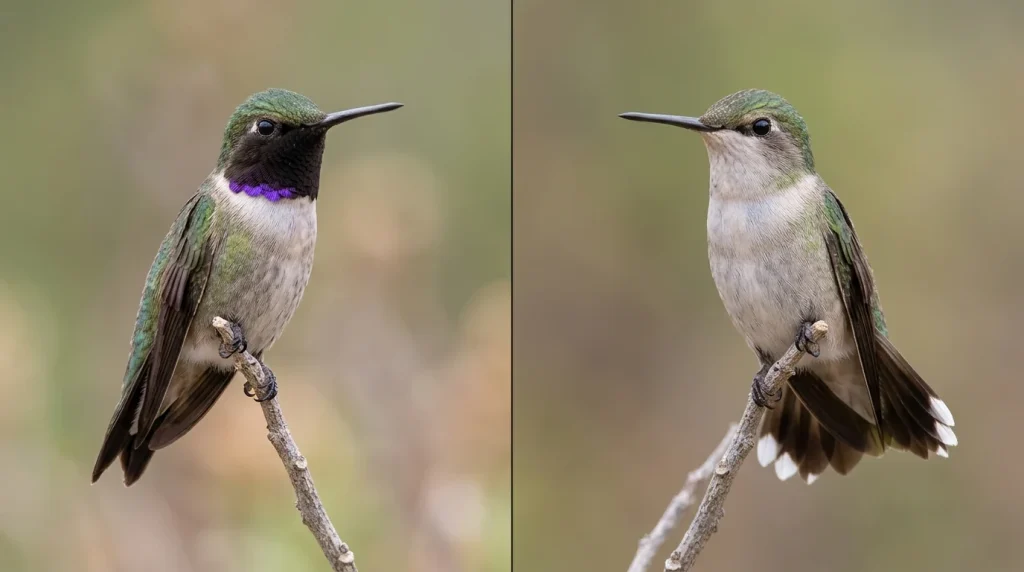
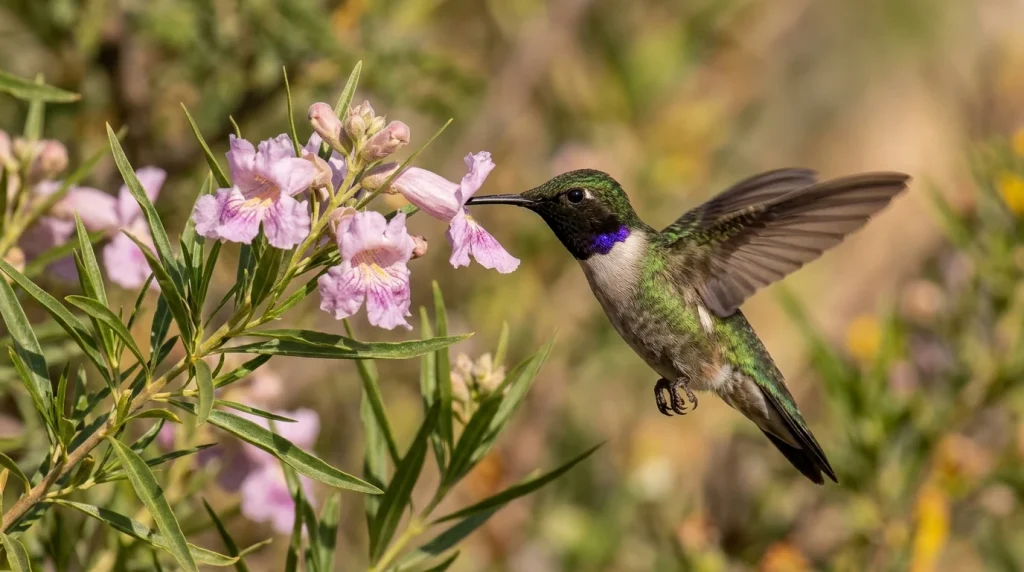
In adult males, the throat usually looks velvety black. From a favorable angle, its lower edge flashes violet-purple above a pale breast band. The purple can disappear completely when the bird turns, so an apparently all-black throat does not rule out this species.
Useful supporting clues include:
- Tail movement: Often pumps or flicks the tail while hovering, especially at flowers or feeders. Other hummingbirds also do this.
- Perched profile: The folded wings extend relatively far down the tail, though posture changes their apparent length.
- Face: Generally subdued, with a dark eye and small pale marking behind it rather than a bold facial pattern.
- Setting: A wooded creek through otherwise dry country is particularly promising habitat.
Watch several turns of the head and body, and take photographs from multiple angles when possible. The Cornell Lab of Ornithology’s identification guide provides useful photographs for comparing sex and age classes.
Male, female, and juvenile differences
Adult male: Has the black throat and narrow violet lower band, green upperparts, pale underparts, and a dark, forked tail. The outer tail feathers lack the conspicuous white tips of females. The crown is green, not violet.
Adult female: Has a pale throat, sometimes with fine dusky spotting, and gray-white underparts. Her rounded tail has dark outer feathers with white tips, best seen when spread. Females average slightly larger than males, but size is rarely dependable without direct comparison.
Juvenile: Generally resembles a female, with white-tipped outer tail feathers and sometimes subtle buff edges on fresh upperpart feathers. Young males may develop dark throat spots or scattered iridescent feathers before acquiring a complete adult gorget.
A spotted throat alone does not reliably establish sex. Females and immature birds can be extremely difficult to separate from Ruby-throated Hummingbirds, especially outside their expected ranges. Some photographs are best left unidentified.
Range and distribution
The breeding range extends from southern British Columbia through much of the western United States into northern Mexico. It includes interior valleys, the Great Basin, the Southwest, and parts of the southern Great Plains, including much of Texas. Distribution is patchy: suitable vegetation and water corridors matter more than a simple map boundary.
Most birds winter in Mexico, especially western and south-central regions. Small numbers occur during winter along the U.S. Gulf Coast and elsewhere in the southern states. Strays can appear much farther east.
Across much of the West, this is mainly a spring-through-early-autumn visitor. Range is a useful identification filter, but an unusual location should prompt careful documentation rather than automatic rejection or acceptance.

Preferred habitat
Black-chinned Hummingbirds use more than just deserts. Their habitats include streamside cottonwoods and willows, oak woodland, canyon bottoms, open woodland edges, orchards, parks, and leafy neighborhoods. They often thrive where flowering openings alternate with shaded trees.
In arid regions, riparian vegetation supplies nest sites, shelter, and insect prey. Birds also forage in dry scrub when flowers are available. During migration and after breeding, some move into higher elevations to exploit seasonal blooms.
For field searches, concentrate on flowering shrubs near stream corridors, garden edges beside mature trees, and exposed twigs overlooking nectar patches. A feeder in a treeless yard may receive visits, but a layered landscape offers much more complete habitat.
Behavior and flight
Flight alternates between precise hovering, rapid straight-line travel, and abrupt chases. Birds can move backward from flowers and shift sideways without landing. Males often watch feeding areas from exposed perches, returning to favored twigs between visits.
Both sexes may defend rich food sources. A dominant bird chasing others does not necessarily indicate a nesting territory. Between feeding bouts, watch for preening, stretching, and short sallies after insects.
Diet and feeding
Nectar supplies energy, while small insects and spiders provide protein and other nutrients. Black-chinned Hummingbirds take prey in flight and pick it from vegetation or spider webs. Females feed nestlings a mixture that includes substantial animal food.
They visit many tubular or trumpet-shaped flowers, including locally native penstemons, sages, and desert willow. Flower color alone is not decisive; nectar availability and flower structure also influence use.
Calls and sounds
Listen for soft, sharp chips or ticks, sometimes delivered in quick series during encounters. Wingbeats produce a humming sound, and display flights can include mechanical sounds as well as calls. Their voice is less conspicuous than the elaborate vocalizations of some larger hummingbirds; a brief chip by itself is rarely diagnostic.
Courtship and reproduction
Males perform aerial displays, including looping or pendulum-like dives, and may make close shuttle flights near a female. They do not form a lasting parenting partnership.
The female builds a tiny cup of plant fibers bound with spider silk and camouflaged with materials such as lichens. She usually places it on a slender branch in a tree or shrub. A typical clutch contains two white eggs. Incubation lasts roughly two weeks, and the young generally leave the nest about three weeks after hatching. Timing varies with conditions, and they may raise more than one brood.

Migration
Spring arrivals vary with latitude and weather, beginning earlier in the Southwest than in northern breeding areas. Southbound movements start during summer and continue into autumn. Adult males often depart before females and young.
Migration need not follow an identical route each season; flowering conditions can draw birds through different elevations. Feeders do not prevent normal migration, though they can provide useful supplemental energy.
Predators and other dangers
Predators include small raptors and other birds; snakes and mammals may take eggs or nestlings. Free-roaming cats are a preventable threat near homes. Window collisions, pesticides, severe weather, and loss of flowering or streamside vegetation also pose risks.
Reduce hazards with exterior window treatments, indoor-only cats, and pesticide-free planting. Avoid approaching nests repeatedly, which can disturb the female or draw attention to the site.
Conservation
The Black-chinned Hummingbird is globally classified as Least Concern and remains widespread. That status does not mean every local population is secure. Protecting riparian corridors, maintaining diverse native flowers, and reducing pesticide use help preserve both nectar and insect resources. Drought and shifts in flowering schedules can affect local food availability.
How to attract this Hummingbird
- Plant for a long season: Choose regionally native flowers with overlapping bloom periods.
- Offer shelter: Retain suitable shrubs, trees, and small perching branches.
- Mix nectar correctly: Use one part plain white granulated sugar to four parts water. Do not add dye, honey, or artificial sweeteners.
- Keep feeders clean: Replace nectar and clean thoroughly every few days, more often in heat, and immediately if cloudy or moldy.
- Reduce monopolizing: Space several small feeders out of one another’s sight.
- Provide gentle water: Fine mist or shallow moving water may attract bathing birds.
Similar species
- Ruby-throated Hummingbird: The closest identification problem. Adult males show a red rather than violet throat when illuminated, but both can look black in poor light. Females and immatures overlap strongly in appearance. Black-chinned often looks longer-billed and longer-winged when perched, but these are supporting clues, not proof. Fine wing-feather structure can help experienced observers with excellent photographs.
- Anna’s Hummingbird: Usually larger and stockier. Adult males have an iridescent rose-red crown and throat. Females often look grayer and greener below and may show a central throat patch.
- Costa’s Hummingbird: Adult males have a purple crown and long, flaring purple throat extensions. Females are much harder to spot and often appear shorter-billed and more compact.
- Rufous and Allen’s Hummingbirds: Look for rusty tones on the flanks and tail. Females and juveniles may show only limited rust, so examine a spread tail when possible.
- Broad-tailed Hummingbird: Typically larger, with more obvious buffy sides in females and a broader-looking tail. Adult males have a rosy throat and a characteristic ringing wing trill in breeding condition.

Interesting facts
- The violet throat color depends on feather structure and viewing angle, not simply purple pigment.
- Spider silk binds the nest while allowing it to stretch as chicks grow.
- Like other hummingbirds, this species can use torpor to reduce energy expenditure under demanding conditions.
Frequently asked questions
Why can’t I see the male’s purple throat?
Iridescence is directional. Wait for the bird to turn toward favorable light; the violet band is narrow even when visible.
Can I identify a female from one feeder photograph?
Sometimes, but not reliably in every case. Location, date, multiple views, and comparisons with other likely species are important.
Does this Hummingbird live only in deserts?
No. It also breeds in wooded valleys, stream corridors, parks, and gardens, including areas well outside true desert.