
Ruby-throated Hummingbird Guide
Keep Track of What You See
Create a free Wild Things Guide membership to record this Ruby-throated Hummingbird in My Sightings and build your personal wildlife list.
Join to Add This SightingIdentification, Habitat, Migration, and How to Attract Them
Few backyard birds feel as magical as the Ruby-throated Hummingbird. One moment the garden is still, and the next a tiny emerald shape appears, hovering like a living jewel in front of a flower or feeder. With wings that beat too quickly for the eye to follow and a throat that can flash brilliant red in the right light, this species is one of the most beloved birds in eastern North America.
This guide introduces the Ruby-throated Hummingbird in a friendly, practical way for birdwatchers, gardeners, and nature lovers. You will learn how to identify males, females, and juveniles; where they live; what they eat; how they migrate; and how to make your yard more welcoming.

Quick Facts
- Common name: Ruby-throated Hummingbird
- Scientific name: Archilochus colubris
- Length: About 3 to 3.75 inches
- Wingspan: About 4 to 4.75 inches
- Weight: Roughly 2 to 6 grams, often less than a nickel
- Range: Breeds mainly in eastern North America; winters in Mexico and Central America
- Diet: Flower nectar, tree sap, tiny insects, and spiders
- Conservation status: Generally widespread, but vulnerable to habitat loss, window collisions, cats, pesticides, and climate shifts
How to Identify It
The Ruby-throated Hummingbird is a tiny, compact hummingbird with a straight, slender bill, short legs, and long pointed wings. In good light, the upperparts look bright metallic green. The underparts are pale grayish white, and the wings and tail are darker.
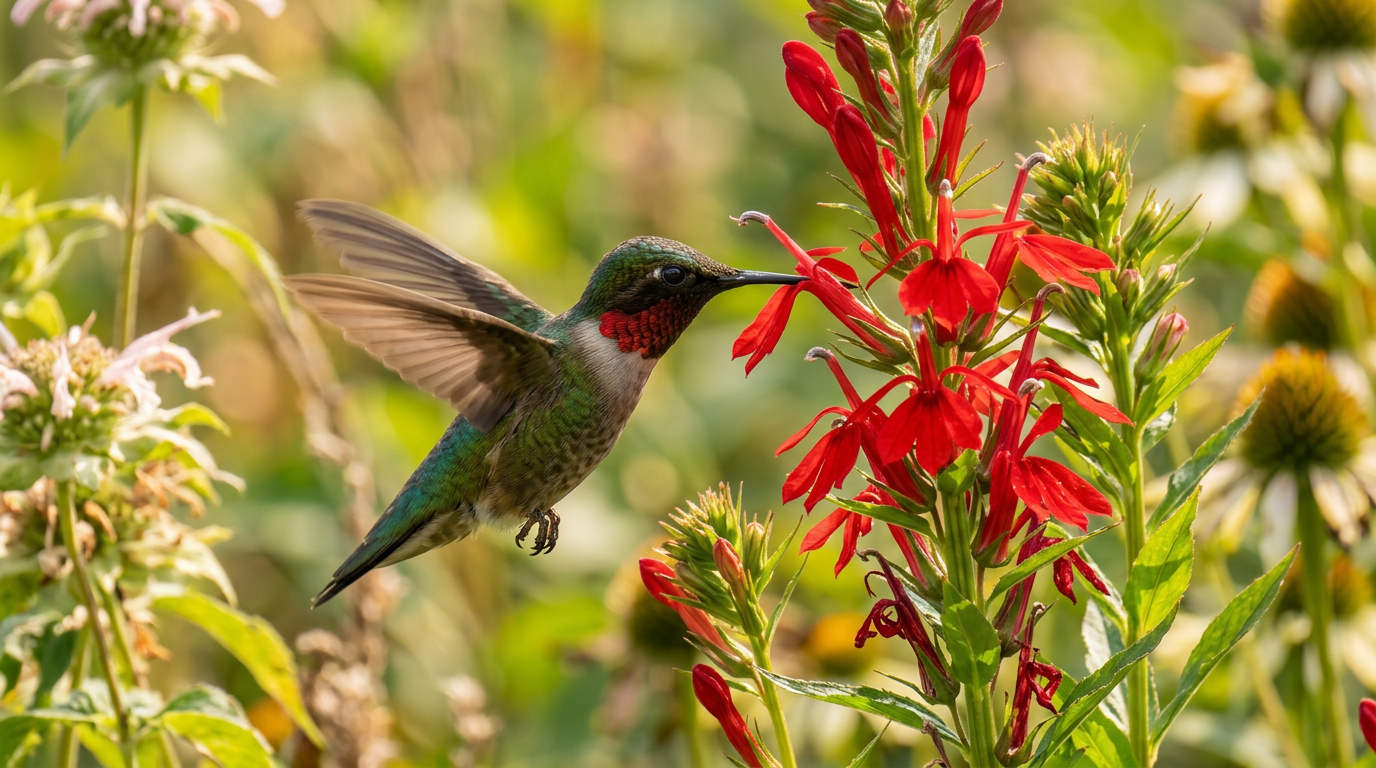
The adult male is the easiest to recognize because of his famous ruby-red throat, called a gorget. That throat patch can look brilliant red, orange-red, or even black depending on the angle of the light. If the sun is behind the bird, the male may appear surprisingly plain until he turns his head.
Look for behavior as well as color. Ruby-throated Hummingbirds hover in front of blossoms, zip between perches, and often defend feeding areas with energetic chases. Their flight is direct, fast, and sometimes almost insect-like.

Male, Female and Juvenile Differences
Adult males have a ruby throat, a darker, forked tail, a green back, and a pale underside. They are often the boldest birds around a feeder and may perch nearby to guard a favorite food source.
Adult females lack the full red throat. Their throats are mostly white, sometimes with faint speckling, and their tails are more rounded with white tips on the outer feathers. Females build the nest, incubate, and feed the young.
Juveniles can look much like adult females. Young males may show a few dark or reddish speckles on the throat as the gorget begins to develop. Late in summer, a hummingbird with a spotted throat may be a young male preparing for its first migration.
Similar Species
In much of the eastern United States and Canada, the Ruby-throated Hummingbird is the only regularly breeding hummingbird, which makes identification simpler. Still, other hummingbirds may appear during migration or in winter, especially along the Gulf Coast and in the Southeast.
- Black-chinned Hummingbird: More common in the West. Males have a dark throat with a narrow violet band rather than a full ruby gorget.
- Rufous Hummingbird: Often warmer orange or rusty, especially on the sides and tail. This species is famous for wandering far outside its normal western range.
- Anna’s Hummingbird: Larger and mostly western. Adult males can show rose-pink on the head and throat.
Range and Distribution
Ruby-throated Hummingbirds breed across a broad stretch of eastern North America, from the Gulf Coast north into parts of southern Canada and west toward the Great Plains. They are familiar summer visitors in gardens, wood edges, parks, orchards, and forests.
When the breeding season ends, most Ruby-throated Hummingbirds migrate south to Mexico, Central America, and nearby tropical regions. Some travel across or around the Gulf of Mexico, a remarkable journey for a bird so small. Their movements are tied to daylight, food availability, weather, and inherited migration instincts.
Preferred Habitat
This hummingbird is adaptable. It uses deciduous forests, woodland edges, meadows, stream corridors, suburban gardens, parks, and old fields. The best habitat combines nectar sources, tiny insects, sheltered perches, and safe nesting sites. A yard with native flowering plants, shrubs, small trees, and minimal pesticide use can become excellent hummingbird habitat.
Behavior and Flight
Ruby-throated Hummingbirds are famous for hovering, but they can also fly forward, backward, sideways, and nearly straight up or down. Their wings rotate in a figure-eight pattern, allowing them to hold position in front of a flower while feeding. During territorial disputes, they may chase one another in fast arcs through the garden.
Despite their delicate appearance, they are energetic and assertive. A single bird may defend a feeder, flower patch, or favorite perch from other hummingbirds and even from larger birds that wander too close.
Diet and Feeding
Nectar is the food most people associate with hummingbirds, and Ruby-throated Hummingbirds are drawn to tubular flowers in shades of red, orange, and pink. Native plants such as cardinal flower, bee balm, trumpet honeysuckle, columbine, jewelweed, and coral bells can be excellent choices depending on your region.
They also need protein. Tiny flies, gnats, mosquitoes, aphids, spiders, and other small arthropods are important, especially during nesting season. Hummingbirds pick insects from leaves, catch them in flight, or steal them from spider webs. This is one reason pesticide-free gardens are so valuable.
If you use feeders, make a simple solution of one part plain white sugar to four parts water. Do not use honey, brown sugar, artificial sweeteners, or red dye. Clean feeders frequently, especially in hot weather, to prevent mold and fermentation.
Calls and Sounds
Ruby-throated Hummingbirds are not loud singers, but they do make sounds. Listen for sharp, thin chips, squeaks, and quick chatter during chases. Their wings can produce a soft humming or buzzing sound, especially when a bird hovers close by. Courtship and aggressive flights may include extra wing noises that help announce the bird’s presence.
Courtship and Reproduction
Males arrive early on breeding grounds and try to attract females with display flights. A courting male may perform looping or U-shaped dives, flashing his gorget as he moves. After mating, the female handles the entire nesting process on her own.
The nest is one of the wonders of the bird world: a tiny cup built from plant down, spider silk, bud scales, and lichens. Spider silk allows the nest to stretch as the chicks grow. The outside is camouflaged with bits of lichen, making it look like a knot on a branch. A typical clutch contains two tiny white eggs.

Migration
Ruby-throated Hummingbirds are long-distance migrants. Before migration, they build fat reserves by feeding heavily from flowers, insects, sap wells, and feeders. Some individuals cross the Gulf of Mexico in a single demanding flight, while others follow coastal routes. In spring, males often arrive first, followed by females. In fall, adults usually leave before many juveniles, which must make the journey for the first time using inherited navigational cues.
Predators and Other Dangers
Hummingbirds face risks from many directions. Predators can include hawks, shrikes, larger birds, snakes, frogs, praying mantises, and domestic cats. Eggs and nestlings may be taken by jays, crows, squirrels, snakes, and other nest predators.
Human-related dangers are also significant. Window collisions, outdoor cats, pesticide use, habitat loss, and poorly maintained feeders can all harm hummingbirds. Keeping cats indoors, reducing window reflections, planting native flowers, and cleaning feeders regularly are simple steps that make a difference.
Conservation Status
The Ruby-throated Hummingbird remains common across much of its range, but common does not mean invulnerable. Healthy migration routes, breeding habitat, native plant communities, and insect populations all matter. Climate change may also shift flowering times and migration patterns, creating mismatches between birds and food sources. Backyard habitat, when repeated across neighborhoods, can support migration and nesting in meaningful ways.
How to Attract This Hummingbird
- Plant native nectar flowers: Choose blooms that open from spring through fall so food is available during migration and nesting.
- Use feeders responsibly: Mix one part white sugar with four parts water and clean feeders often.
- Skip pesticides: Hummingbirds need tiny insects as much as nectar.
- Provide perches: Small trees, shrubs, and bare twigs give birds places to rest and watch over feeding areas.
- Offer moving water: Fine misters or shallow dripping water can attract hummingbirds, especially in warm weather.
- Make windows safer: Use decals, screens, or external patterns to reduce collisions.
Interesting Facts
- A Ruby-throated Hummingbird weighs only a few grams, yet it can migrate hundreds of miles.
- The male’s ruby throat is not pigment alone; it flashes because microscopic feather structures reflect light.
- Hummingbird nests are built with spider silk, which expands as chicks grow.
- They may visit hundreds or even thousands of flowers in a day.
- They are important pollinators for many tubular flowers.
Frequently Asked Questions
When should I put out my hummingbird feeder?
Put feeders out shortly before Ruby-throated Hummingbirds usually arrive in your area. In many southern locations, that may be early spring, while northern areas may see arrivals later in spring. Keeping a clean feeder ready can help early migrants.
Will leaving a feeder up stop them from migrating?
No. Migration is driven mainly by seasonal changes in daylight and internal rhythms. Leaving a clean feeder up in fall can help late migrants refuel.
What is the best feeder recipe?
Use one part plain white sugar to four parts water. Red dye is unnecessary and should be avoided. Replace the solution and wash the feeder often.
Do Ruby-throated Hummingbirds return to the same yard?
Many hummingbirds show strong site fidelity and may return to familiar feeding or nesting areas if habitat remains suitable.
What flowers are best for Ruby-throated Hummingbirds?
Excellent choices include cardinal flower, bee balm, trumpet honeysuckle, columbine, jewelweed, coral bells, and other native tubular flowers suited to your region.
The Ruby-throated Hummingbird may be small, but it brings enormous energy, beauty, and ecological value to the places it visits. By learning its habits and creating bird-friendly spaces, you can enjoy closer views while helping this remarkable traveler thrive.


