

Black Ash Guide
Keep Track of What You See
Create a free Wild Things Guide membership to record this Black Ash in My Sightings and build your personal wildlife list.
Join to Add This SightingTree Name
Black ash (Fraxinus nigra) is a deciduous tree found in northern swamps, wet woods, and along stream margins. A member of the olive family (Oleaceae), it is also called brown ash or basket ash. Its compound leaves, dark buds, and corky bark offer useful identification clues, especially when considered together with its wetland setting.
This tree is also culturally important. Its wood supplies basketmaking traditions maintained by numerous Indigenous nations across northeastern North America. Emerald ash borer now threatens both black ash forests and continued access to this material.

Quick Identification
- Leaf arrangement: Opposite, with two compound leaves attached across from one another on the twig.
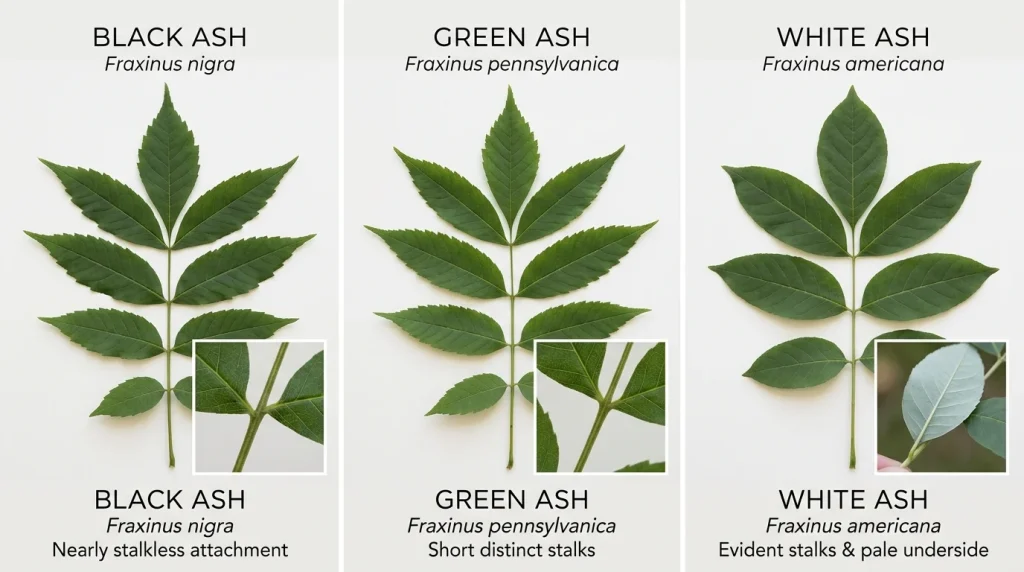
- Leaflets: Usually 7–11, with toothed edges; the lateral leaflets attach directly, or nearly directly, to the central leaf stalk.
- Bark: Gray, becoming soft-looking and corky, with shallow furrows and irregular scaly ridges.
- Buds: Dark brown to nearly black; the uppermost lateral buds sit a short distance below the terminal bud.
- Fruit: Flattened, single-winged samaras, with the wing extending along much of the seed-bearing portion.
- Setting: Cool, moist to saturated ground, often in wooded wetlands.
The strongest practical combination is opposite compound leaves, nearly stalkless lateral leaflets, and corky gray bark on a tree growing in wet ground. Habitat alone is not enough.
Appearance
Mature black ash commonly reaches about 40–60 feet (12–18 m), occasionally taller on favorable sites. Crowns are often roughly 20–35 feet (6–11 m) wide, although competition and growing conditions strongly affect their shape. Forest trees typically have a relatively straight trunk and a narrow, somewhat open crown; trees with more light develop broader crowns.
The complete leaf is generally about 10–16 inches (25–40 cm) long. Each leaflet is elongated to oval-lance-shaped, pointed at the tip, and finely to distinctly toothed. Leaflet undersides may show rusty or brownish hairs along the main vein, especially near the base.
To identify the tree, distinguish a leaflet from a whole leaf. A bud occurs where the complete leaf stalk meets the twig, not where individual leaflets attach to the central stalk. This prevents a common mistake when comparing ash with simple-leaved trees.

Bark, Twigs, and Buds
Young trunks are comparatively smooth and gray. Older bark develops shallow fissures and irregular, flaky or corky ridges. It generally lacks the strongly interlacing diamond pattern often associated with mature white ash. Bark appearance varies with age, so examine more than one part of the trunk.
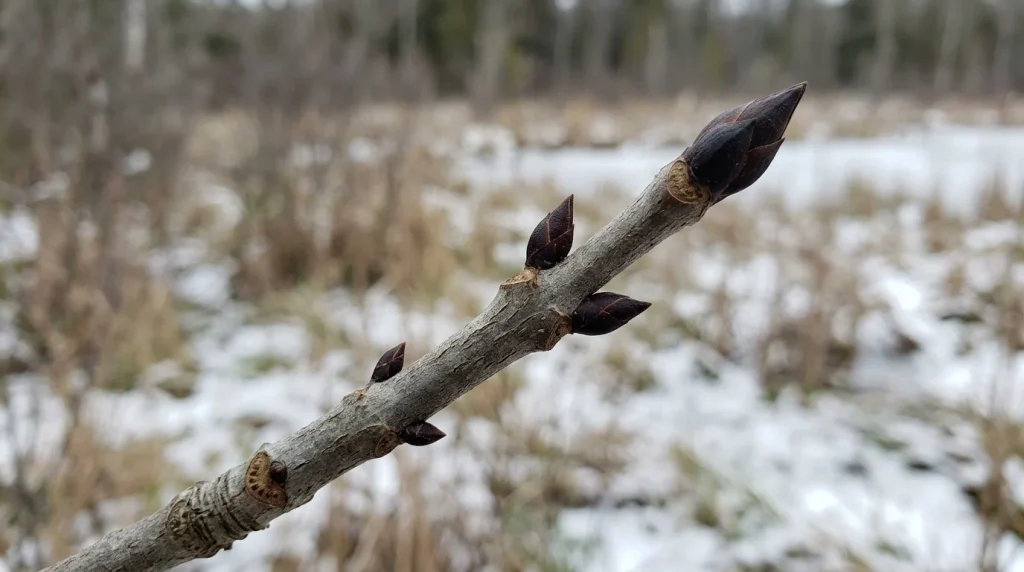
Twigs are fairly stout, with opposite buds and leaf scars. The terminal bud is conspicuous, dark brown to almost black, and usually pointed to egg-shaped. A useful winter clue is the short stretch of twig between the terminal bud and the highest pair of lateral buds.
Opposite branching is helpful but can be obscured by broken twigs or dead branches. Follow several living shoots rather than expecting every fork to form a perfect pair. Avoid peeling bark or cutting branches to confirm an identification.

Range and Habitat
Black ash is native to northeastern North America. Its range extends through southern Canada from Newfoundland west to southeastern Manitoba, and through much of the northeastern United States and upper Midwest. Scattered southern occurrences reach the central Appalachian region, including Virginia.
Look for it in hardwood swamps, peatland margins, streamside woods, and low, poorly drained flats. It often grows with northern white-cedar, red maple, yellow birch, American elm, and other wet-site trees, depending on the region. Many stands occupy seasonally saturated soils rather than permanently deep water.
Although strongly associated with wetlands, black ash is not restricted to one soil type. Water movement, seasonal flooding, and local soil chemistry all influence its distribution. The U.S. Forest Service’s black ash silvics account provides a detailed treatment of its habitat and life history.

Flowers, Fruit, Nuts, or Cones
Small, inconspicuous flowers appear in spring before or around leaf emergence. They lack showy petals and are pollinated by wind. Flowering arrangements vary, with male and female flowers occurring on separate trees or together on some individuals.
The fruit is a samara: a dry seed-bearing structure equipped with a flattened wing. Black ash samaras are usually about 1–1½ inches (2.5–4 cm) long, oblong, and sometimes notched at the tip. The wing extends down along much of the seed cavity, making the fruit look flatter and more broadly winged than a typical white ash samara.
Fruits develop in hanging clusters, ripen toward late summer or fall, and disperse by wind. Some remain into winter. Seed production varies year to year, and an otherwise healthy tree may carry little fruit. Black ash produces neither nuts nor cones.

Wildlife Connections
Black ash seeds provide food for some birds and small mammals. Its foliage supports plant-eating insects, which in turn support woodland food webs. As trees mature and decay, cavities, loose bark, and branches provide shelter or foraging surfaces.
Its importance also extends beyond individual animals. Black ash can be a major canopy tree in wetlands, drawing water from the soil and returning it to the atmosphere through transpiration. Losing many trees at once can alter light, vegetation, and water conditions across an entire stand.
Woodpeckers may forage heavily on insect-infested ash. Pale patches where birds have stripped outer bark can signal insect activity, but they don’t identify the insect on their own.
Seasonal Identification
- Spring: Watch for dark opposite buds, modest flower clusters, and expanding compound leaves. Black ash often leafs out relatively late.
- Summer: Count leaflets on several leaves and inspect their attachments. Nearly stalkless lateral leaflets are especially useful.
- Fall: Leaves generally turn yellow, sometimes with brownish tones, and may drop fairly early. Look for mature samara clusters.
- Winter: Combine opposite twigs, dark buds, the gap below the terminal bud, and corky bark. Remaining fruits can help.
Seasonal timing varies with latitude, weather, and site. Yellow foliage alone is not diagnostic, and premature thinning may reflect drought, flooding, insects, or other stress.
Human Uses and History
Black ash has a distinctive role in Indigenous basketmaking, including traditions among Wabanaki, Haudenosaunee, Anishinaabe, and other peoples. Skilled makers select suitable logs and pound them to separate annual growth layers into splints, then prepare them for weaving.
This process works because black ash is ring-porous: its large early-season vessels create a structurally different zone from the denser wood formed later. Basketmaking knowledge includes tree selection, harvesting, processing, design, and cultural relationships that extend well beyond the finished object.
The wood has also been used for furniture, veneer, interior work, and other products. In landscapes, black ash is best understood as a wet-site native rather than a broadly adaptable street tree. Planting decisions now require serious consideration of emerald ash borer.
Conservation and Threats
Emerald ash borer, an introduced beetle, is the leading threat to black ash across much of its range. Larvae feed beneath the bark, disrupting the tissues that transport water and nutrients. Black ash is highly vulnerable, and infestations can cause extensive mortality.
Warning signs include crown thinning, dead upper branches, shoots from the trunk or base, bark splitting, and small D-shaped adult exit holes. None should be evaluated in isolation. A qualified arborist or local forestry agency can help distinguish emerald ash borer from other causes of decline.
Do not transport potentially infested firewood. Follow current local movement rules and report suspected new infestations through the appropriate agency. Some individual trees can be protected with professional treatment, but this is not a simple solution for entire wetlands.
Conservation efforts include seed collection, monitoring surviving trees, and collaboration with Indigenous communities. Wetland drainage and altered flooding can add further pressure. Stand-level planning matters because widespread canopy loss may leave sites wetter and change which plants can establish.
Similar Species
Green ash (Fraxinus pennsylvanica): Also common in moist lowlands, usually with 5–9 leaflets. Its lateral leaflets generally have short stalks, unlike the nearly stalkless ones of black ash. Its samaras typically have a narrower wing that does not extend as fully along the seed body.
White ash (Fraxinus americana): Usually has 7 leaflets, commonly with noticeable stalks and paler undersides. It more often occupies well-drained sites. Mature bark frequently develops prominent diamond-shaped furrows; its samara wing is concentrated toward the outer end of the fruit.
Boxelder (Acer negundo): Has opposite compound leaves but usually only 3–7 leaflets, often coarsely toothed or lobed. Its fruits occur as paired maple samaras rather than separate ash samaras.
Mountain-ashes (Sorbus species): Have superficially similar compound leaves, but their leaves are alternate. Showy flower clusters and orange or red fleshy fruits separate them readily from true ashes.
Interesting Facts
- The names black ash and brown ash refer to the same species, not separate basket-making trees.
- Ash samaras are sometimes called “keys.” They are winged fruits, not loose winged seeds.
- Black ash can reproduce through stump sprouts as well as seed, though sprouting does not eliminate vulnerability to emerald ash borer.
- A black ash wetland is partly shaped by its trees: their seasonal water use helps influence growing conditions beneath the canopy.
Frequently Asked Questions
What is the easiest way to identify black ash?
Find opposite compound leaves with usually 7–11 leaflets, then check that the lateral leaflets are nearly stalkless. Corky gray bark and a wetland setting strengthen the identification.
How fast does black ash grow?
Usually slowly to moderately. Young trees may add roughly 6–18 inches (15–45 cm) in height annually under suitable conditions, but shaded or persistently waterlogged trees can grow much less.
How long can black ash live?
Without severe disturbance or infestation, it can live roughly 150–200 years, sometimes longer. Don’t confuse that potential lifespan with current survival prospects in emerald ash borer–affected areas.
Should I remove a declining black ash?
Have a qualified arborist assess trees near buildings, roads, or frequently used areas. Dead ash can become brittle. In remote habitat, retaining deadwood may benefit wildlife, but safety and local conservation objectives should guide the decision.


