Bigtooth Aspen Guide
Keep Track of What You See
Create a free Wild Things Guide membership to record this Bigtooth Aspen in My Sightings and build your personal wildlife list.
Join to Add This SightingTree Name
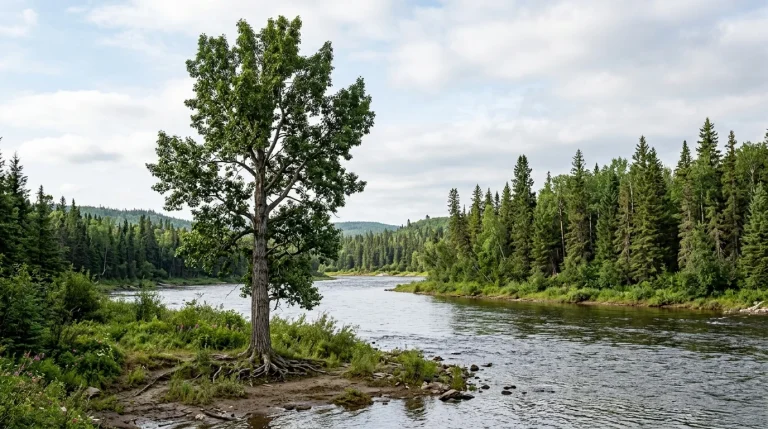
Bigtooth aspen (Populus grandidentata) is a fast-growing, deciduous tree of northeastern and north-central North America. It belongs to the willow family, Salicaceae, alongside other aspens, cottonwoods, poplars, and willows. Large-toothed aspen and largetooth aspen are alternative common names.
This sun-loving pioneer thrives in burns, logging sites, abandoned fields, and woodland edges. Its pale upper bark and fluttering foliage suggest quaking aspen, but its conspicuously coarse leaf teeth provide the most useful distinction. Several neighboring trunks may belong to one root-connected clone rather than represent separate seedlings.
Quick Identification
- Leaves: Alternate, broadly oval to nearly round, usually 2–4 inches (5–10 cm) long, with large, irregular, bluntly pointed or rounded teeth.
- Leaf stalks: Long and flattened sideways, allowing the blades to flutter in a breeze.
- New foliage: Emerging leaves are conspicuously pale and woolly; most of this hair disappears as they mature.
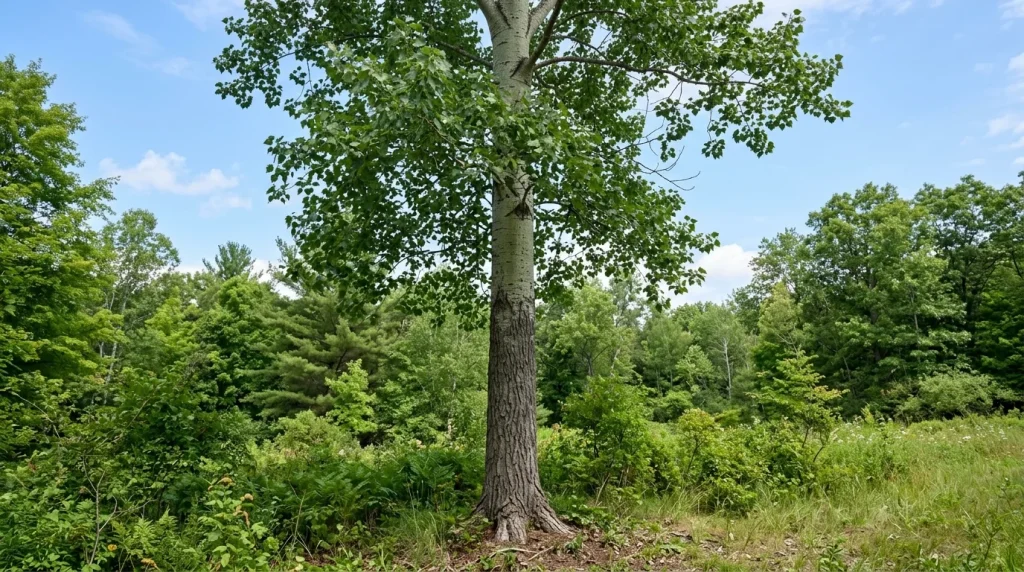
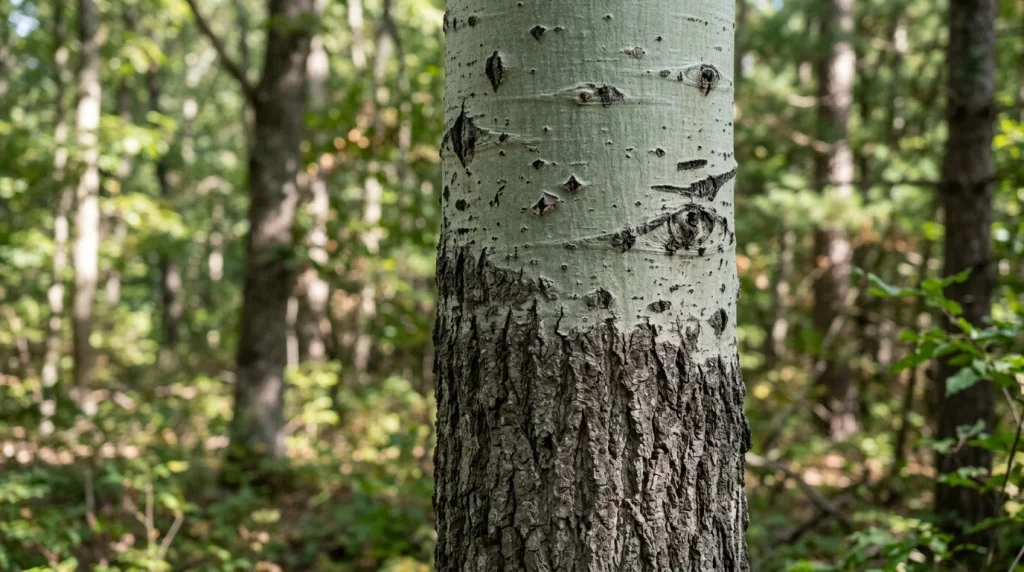
- Bark: Smooth gray-green, yellow-green, or pale gray on young trunks and upper stems; darker and furrowed near the base of older trees.
- Winter buds: Generally grayish and hairy, unlike the relatively smooth, glossy buds of quaking aspen.
- Growth pattern: Often forms patches of slender, upright trunks in sunny, disturbed woodland.
For a dependable identification, combine leaf teeth with buds, bark, and habitat. Pale bark alone is not enough.
Appearance
Mature bigtooth aspens commonly reach 50–80 feet (15–24 m), with crowns roughly 20–40 feet (6–12 m) wide where space allows. Larger trees occur on favorable sites. Forest-grown trees usually have straight trunks and relatively narrow crowns; open-grown individuals develop broader, irregularly rounded crowns.
Summer leaves are green above and paler beneath, with a short-pointed tip and a rounded to broadly wedge-shaped base. Their relatively few, conspicuous teeth give the outline a scalloped or roughly saw-toothed appearance. Examine several ordinary leaves: vigorous sucker shoots can carry unusually large foliage.
Growth is rapid in good light, often around 1–3 feet (30–90 cm) annually in young trees, though moisture, competition, and browsing strongly affect this. Individual stems commonly live about 50–100 years; some persist longer.

Bark, Twigs, and Buds
Young bark is smooth and pale, often with a greenish or yellowish cast. Older trunks develop darker gray-brown bark, especially low on the stem, where irregular furrows and ridges can become substantial. Upper trunks and branches may remain comparatively smooth. Dark scars and patches are common but not diagnostic on their own.
Twigs are moderately stout, with alternate buds. Young shoots may be hairy and become smoother with age. Dormant buds are usually pointed to egg-shaped and covered with fine grayish or whitish hairs, although wear and individual variation affect their appearance.
In winter, inspect several intact buds with a hand lens. Bigtooth aspen’s relatively dull, hairy buds are particularly helpful when separating it from quaking aspen. Look for fallen leaves beneath the same crown as supporting evidence.
Range and Habitat
Bigtooth aspen is native to southeastern Canada and the northeastern and north-central United States. Its range extends from the Maritime region west through southern Quebec and Ontario toward southeastern Manitoba, and south through the Great Lakes and northeastern states. Southern occurrences extend into parts of the central Appalachian region and adjacent uplands.
It favors sunny sites with well-drained sandy, gravelly, or loamy soils. Look for it on upland slopes, ridges, old burns, cutover land, and recovering fields. It often grows with quaking aspen, paper birch, red maple, oaks, and pines, depending on the region.
Compared with quaking aspen, it has a more restricted eastern distribution and is often associated with better-drained uplands. It is not a typical tree of persistently waterlogged ground. The U.S. Forest Service’s bigtooth aspen silvics account provides a detailed treatment of its range, soils, and stand development.

Flowers, Fruit, Nuts, or Cones
Bigtooth aspen produces hanging catkins rather than showy, petaled flowers. Male and female flowers occur on separate trees. Flowering takes place in spring before the leaves fully expand, with timing varying by latitude and weather. Wind carries pollen between trees.
Female catkins develop strings of small capsules. These split in late spring or early summer, releasing tiny seeds attached to cottony hairs. The hairs help seeds travel on air currents; this tree produces neither nuts nor cones.
Seeds remain viable for only a short time under natural conditions and establish best on suitably moist, exposed surfaces. In many established stands, root suckering is a more conspicuous means of regeneration than seedling establishment.

Wildlife Connections
Aspen stands provide food and cover for many animals. Ruffed grouse eat aspen buds and catkins and use young, dense stands for cover. Deer and, where present, moose browse young shoots. Beavers cut stems and eat bark and twigs, while smaller mammals may feed on bark near ground level.
The foliage supports leaf-eating insects, including caterpillars that birds eat. Aging stems often develop decay, giving woodpeckers opportunities to excavate cavities. Other birds and small mammals may later occupy those holes.
Wildlife value changes as a stand ages: dense suckers, mature crowns, cavity trees, and fallen wood support different needs. A landscape containing several age classes generally provides more varied habitat than a uniform stand.
Seasonal Identification
Spring: Look for catkins on bare branches, followed by emerging leaves with a pale, woolly appearance. Bigtooth aspen often leafs out later than nearby quaking aspen, although local weather and individual trees can blur that difference.
Summer: The large leaf teeth are easiest to study. Check alternate leaf arrangement, flattened stalks, and comparatively smooth mature blades.
Fall: Foliage usually turns yellow or golden, sometimes with orange tones. Color can be striking across a stand, but autumn color alone cannot distinguish the species.
Winter: Use hairy buds, pale upper bark, darker lower-trunk furrows, and the stand’s overall form. Together, several of these clues are more persuasive than any single feature.

Human Uses and History
Bigtooth aspen supplies light-colored, relatively lightweight wood used for pulp, paper, oriented strand board, pallets, boxes, and other manufactured products. It is often handled commercially with other aspens rather than sold under a separate species name. The wood has limited natural decay resistance outdoors.
Its vigorous regeneration has made it an important component of working forests, particularly in the Great Lakes region. Cutting or disturbance can stimulate dense new shoots from surviving roots when light and other conditions are suitable.
As a landscape tree, it suits spacious, naturalistic settings best. Root suckers, spreading roots, relatively short-lived stems, and eventual decay make it less suitable beside pavement, in small gardens, or near buildings. Planting should account for the future stand, not just one trunk.
Conservation and Threats
Bigtooth aspen remains widespread, but individual stands are dynamic. Because the species is strongly shade-intolerant, seedlings and suckers usually struggle beneath a closed canopy. Without renewed disturbance, longer-lived, more shade-tolerant trees often replace it.
Heavy browsing can prevent young shoots from escaping the understory. Repeated defoliation, drought, stem cankers, and wood-decay fungi can weaken trees, particularly when stresses overlap. Fire effects vary: disturbance may encourage suckering, but severe heating can damage the roots needed for recovery.
Where maintaining aspen habitat is a goal, management commonly focuses on adequate sunlight and successful regeneration. Where older-forest habitat is the priority, natural succession may be appropriate. Retain cavity trees and deadwood where they do not create unacceptable safety risks.
Similar Species
- Quaking aspen (Populus tremuloides): Usually has smaller, more nearly round leaves with numerous fine teeth. Its buds are generally smoother and shinier. Both species have flattened leaf stalks and fluttering foliage, so trembling leaves do not distinguish them.
- Eastern cottonwood (Populus deltoides): Typically has distinctly triangular leaves with broad bases and coarsely toothed margins. It commonly becomes a much larger tree and is strongly associated with river corridors and disturbed alluvial ground.
- White poplar (Populus alba): An introduced, suckering tree with pale bark. Many leaves, especially on vigorous shoots, are lobed, and their undersides remain densely white-felted. Bigtooth aspen’s mature leaves usually lose most of their early woolliness.
Bigtooth and quaking aspens can hybridize, producing intermediate traits. When identification remains uncertain, photograph several leaves, both leaf surfaces, buds, and the trunk rather than relying on one unusual specimen.

Interesting Facts
- The scientific epithet grandidentata refers to the conspicuously large teeth along the leaf margins.
- A grove may include many genetically identical stems connected through a shared root system. The age of one trunk is therefore not necessarily the age of the clone.
- The flattened leaf stalks help foliage move in light winds, producing the familiar aspen rustle.
- Greenish young bark contains photosynthetic tissue that can contribute to the tree’s carbon balance.
Frequently Asked Questions
What is the easiest way to identify bigtooth aspen?
Look for broad leaves with large, irregular teeth, then confirm flattened leaf stalks and pale upper bark. Hairy winter buds or woolly emerging leaves add useful supporting evidence.
Is bigtooth aspen the same as quaking aspen?
No. They are closely related native species that can grow together. Bigtooth aspen has much coarser leaf teeth and generally hairier buds; quaking aspen has a far wider North American range.
Does bigtooth aspen spread aggressively?
It can produce many root suckers, particularly after cutting or injury and where sunlight is abundant. This helps it regenerate naturally but can make it difficult to confine in a small yard.
Do all bigtooth aspens produce cottony seeds?
No. Only female trees produce seed capsules, following pollination. Male trees produce pollen-bearing catkins instead. Seed crops and their visibility vary by year and site.
Can it grow in shade?
Not well over the long term. Bigtooth aspen needs abundant light for vigorous growth and successful regeneration. Young shoots beneath a dense forest canopy generally decline unless the canopy opens.