American Hazelnut Guide
Keep Track of What You See
Create a free Wild Things Guide membership to record this American Hazelnut in My Sightings and build your personal wildlife list.
Join to Add This SightingTree Name
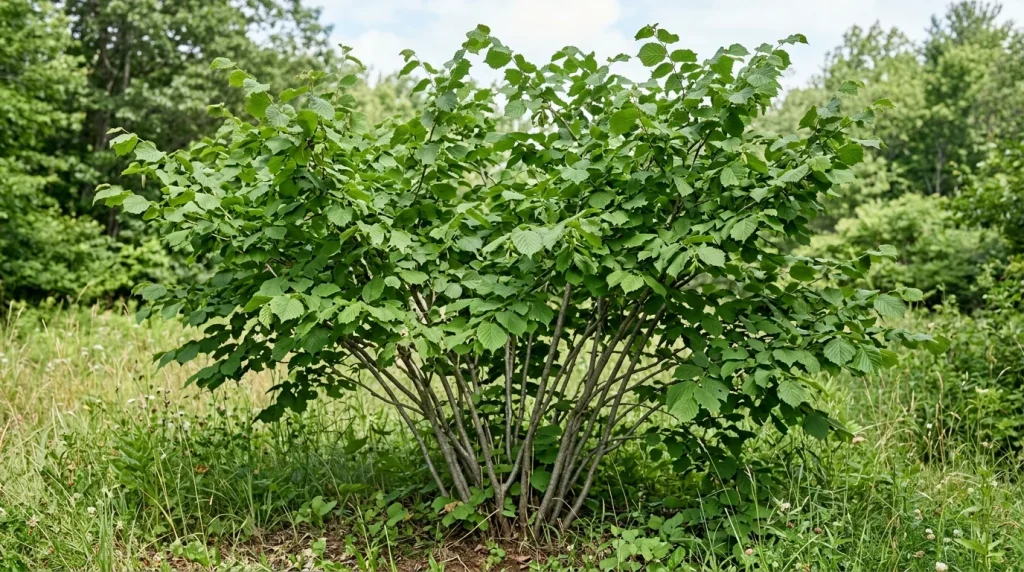
American hazelnut (Corylus americana), also called American filbert, is a native, deciduous shrub in the birch family, Betulaceae. Although included in tree guides, it usually grows as a many-stemmed thicket rather than a single-trunked tree. Its broad, toothed leaves, dangling spring catkins, and nuts wrapped in leafy husks make it a rewarding woodland-edge plant to learn.
The nuts are true hazelnuts, related to the larger commercial filberts. For field identification, however, the leafy wrapper around each nut is often more useful than the nut itself.
Quick Identification
- Habit: A rounded, suckering shrub, usually 3–10 ft (0.9–3 m) tall; favorable sites can produce taller plants.
- Leaves: Alternate, broadly oval to nearly round, usually 2½–6 in (6–15 cm) long, with pointed tips and doubly toothed margins.
- Texture: Leaves are commonly softly hairy beneath; young twigs often carry conspicuous hairs.
- Flowers: Slender, hanging male catkins open before the leaves; tiny female flowers show red stigmas.
- Fruit: Small clusters of hard-shelled nuts enclosed by broad, ragged-edged leafy husks.
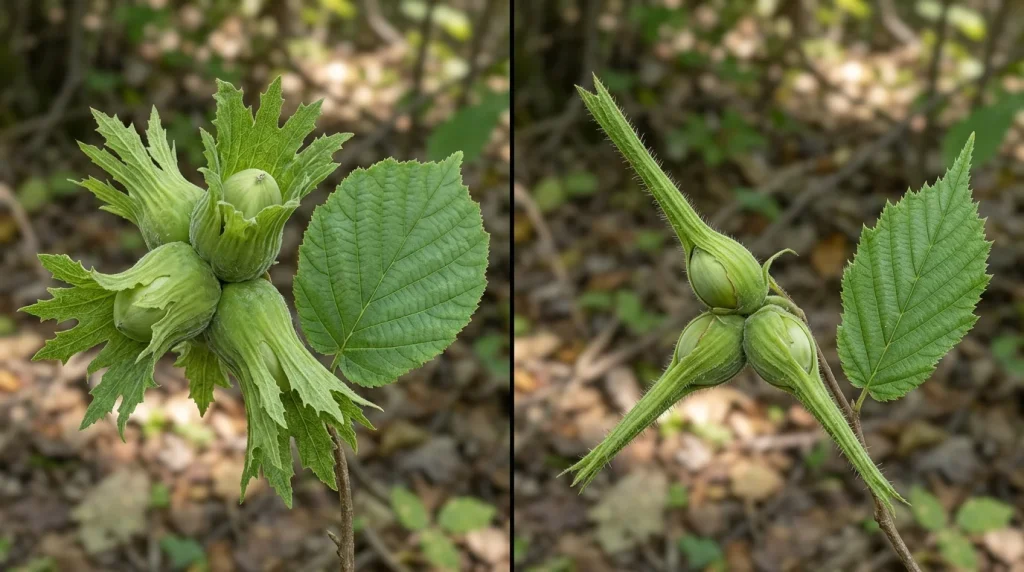
- Best clue: The husk has spreading, irregular lobes rather than the long, narrow tube of beaked hazelnut.
Appearance
American hazelnut commonly forms a crown about 5–10 ft (1.5–3 m) wide, but connected colonies can spread much farther. Numerous slender stems rise from the base, creating a dense outline. Plants in open sun are generally fuller and more productive than shaded plants, which may look loose and sparsely branched.
The leaves have short stalks and rounded to shallowly heart-shaped bases. Their margins are doubly serrate: larger teeth carry smaller teeth. Prominent side veins run toward the larger teeth, giving the blade a slightly pleated appearance. The upper surface is green and sometimes rough or hairy; the underside is usually paler and more noticeably hairy along the veins.
Do not identify it from leaf shape alone. Hazels, some birches, and several woodland shrubs share broad, toothed leaves. Confirm the growth habit, twig texture, and especially the fruiting husk when available.

Bark, Twigs, and Buds
Young stems have relatively smooth, gray-brown to reddish-brown bark. Older stems may develop shallow cracks or a slightly scaly surface, but they do not normally acquire the massive, deeply furrowed bark of a mature canopy tree. A clump typically contains stems of several ages.
Current-season twigs are often hairy, with some hairs bearing tiny glands. Hairiness varies with age and growing conditions, so examine fresh shoots rather than relying on older, weathered branches. Small, pale lenticels may be visible.
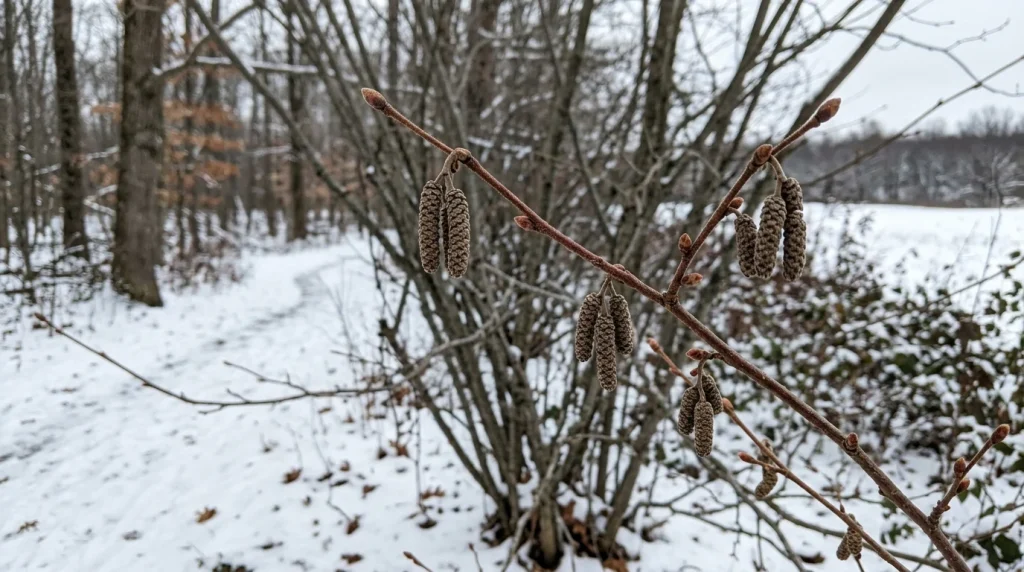
Leaf buds are alternate, short, oval, and blunt rather than long and spear-shaped. Their overlapping scales may be hairy. In winter, look for these buds together with clusters of immature male catkins already hanging from the previous season’s growth. That combination is more useful than bark color alone.

Range and Habitat
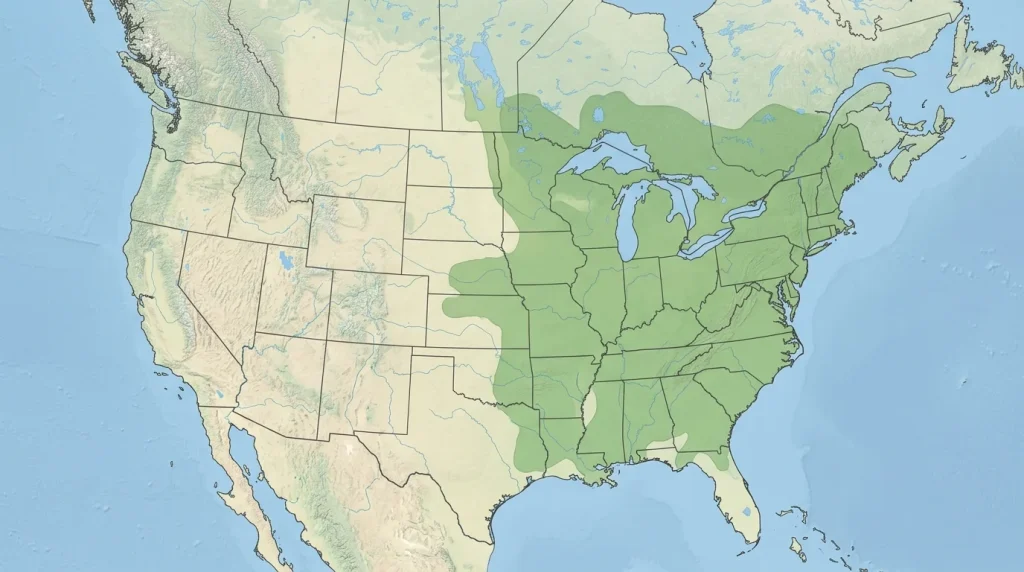
American hazelnut is native across much of eastern and central North America. Its broad range extends from southern Canada through the eastern United States, westward into the Great Plains, and south into parts of the Gulf states. It is not a characteristic native shrub of the Pacific Coast or desert Southwest; local distribution becomes patchier near its range margins.
Look along woodland borders, old fields, fence lines, stream terraces, prairie margins, and open woods. It favors reasonably well-drained soil and tolerates a range of textures. Moist sites can support vigorous growth, but persistently waterlogged ground is generally unsuitable.
Full sun to partial shade suits it best. Plants may survive beneath a forest canopy without heavy flowering or fruiting. The North Carolina State Extension species profile provides additional identification photographs and notes on growing conditions.
Flowers, Fruit, Nuts, or Cones
Male and female flowers occur separately on the same plant. The male flowers are carried in catkins that form before winter, then lengthen and release pollen in late winter or early spring. Flowering happens before leaf-out, with timing varying considerably by latitude and weather.
Female flowers are easily overlooked. They resemble small buds with several bright red stigmas projecting from the tip. These stigmas receive windborne pollen; the plant does not depend on showy petals or nectar to attract pollinators.
Successful nut production generally depends on pollen from another genetically distinct, compatible hazel. Several stems in one spreading patch may belong to the same clone, so a large thicket does not necessarily provide multiple pollen partners.
Nuts mature in late summer or early fall, usually in small clusters. Each hard, roughly rounded nut is about ½ in (1–1.5 cm) across and sits within an enlarged leafy husk. The husk extends beyond the nut in broad, uneven lobes. Wildlife may remove the crop before the husks become conspicuously dry and brown.

Wildlife Connections
The energy-rich nuts feed squirrels, chipmunks, mice, and several birds, including jays and wild turkeys. Animals that carry off and bury nuts can disperse seeds when some caches remain uneaten. The importance of particular consumers varies by region and habitat.
Dense hazelnut cover also offers shelter and potential nesting sites for small birds. Deer and rabbits browse stems or foliage, and insects feed on the leaves. As part of a mixed native planting, hazelnut supplies both food and low, protective structure.
A sparse crop is not necessarily evidence of poor pollination or disease. Animals often harvest nuts while they are still enclosed in green husks. Check several branches and nearby plants before concluding that a shrub failed to fruit.
Seasonal Identification
- Winter: Find a multi-stemmed shrub with alternate blunt buds and short, hanging male catkins. Use several traits together because alders and other hazels also carry overwintering catkins.
- Early spring: Elongated pollen-bearing catkins and tiny red female flowers appear before the leaves.
- Summer: Broad, doubly toothed leaves and developing nuts in leafy husks provide the clearest combination of features.
- Fall: Leaves often turn yellow, sometimes with orange, bronze, or reddish tones. Color is variable and is not a reliable species-level clue.
For a first identification, late summer is usually easiest. Revisit a marked plant in winter to learn its less obvious twig and bud characters.
Human Uses and History
Indigenous peoples within the plant’s range gathered hazelnuts as food, and later settlers used them as well. Specific harvesting, preparation, and storage traditions differed among communities; American hazelnut should not be assigned a single universal cultural use.
The kernels are edible raw or roasted once positively identified, though the nuts are usually smaller than commercially sold hazelnuts. Harvest only where permitted, leave a substantial share for wildlife, and discard moldy or damaged nuts. People with tree-nut allergies should avoid them.
In gardens and restoration plantings, American hazelnut works well as an informal hedge, woodland-edge shrub, or component of a wildlife border. Allow space for suckering. For nut production, use several genetically distinct plants with compatible flowering times rather than divisions from one clump.
Breeders also cross American hazelnut with European hazelnut, seeking combinations of cold hardiness, disease resistance, and improved nut size or quality.
Conservation and Threats
American hazelnut is widespread and generally not regarded as globally threatened, although its local status can differ near range boundaries. Hedgerow removal, repeated mowing, heavy browsing, and loss of open woodland habitat can eliminate individual patches. Increasing shade may reduce flowering without immediately killing the plants.
It can resprout after cutting or some fires, but repeated disturbance can exhaust plants or prevent nut production. Retaining a mixture of woodland edges, shrub cover, and sunny openings supports more habitat variety than clearing every thicket.
American hazelnut often tolerates eastern filbert blight better than susceptible European hazelnuts, but resistance varies and does not mean immunity. Cankers, nut-feeding insects, and browsing may still matter locally. Choose regionally appropriate planting stock and avoid moving visibly diseased material.
Similar Species
Beaked hazelnut (Corylus cornuta): The closest native look-alike. Its husk encloses the nut and narrows into a conspicuous, elongated beak, often covered with stiff hairs. American hazelnut has an open-looking wrapper with broad, ragged lobes. Leaves overlap enough that fruit is the safer distinction.
European hazelnut (Corylus avellana): Commonly cultivated and occasionally escaped. It may become a larger shrub or small tree, and cultivated forms often bear larger nuts. Husk shapes vary, and hybrids can be difficult to identify. In developed landscapes, consider planting history rather than assuming every hazel is native.
American witch-hazel (Hamamelis virginiana): Another broad-leaved woodland shrub, but its leaves tend to have uneven bases and wavy or scalloped margins rather than sharply doubled teeth. It produces woody capsules and yellow, ribbon-petaled autumn flowers, not hazelnuts or hanging male catkins.
Alders (Alnus species): These also have catkins and toothed leaves, but develop small, woody, cone-like fruiting structures instead of nuts in leafy husks.
Interesting Facts
- The apparent “bush” may be a colony of connected stems rather than one trunk with branches.
- Its leafy nut wrapper is an involucre, formed from specialized bracts.
- Male catkins are visible months before they shed pollen, making them useful winter clues.
- Wind pollination before leaf-out helps pollen travel without a fully developed canopy obstructing it.
Frequently Asked Questions
Is American hazelnut a tree or a shrub?
It is normally a multi-stemmed shrub. An unusually tall specimen or trained stem can look tree-like, but suckering is characteristic.
How quickly does it grow, and how long does it live?
Growth is generally moderate, sometimes around 1 ft (30 cm) or more annually on favorable sites. Individual stem longevity varies; a renewing colony can persist for decades, so a single lifespan figure can be misleading.
Why does my plant have catkins but no nuts?
Possible explanations include insufficient compatible pollen, poor flowering overlap, frost injury, shade, or wildlife harvesting the developing crop. Catkins alone do not guarantee nuts.
What is the most dependable field mark?
Look for nuts wrapped in broad, irregularly lobed leafy husks, supported by alternate, doubly toothed leaves and a suckering shrub habit. The absence of a long tubular husk separates it from beaked hazelnut.