
From Eggs to Tadpole to Frog: The Amazing Frog Life Cycle
Discover how a tiny egg develops into a swimming tadpole and transforms through metamorphosis into an adult frog.
A frog begins life in a form that looks almost nothing like the animal it will become. It starts inside a soft, jelly-covered egg, hatches as a legless tadpole, develops limbs and lungs, and finally emerges as a young frog. This remarkable change is one of nature’s clearest examples of metamorphosis.
Every part of the transformation prepares the animal for a different way of living. A tadpole is built to swim and feed underwater. An adult frog, by contrast, can move on land, breathe air, and hunt small animals. The change affects far more than the animal’s appearance: its breathing system, digestive tract, skeleton, senses, diet, and behavior are reorganized along the way.
The five main stages are egg, tadpole, tadpole with legs, froglet, and adult frog. Although diagrams often show these as separate steps, development is continuous, and timing varies by species and habitat.

Frog Eggs in the Water
For many species, the frog life cycle begins when mature frogs gather at a pond, wetland, stream, or other suitable breeding site. Males call to attract females, and after mating, a female releases eggs that are fertilized outside her body. The eggs may appear in rounded clumps, floating sheets, strings, or foamy nests, depending on the species.
Each embryo is surrounded by a clear, gelatinous coating rather than a hard shell. This jelly helps cushion the developing frog, retains moisture, and can make the egg difficult for some small predators to grasp. Because the coating remains permeable, oxygen dissolved in the water can reach the embryo. Sunlight also warms shallow breeding water, influencing how quickly development proceeds.
What happens inside an egg?
The dark center of a newly laid egg is a single fertilized cell. It divides repeatedly, forming an embryo whose head, tail, and basic organs gradually take shape. Careful observers may eventually notice the embryo becoming longer and more curved. Near hatching time, it may wriggle inside the jelly.
Frog eggs face enormous risks. Fish, aquatic insects, birds, newts, and even other frogs may eat them. Sudden freezing, drying, pollution, low oxygen, or excessive heat can also stop development. Frogs compensate by laying many eggs. Some produce hundreds in a season, while others produce several thousand. Only a small fraction are likely to survive to adulthood.
- Eggs are generally laid in or immediately above freshwater.
- The jelly offers protection but does not make the embryos predator-proof.
- Hatching can occur within several days or may take a few weeks.
- Water temperature, oxygen, species, and weather all affect development.
Frogspawn should be observed where it is found. Moving eggs between ponds can spread disease, introduce frogs to unsuitable habitats, and separate embryos from the conditions their parents selected.
The Tadpole Hatches
When development inside the egg is complete, a tiny tadpole breaks through the softened jelly. At first it may cling to nearby vegetation or the remains of the egg mass. Its body is rounded, its tail is long and flattened, and it has no visible legs. To an unfamiliar observer, it can look more like a small fish than a young amphibian.
Newly hatched tadpoles rely on gills to obtain oxygen from water. In some species, delicate external gills can briefly be seen before a fold of skin covers them. Water enters around the mouth, passes across the gills, and exits through an opening called a spiracle. The exact arrangement varies, but the purpose is the same: exchanging gases while the animal remains aquatic.

What does a tadpole eat?
Many young tadpoles scrape algae and microorganisms from plants, stones, and submerged wood. They may also consume decomposing leaves and other organic material. Their small mouths contain rows of specialized keratinized structures that help them graze surfaces. By feeding this way, tadpoles participate in nutrient cycling within the pond.
Not every species follows the same menu. Some tadpoles are omnivorous, some filter tiny particles, and a few are active predators. Even primarily plant-eating tadpoles may consume dead animals, eggs, or other protein-rich material when conditions permit. Food availability can influence both growth and the timing of metamorphosis.
The tadpole’s lateral swimming motion differs from an adult frog’s powerful kick. Its tail supplies propulsion as it searches for food and cover. Staying near aquatic plants can reduce exposure to predators, although dragonfly larvae, fish, diving beetles, birds, and larger amphibians may still find it.
Growing Legs and Changing Shape
As a tadpole grows, changes that were once hidden become easy to see. The hind legs usually appear first as small buds near the base of the tail. They lengthen, bend at recognizable joints, and develop toes. The front legs form internally and emerge later, often one at a time through openings near the gill chamber.
Growing legs are only the visible portion of a much deeper transformation. The skeleton strengthens, the skull changes shape, and the spine and pelvis adapt to support movement on land. Eyes become more prominent, the mouth widens, and the digestive tract changes as the animal moves away from a tadpole diet toward the animal-based diet typical of most adult frogs.
From gills to lungs
Lungs develop during the aquatic stages. A maturing tadpole may swim to the surface and gulp air even before it looks like a frog. This behavior becomes increasingly important as the gills are lost and the lungs assume a greater role. Frog skin also participates in respiration, provided it stays moist and has access to oxygen.
Hormones coordinate these changes. Thyroid hormones act as chemical signals that switch developmental processes on and off in different tissues. They help direct limb growth, organ remodeling, and eventual tail absorption. Metamorphosis is therefore not simply a tadpole growing larger; it is a precisely regulated rebuilding of the body.
- Hind limbs emerge: Small buds become jointed legs with feet and toes.
- Front limbs appear: The animal now approaches the familiar four-legged frog shape.
- Lungs mature: Trips to the surface become increasingly important for breathing.
- The head and mouth change: Structures suited to grazing are remodeled for catching animal prey.
- The tail begins to shrink: Stored material is recycled as the froglet completes its transformation.
Legs are the easiest feature to notice, but thetadpole’ss respiratory, digestive, skeletal, muscular, and sensory systems are changing at the same time.

Metamorphosis Creates a Froglet
Once all four limbs are functional and the body has taken on a frog-like shape, the animal is commonly called a froglet. It can kick with its hind legs, support itself in shallow water, and begin exploring damp ground. A short tail may remain, clearly showing that metamorphosis is not quite finished.
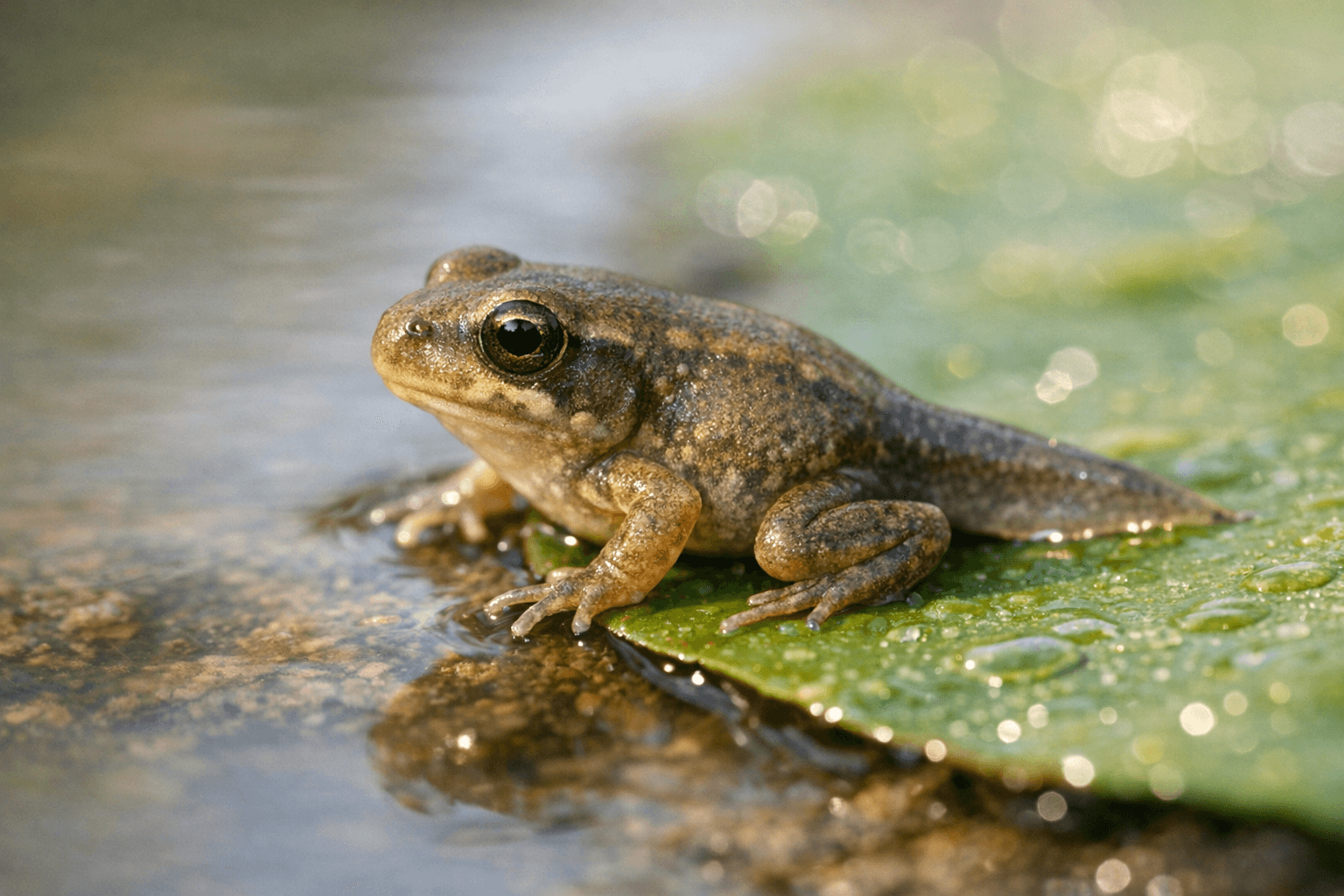
A froglet has the recognizable body and limbs of a frog while retaining the final portion of its tadpole tail.
The tail does not simply fall off. Its tissues are carefully broken down, and useful materials are absorbed into the body. These recycled nutrients provide energy during a demanding stage when the mouth and digestive tract are also changing. The froglet may eat little or nothing for a short period around the climax of metamorphosis.
Life at the pond edge presents new challenges. The froglet must avoid drying out, learn to move effectively on land, and begin capturing tiny live prey. Its permeable skin makes damp shelter essential. Plants, leaf litter, crevices, and shaded banks provide cooler, humid places where a small frog can hide from birds, snakes, mammals, and larger frogs.
For a closer look at the biological transition, this guide to how a tadpole becomes a frog explores the transformation from a tiny aquatic animal into a hopping amphibian.
A froglet is not a miniature tadpole with legs. It is an animal shifting into a new ecological role, with a redesigned body, new food sources, and access to both aquatic and terrestrial habitats.
Life as an Adult Frog
After the tail disappears, metamorphosis is complete. The young frog may still need months or years to reach reproductive maturity, so “adult-shaped” does not always mean sexually mature. During this period, it feeds, grows, avoids predators, and may move away from the breeding pond into nearby woodland, meadow, marsh, or garden habitat.
Most adult frogs are predators. Depending on their size and species, they eat insects, spiders, worms, slugs, snails, and other small animals. Larger frogs may capture fish, small reptiles, or other amphibians. Frogs therefore transfer energy through food webs and can help limit populations of many invertebrates.
How adult frogs breathe
Adult frogs use lungs, but lungs are only part of the story. Oxygen and carbon dioxide can also pass through their thin, moist skin in a process called cutaneous respiration. The lining of the mouth also contributes to gas exchange. This unusual flexibility helps frogs live between water and land, but it also makes them vulnerable to dehydration and contaminants.
When breeding conditions return, mature frogs travel to ponds or other egg-laying sites. Many males establish calling positions and produce species-specific sounds. Females select mates, eggs are fertilized, and the cycle begins again. Adults may return to the same general breeding area year after year if the habitat remains suitable.
Frogs have their own characteristic body plan and life cycle. If you encounter a long-bodied amphibian with a tail, use this guide to determine whether it is a salamander or a newt rather than a frog.
How Long Does the Frog Life Cycle Take?
There is no single timetable for every frog. In many familiar species, the journey from egg to froglet takes approximately six to twelve weeks. However, that range is only a useful general guide. Some species transform more quickly, while others remain tadpoles for many months and may even spend a winter underwater before completing metamorphosis.
Temperature is a major influence because amphibians depend on environmental heat to regulate their body processes. Warm water within a species’ safe range generally accelerates growth and development. Cooler conditions tend to slow them. Extreme heat, however, can reduce oxygen in the water, dry temporary pools, or cause dangerous stress.
Food, crowding, predators, water depth, day length, and pond duration also matter. A temporary pond creates urgency: tadpoles must transform before the water disappears. Some species respond by speeding development, although rapidly produced froglets may emerge smaller. In permanent water, other species can invest more time in aquatic growth.
| Stage | Typical visible features | Main habitat need |
|---|---|---|
| Egg | Embryo enclosed in clear jelly | Clean, oxygenated water with suitable temperature |
| Tadpole | Tail, rounded body, no visible legs | Food, aquatic cover, and enough water to grow |
| Legged tadpole | Hind legs first, then front legs | Water plus easy access to the surface |
| Froglet | Four legs and a shrinking tail | Shallow edges and damp terrestrial shelter |
| Adult | No tail; strong limbs and frog-shaped body | Prey, moisture, cover, and breeding habitat |
These stages are universal as a broad pattern, but exact appearance, behavior, and timing differ among species.
Why Healthy Ponds Matter for Frogs
A frog’s successful development depends on connections between water and land. Eggs and tadpoles need aquatic habitat, while froglets and adults also require safe areas around the pond. A breeding pool surrounded by bare, dry ground may be far less useful than one connected to vegetation, leaf litter, logs, and shaded refuges.
Native aquatic plants add structure to a pond. They provide surfaces for algae, hiding places for tadpoles, egg-laying sites for adults, and cover from predators. Plants also influence oxygen, shade, and water temperature. A range of depths helps because shallow areas warm quickly, while deeper pockets may remain available during dry weather.

Threats across the life cycle
Frogs naturally lose many eggs and tadpoles to predators, but human-driven pressures can affect whole populations. Wetland drainage removes breeding sites. Roads divide seasonal migration routes. Pesticides and other pollutants can enter waterways, while invasive predators may consume eggs and larvae that evolved without them. Amphibian diseases and a changing climate add further stress.
Because frog skin is permeable and their lives span aquatic and terrestrial environments, frogs can be especially sensitive to environmental disturbance. Their presence does not prove that a pond is perfectly healthy, but stable breeding populations can be an encouraging sign that several habitat needs are being met.
Practical ways to help
- Protect existing wetlands. Natural ponds and seasonal pools can support complex communities that take years to develop.
- Avoid pesticides and herbicides. Chemicals used nearby may wash into breeding water or reduce the insects adult frogs need.
- Choose native plants. Local species offer cover and help support native invertebrate food webs.
- Leave hiding places. Logs, stones, dense plants, and undisturbed leaf litter provide damp refuges.
- Provide safe pond edges. Gently sloping sides allow froglets and other wildlife to leave the water easily.
- Do not release pets or nonnative animals. Fish and other introduced species may eat eggs and tadpoles or spread disease.
- Conserve water. Responsible water use helps protect streams, wetlands, and groundwater that sustain amphibian habitat.
Healthy frog populations need clean breeding water, safe pond margins, nearby feeding areas, damp shelter, and connected routes between them. Protecting the surrounding landscape is as important as caring for the water itself.
How to Observe the Frog Life Cycle Responsibly
A pond visit can turn an illustration into a living lesson. The safest approach is to watch quietly from the bank with an adult, especially around deep water or slippery ground. Binoculars can help you inspect the surface without entering sensitive habitat, while a notebook lets you record changes over several visits.
Look for jelly-like egg masses attached to vegetation or resting in shallow water. Tadpoles may gather in warm, sunny areas or graze along submerged surfaces. Later in the season, watch for small hind legs, trips to the surface, and tiny froglets sitting at thewater’ss edge.
- Record the date, weather, and general pond conditions.
- Estimate the number of eggs or tadpoles without disturbing them.
- Sketch visible features such as legs, tail length, or body shape.
- Return periodically and compare observations.
- Leave eggs, tadpoles, plants, and adult frogs exactly where they are.
Avoid handling frogs unless it is necessary for their immediate safety and permitted locally. Oils, lotions, insect repellents, and other substances on human hands can irritate amphibian skin. Never take animals home to raise without appropriate expertise and authorization; maintaining correct water quality, diet, temperature, and disease prevention is more difficult than it appears.
Conclusion: One Animal, Two Very Different Lives
The journey from eggs to tadpole to frog is extraordinary because it allows one animal to occupy two worlds. The early stages are adapted to freshwater, where tadpoles swim with tails and breathe mainly through gills. Metamorphosis then produces legs, lungs, a new feeding system, and a body capable of moving onto land.
Each stage depends on the one before it. Eggs require clean, suitable water. Tadpoles need food, oxygen, and enough time to grow. Froglets need safe, damp pond edges, while adults need connected terrestrial habitat and reliable breeding sites. Protecting that complete chain gives frogs the best chance to return and begin the cycle again.
Look for the Frog Life Cycle Near You
Visit a pond or wetland with an adult, observe from a respectful distance, and see how many stages of the frog life cycle you can identify.
Start a simple nature journal, revisit the site over several weeks, and record how the animals change without touching or moving them.