

What is a Tree?
A tree is a long-lived plant that supports its leaves above the ground on a persistent, self-supporting stem or trunk. Most trees have woody trunks that branch into a crown of twigs and foliage. Yet nature does not draw a sharp boundary around this familiar shape: some trees have several trunks, palms build their stems differently from oaks, and plants that grow tall in sheltered valleys may remain shrublike on exposed mountainsides.
Understanding trees therefore involves more than recognizing a tall plant. It means looking at how they grow, how their parts work together, and why tree form has evolved in many different plant groups.
A Growth Form, Not a Single Plant Family
In everyday language, a tree is usually a woody plant with one main trunk and an elevated crown. Scientific and forestry definitions often add a minimum height at maturity, commonly around five meters, although the exact threshold varies. No single definition fits every purpose or captures every tree-shaped plant.
“Tree“ describes a way of growing, rather than a single branch of the plant family tree. An oak, a pine, and a palm belong to very different evolutionary groups. They share a tall, self-supporting form, but they did not all inherit that form from one ancestor that was itself a tree.
This distinction explains why trees can differ so dramatically in their leaves, reproductive structures, and internal anatomy. Over evolutionary time, different plant lineages developed ways to lift their foliage above neighboring vegetation. Greater access to sunlight can reward the substantial investment needed to build and maintain a trunk.
Where Trees End, and Shrubs Begin
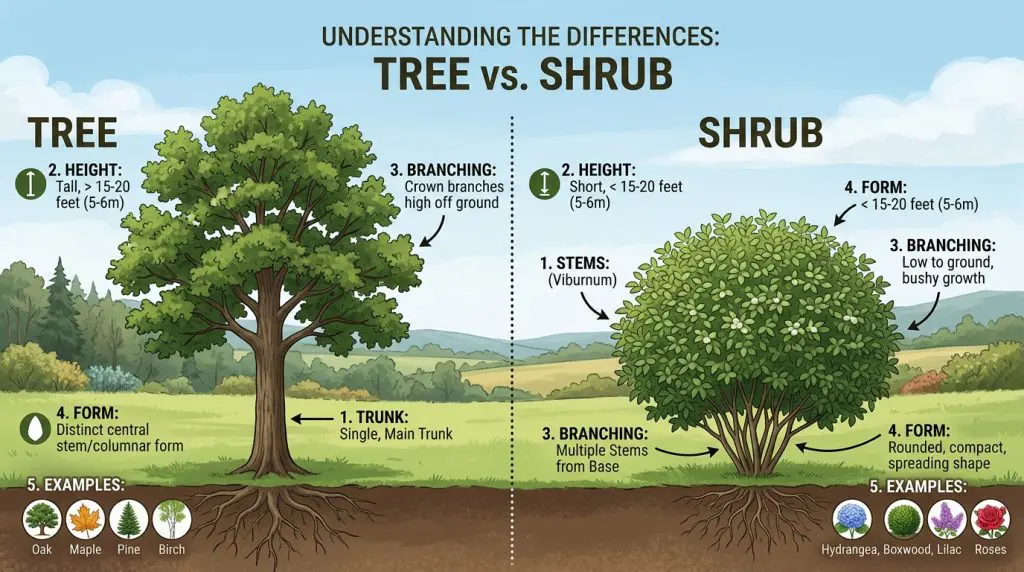
Shrubs are generally shorter woody plants with several stems arising near ground level, while trees usually develop a more prominent main trunk. These are useful descriptions, not absolute rules. A hazel may grow as a many-stemmed shrub or be trained into a small tree. Some willows naturally form either shape, depending on the species and growing conditions.
Damage can also change a plant’s appearance. If a young tree loses its main stem to browsing, fire, or cutting, several replacement stems may develop. Conversely, gardeners can prune a shrub to leave one trunk. The number of stems alone does not settle whether a plant is a tree.
Environment matters too. Near the upper limit of tree growth on mountains, wind, cold, and ice can keep normally upright trees low and twisted. These stunted forms are often called krummholz, a German word meaning “crooked wood.” A plant’s inherited growth potential and its actual shape are not always the same.
The Main Parts of a Tree
Roots: Anchorage and Absorption
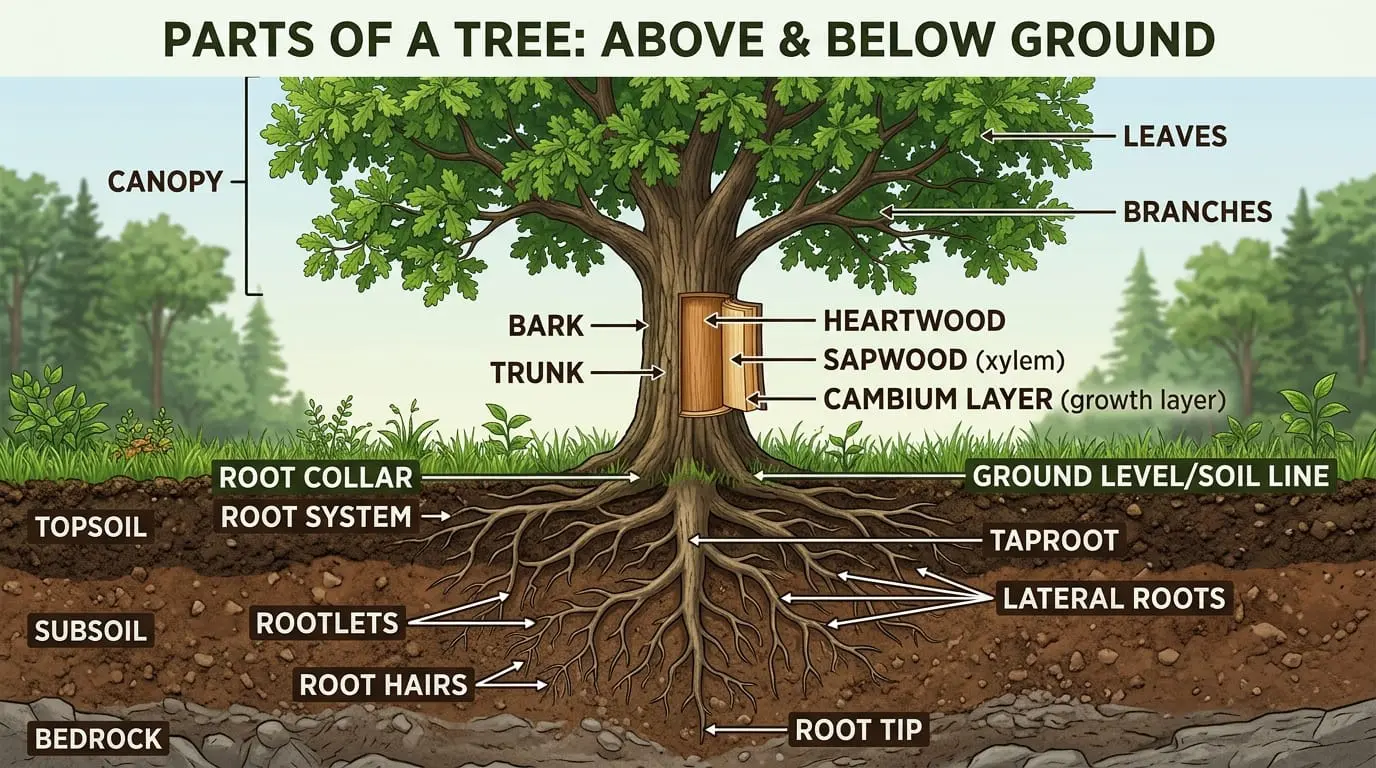
Roots anchor a tree and absorb water and mineral nutrients from the soil. Large roots provide support and transport, while fine roots do much of the absorbing. Many trees also form partnerships with soil fungi called mycorrhizae. The fungi help obtain nutrients, and sometimes water, in exchange for sugars the tree supplies.
A tree’s roots rarely mirror its crown as a deep, upside-down branching system. Although some trees develop deep roots where conditions allow, much of the absorbing root network lies in relatively shallow soil, where oxygen and nutrients are available. Roots may spread well beyond the crown’s outer edge.
The Trunk: Support and Transport
The trunk holds the crown aloft and links the roots with the leaves. In a typical woody tree, water and dissolved minerals move upward through tissue called xylem. Most wood is xylem produced during previous growth. Another tissue, phloem, carries sugars and other organic substances from places where they are made or stored to places where they are needed.
The outer bark helps protect the trunk from injury, drying, and temperature extremes. Inside it, the living inner bark includes the phloem. In many species, older central wood becomes heartwood, which no longer conducts water but still contributes structural support. The younger, water-conducting wood outside it is called sapwood.
The Crown: Capturing Light
The crown consists of the tree’s branches, twigs, and foliage. Leaves carry out photosynthesis: using light energy to turn carbon dioxide and water into sugars, while releasing oxygen. These sugars provide both fuel and building material for growth.
Tiny adjustable pores called stomata allow gases to move into and out of leaves. Water vapor also escapes through them in a process called transpiration. This water loss helps pull water upward through the xylem, but it creates a balancing act: leaves must admit carbon dioxide without losing more water than the roots can replace.
How Trees Grow Taller and Thicker
Trees grow longer at specialized regions of dividing cells near the tips of shoots and roots. These growing regions are called meristems. A branch does not rise with the trunk as the tree gets taller; its attachment remains at roughly the same height while new growth extends above it.
In most familiar woody trees, the trunk and branches become thicker through a different growing layer called the vascular cambium. This thin layer produces new xylem toward the inside and new phloem toward the outside. Over time, the accumulating wood creates a strong supporting column.
Where growth follows a pronounced seasonal cycle, differences in the wood formed during the growing season often produce visible rings. A ring commonly represents one year, but drought, irregular growth, and other conditions can produce missing or extra rings. Some tropical trees form annual rings; others do not show clear annual boundaries.
Tree trunks are not solid masses of living cells. Many water-conducting and supporting cells are dead at maturity, while living cells elsewhere transport sugars, store reserves, and produce new tissue. This combination allows trees to maintain large structures without keeping every cell alive.
The Different Kinds of Trees
Many familiar trees are angiosperms, or flowering plants. Oaks, birches, maples, magnolias, and apple trees belong to this group. Their flowers may be showy or barely noticeable, and their seeds develop within fruits. Botanically, an acorn and a maple’s winged seed-bearing structure are fruits, as is an apple.
Other trees are gymnosperms, seed plants whose seeds are not enclosed within fruits. Conifers, including pines, firs, spruces, and redwoods, are the largest familiar group. Most bear their seeds in cones. Ginkgo is also a gymnosperm, although its broad, fan-shaped leaves look very different from pine needles.
Palms are flowering plants too, but they build their trunks differently from typical broadleaved trees and conifers. They lack the conventional vascular cambium that produces successive cylinders of wood, and their trunks do not display ordinary annual wood rings. Tree ferns provide another variation: they develop upright trunks but reproduce by spores rather than seeds.
Another useful distinction concerns foliage. Deciduous trees shed their leaves during a particular season, often in response to cold or drought. Evergreen trees retain foliage year-round, replacing individual leaves over time. These categories cross evolutionary boundaries: holly is an evergreen flowering tree, while larch is a deciduous conifer.
From Seedling to Old Tree
For seed-producing trees, life begins when a seed germinates under suitable conditions. The emerging seedling initially relies on stored food, then increasingly on photosynthesis. Establishment is a vulnerable stage: seedlings may die from drought, shade, disease, browsing, or competition before developing substantial roots and stems.
Surviving trees eventually reach reproductive maturity, though the time required varies enormously. Wind pollinates many species, while others depend on insects, birds, or bats. Seeds may travel on air currents, float in water, or be carried by animals. Producing many seeds does not guarantee success; only a small fraction typically become mature trees.
Trees can also reproduce without seeds. Some send up new stems from roots or grow again from surviving stumps. In such cases, several visible trunks may be genetically identical parts of one spreading organism. The age of an individual trunk can therefore differ greatly from the age of the wider clone.
Tree lifespans range from decades to thousands of years, depending on species and circumstances. Old age does not necessarily mean a tree has stopped growing or reproducing. Even a hollow tree may remain alive because its essential transport and growing tissues lie mainly toward the trunk’s outside.
Why Trees Matter to Ecosystems
A tree is both an organism and a habitat. Its leaves feed herbivores, its flowers and fruits support pollinators and seed dispersers, and its bark shelters small animals, fungi, and lichens. Cavities provide nesting and roosting sites. Roots, fallen leaves, and dead branches create further habitats below and around it.
Trees also influence local conditions. Crowns provide shade, transpiration can cool the surrounding air, and roots help stabilize soil. Fallen leaves supply organic matter as decomposers break them down. Trees affect how rainfall reaches the ground and how water moves through a landscape, although those effects vary with climate, soil, and vegetation.
Through photosynthesis, trees take carbon from the atmosphere and store some of it in wood, roots, and other tissues. That storage is not automatically permanent: decomposition, fire, and land clearing can return carbon to the atmosphere. Protecting existing forests involves preserving both their living trees and the wider systems that maintain them.
Even after death, a tree continues to shape its surroundings. Standing dead trunks and fallen logs support organisms that living wood cannot, while slowly returning nutrients to the ecosystem. Seen this way, a tree is more than a tall plant: it is a long-lasting structure around which other lives gather, grow, and change.


