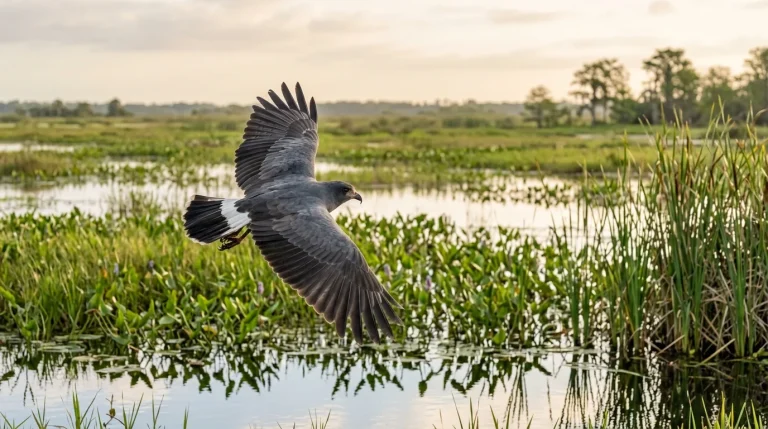
White-tailed Kite Guide
Keep Track of What You See
Create a free Wild Things Guide membership to record this White-tailed Kite in My Sightings and build your personal wildlife list.
Join to Add This SightingIntroduction
The White-tailed Kite (Elanus leucurus) is a pale, long-winged raptor of open country, best recognized by its white body, black shoulder patches, and remarkable hovering flight. Against a bright sky, it can look almost gull-like, but its hooked bill, hunting posture, and controlled descent reveal a bird of prey. In North America, look for it especially around California grasslands and parts of Texas. Finding suitable habitat is usually more productive than searching deep woodland or rugged mountains.

Quick Identification
- Overall impression: Slender, mostly white raptor with a pale gray back and long, pointed wings.
- Key markings: Black shoulder patches, dark areas around the eyes, and a predominantly white tail.
- Adult eyes: Red, though difficult to see at normal field distances.
- Signature behavior: Hovers over grassland with active wingbeats, then drops toward prey.
- Useful setting: Open fields with scattered trees, fence lines, or tall shrubs for perching and nesting.
Appearance and Field Marks
Adults have white heads and underparts, pale gray upperparts, and conspicuous black patches on the upper wings near the shoulders. The wings are long and tapering; the tail is relatively long and mostly white, without the bold dark bands seen on many hawks. Small dark eye patches give the face a focused, somewhat owl-like expression.
From below, the bird looks strikingly pale, with dark wrist areas and darker outer flight feathers. These markings change in prominence with viewing angle and light. Backlighting may conceal nearly all color, making wing shape and behavior especially important. The Cornell Lab of Ornithology’s White-tailed Kite identification guide provides useful photographs for comparing perched and flying birds.
Male and Female Differences
Males and females have essentially the same plumage. Females average somewhat larger and heavier, but the overlap is too great for dependable sex identification from a lone bird. Even a pair viewed together may be difficult to sex unless their breeding roles are apparent.
During nesting, a bird repeatedly delivering prey to an incubating partner is usually the male. Do not treat size, brightness, or the apparent extent of black markings as reliable stand-alone sex differences.

Size and Wingspan
- Length: About 32–38 cm (13–15 in).
- Wingspan: About 99–110 cm (39–43 in).
- Build: Light-bodied, with long wings and a relatively long tail.
A White-tailed Kite is larger and has much longer wings than an American Kestrel, but is generally slimmer and smaller-bodied than a Red-tailed Hawk. Its wingspan can make it seem surprisingly large in flight. Judge proportions rather than apparent size when distance is uncertain.
Range and Distribution
In the United States, White-tailed Kites occur mainly in California and parts of the Pacific coastal region, especially western Oregon, with more localized occurrence farther north. They also inhabit portions of Texas and occur locally along the Gulf Coast, including parts of Florida. Distribution is uneven, and birds may be scarce between occupied areas.
The species also occurs through parts of Mexico and Central America and across substantial areas of South America, reaching Chile and Argentina. It is not continuously distributed throughout that broad range. North American records outside established areas may involve dispersing birds rather than regular populations.

Habitat
Look for grasslands, marsh margins, lightly grazed pasture, fallow fields, and agricultural mosaics with abundant small mammals. Scattered trees or shrubs provide nest sites and observation perches. Broad expanses of dense forest are unsuitable hunting habitat.
Good sites often combine grassy cover for rodents with nearby open patches where prey can be detected and caught. Kites may use suburban edges and parks when adequate foraging land remains nearby. A nesting tree alone is not enough; the surrounding feeding habitat matters.

Migration
White-tailed Kites are generally resident rather than predictable long-distance migrants. Nevertheless, they can disperse or shift their local distribution as prey supplies and habitat conditions change. Young birds may wander beyond established breeding areas.
At a particular field, numbers can vary greatly between seasons or years. A sudden absence does not necessarily indicate a regular migration schedule. Outside the breeding season, birds may gather at communal roosts, making some locations especially productive near dusk.
Flight Style
The most distinctive hunting maneuver is hovering, sometimes called kiting. Facing into the wind, the bird holds its position with repeated wingbeats and a spread or adjusting tail while looking downward. It may move to another spot, hover again, and then descend rapidly toward the ground.
Traveling flight combines buoyant wingbeats with glides. The long wings and pale body can suggest a tern or gull at first glance. Hovering is highly suggestive, but not conclusive: kestrels and Rough-legged Hawks also use this hunting technique.
Diet and Hunting
Small mammals dominate the diet, especially voles and other rodents available in open habitats. Mice and similar prey are important in many areas; birds, reptiles, and large insects are taken less regularly.
A hunting kite usually searches from the air, then drops feet-first into vegetation. It may carry a capture to a perch or deliver it to its mate or young. Watch a productive field for several minutes rather than following every movement immediately: a bird may repeatedly work the same patch. Avoid entering the field, which can interrupt hunting and disturb concealed wildlife.

Voice and Calls
Calls are generally high-pitched whistles, squeaks, or short repeated notes, rather than the powerful scream associated with some large hawks. Birds may become more vocal during courtship, territorial encounters, or nest exchanges. Begging young can also draw attention.
White-tailed Kites are often quiet while hunting. Use voice alongside shape, plumage, and behavior, not as the sole identification clue.
Breeding and Nesting
Pairs nest in trees or substantial shrubs, often near open feeding areas. The nest is a platform of sticks lined with finer material and may be concealed within foliage. Both birds help build the nest, but the female does most of the incubation, and the male provides much of the food.
A typical clutch contains three to five eggs, usually pale with brownish markings. Incubation lasts about a month. Breeding dates vary geographically and with local conditions; favorable prey supplies can permit an extended season and additional nesting attempts. Observe nest activity from a distance and never approach to obtain a clearer photograph.

Young and Development
Juveniles differ noticeably from adults. They often show buff or rusty coloring on the head and breast, darker streaking below, and pale or buff-edged upperpart feathers that create a scaly appearance. Their eyes are darker than adults’ red eyes.
Young typically leave the nest at roughly five to six weeks, but fledging does not mean immediate independence. Parents continue providing food while the youngsters develop flight and hunting skills. A streaked young kite near adults can look like a different species until you consider its long wings, pale tail, and behavior.

Where to See
In California, scan coastal grasslands, open-space preserves, wetland edges, and agricultural landscapes. In Texas, suitable coastal prairie and other open grasslands can be productive. Western Oregon also supports birds in appropriate open country.
Use recent local sightings to locate active areas, then search from public roads, trails, or designated overlooks. Early morning and late afternoon often offer useful light and hunting activity, though kites also hunt at other times. Scan exposed treetops first, then sweep the sky above nearby fields. Respect private property and keep roost locations undisturbed.
Similar Species
- American Kestrel: Also hovers, but is smaller, with rusty coloration, strong facial stripes, and a patterned tail.
- Northern Harrier: Usually hunts by coursing low over vegetation. Look for its white rump, longer-looking tail, and wings held in a shallow V.
- Rough-legged Hawk: Can hover, especially in winter. It is bulkier, with more extensive dark underwing or belly markings and a conspicuous dark tail band.
- Mississippi Kite: Adults are darker gray overall, with a dark tail rather than a white one. They often catch insects in flight.
- Gulls and terns: May resemble a distant pale kite, but lack its black shoulder pattern and raptorial head and feet.
Conservation
The White-tailed Kite is commonly classified as Least Concern globally. That broad assessment does not mean every local population is secure. Grassland conversion, development, and the loss of suitable nesting trees can reduce available habitat.
Because kites eat rodents, rodenticide exposure is a concern. Conserving open feeding areas, retaining appropriate trees, and using wildlife-conscious rodent management can help. Local abundance also fluctuates with prey availability, so interpret short-term changes cautiously rather than automatically attributing them to population decline.
Field Identification Tips
- Find the silhouette first: long, pointed wings, a small head, and a relatively long tail.
- Confirm the pale body and mostly white tail; look for black shoulders when the upper wings become visible.
- Watch a complete hunting sequence rather than relying on a single hover.
- Check for juvenile buff coloring before rejecting a bird that isn’t cleanly white.
- Use range and habitat as supporting evidence, not substitutes for visible field marks.
Interesting Facts
- Nonbreeding birds sometimes gather in communal roosts, occasionally in substantial numbers.
- Pairs may transfer prey in flight during courtship or breeding activity.
- The species was formerly treated as part of the Black-winged Kite so that older books may use different taxonomy.
Frequently Asked Questions
Is a White-tailed Kite a hawk?
It belongs to Accipitridae, the family containing hawks, eagles, and many other kites. “Kite” is a common-name grouping, not a separate taxonomic order.
Can it be identified just by hovering?
No. Confirm the white body and tail, black shoulders, and long-winged shape. Kestrels and Rough-legged Hawks also hover.
Why does one bird look rusty rather than white?
It may be a juvenile. Young White-tailed Kites commonly have buff or rusty tones and breast streaking that adults lack.
Will it visit a backyard?
Occasionally, especially beside extensive grassland. It is not a typical feeder visitor; its main attraction is suitable, rodent-rich hunting habitat.