White-lined Sphinx Moth Guide
Keep Track of What You See
Create a free Wild Things Guide membership to record this White-lined Sphinx Moth in My Sightings and build your personal wildlife list.
Join to Add This SightingIntroduction
The White-lined Sphinx Moth is a large, powerful-flying hawk moth recognized by the pale stripe crossing each forewing and the bright pink bands on its hindwings. It is widespread across much of North America and is especially conspicuous in deserts, grasslands, gardens, and other open places with abundant flowers.
Adults hover while feeding and are sometimes mistaken for hummingbirds, particularly in dim evening light. Population numbers fluctuate considerably. In favorable years, large caterpillar populations or noticeable flights of adults may appear where the species was scarce the previous season.
Quick Identification
- Size: Body usually about 1.5–2.5 inches (3.8–6.4 cm) long; wingspan approximately 2–3.5 inches (5–9 cm).
- Forewings: Brown to olive-brown, crossed by a broad cream or silvery-white diagonal stripe extending from the wing base toward the tip.
- Hindwings: Black with a prominent rosy-pink central band and pale edging.
- Body: Robust and streamlined, with alternating pale and dark markings along the abdomen.
- Flight: Fast and direct, with an ability to hover in front of tubular flowers.
The pink hindwings may be hidden when a resting moth holds its forewings over its body. The long pale forewing stripe is therefore the most useful field mark. Antennae are thicker than those of most butterflies and end in a slight hook rather than a pronounced club.

Caterpillar Identification
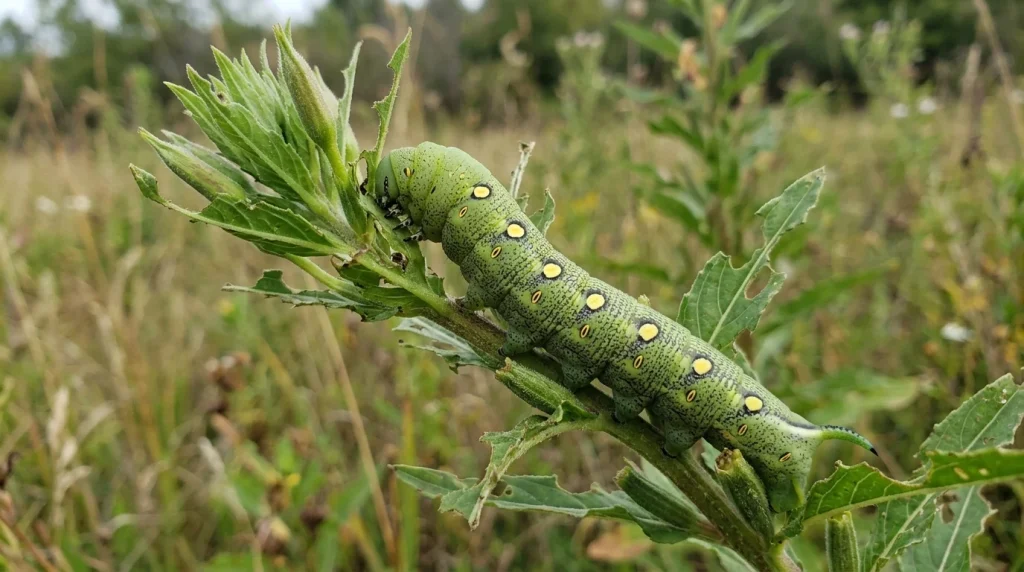
White-lined Sphinx caterpillars are large hornworms that can approach 3 inches (7.5 cm) in length. Their color is unusually variable. Individuals may be green, yellow-green, tan, reddish, dark brown, or nearly black, even when they occur in the same area.
Most have a line of conspicuous pale, yellow, orange, or reddish spots along each side. Smaller dark markings and short lines often surround these spots. A flexible horn projects from the rear of the abdomen. Despite its intimidating appearance, this horn is not a stinger and cannot inject venom.
Young larvae may be less boldly patterned than mature caterpillars. Useful clues include the rear horn, cylindrical body, side spots, and presence on a likely host plant. Reported hosts include evening primroses, willowherbs, four-o’clocks, purslanes, grapes, and various other broadleaf plants.
Eggs, Chrysalis, or Cocoon
The eggs are small, rounded, and generally pale green. Females place them singly or in small numbers on suitable host foliage. Their size and color make them difficult to find without inspecting the undersides of leaves.
Like other moths, this species forms a pupa rather than a butterfly chrysalis. A mature caterpillar usually leaves its food plant, burrows into loose soil or leaf litter, and creates a simple underground chamber. It does not normally make a conspicuous silken cocoon. The pupa is smooth, firm, and brown, with the developing wing and body structures visible in its outline.
Life Cycle
The life cycle progresses through egg, larva, pupa, and adult. Eggs hatch into small caterpillars that pass through several growth stages, or instars. Feeding accelerates during later instars, when a caterpillar can consume substantial amounts of foliage.
Once fully grown, the larva enters the soil to pupate. An adult may emerge within the same warm season, or the pupa may remain dormant through winter or another unfavorable period. The number and timing of generations vary with latitude, elevation, rainfall, and temperature. Several generations may occur in warm southern regions, while activity is more seasonally restricted farther north.
Range and Distribution
The White-lined Sphinx occurs broadly from southern Canada across most of the contiguous United States and Mexico, continuing into parts of Central America. It is one of North America’s most widely encountered sphinx moths, although it is not uniformly abundant throughout that range.
Adults are strong, mobile fliers and may disperse well beyond areas where they developed. Northern records can be seasonal or irregular, while populations in warmer areas may remain active for much longer portions of the year. Regional observations and seasonal maps are available through the Butterflies and Moths of North America species account.

Habitat
This adaptable moth uses open habitats where larval food plants and nectar flowers are available. Typical settings include desert washes, sagebrush country, prairie, grassland, scrub, meadows, roadsides, agricultural edges, vacant lots, parks, and gardens.
It is particularly noticeable in arid and semiarid landscapes after rainfall stimulates annual wildflowers. It also occurs in suburban neighborhoods with night-blooming or tubular flowers. Dense, closed-canopy forest is generally less characteristic than sunny openings and edges.

Adult food sources
Adults drink nectar through a long proboscis while hovering or briefly touching a flower with their front legs. They favor blossoms with deep floral tubes, including evening primrose, four-o’clock, honeysuckle, petunia, phlox, penstemon, salvia, and various desert wildflowers.
Feeding is common around dusk and after dark, but adults may also visit flowers during daylight. A moth approaching a flower can produce an audible hum from rapid wingbeats. Its hovering behavior allows it to reach nectar unavailable to many short-tongued insects.
When and Where to Look
Search around nectar-rich flowers from late afternoon through the first hours of darkness. Warm, calm evenings are usually most productive. In gardens, watch patches of evening primrose, four-o’clock, honeysuckle, petunia, or salvia rather than trying to follow a fast-moving moth across an open area.
Adults may visit porch lights, although artificial light is not the most reliable way to find them. During the day, check walls, tree trunks, shaded vegetation, and structures near outdoor lights for resting moths. Caterpillars are easiest to find by examining host plants for chewed foliage and dark droppings. Timing varies regionally, but sightings are generally concentrated from spring into fall, with longer seasons in the south.
Is It Harmful?
The adult moth is harmless to people, pets, and buildings. It cannot bite or sting. Its caterpillar is also harmless to handle gently; the tail horn is soft and defensive rather than venomous.
Large caterpillars can remove noticeable foliage from garden plants, and temporary population outbreaks may cause localized defoliation. Established ornamental plants often tolerate limited feeding, but young plants may need protection. Hand-picking is usually sufficient in a small garden. Avoid broad-spectrum insecticides, which can kill pollinators and other beneficial insects as well as the caterpillars.
Conservation and Ecological Importance
The IUCN has not globally assessed the White-lined Sphinx and is generally regarded as widespread rather than threatened. Local numbers naturally rise and fall, so a quiet year does not necessarily indicate a lasting decline.
Adults pollinate long-tubed flowers as pollen brushes against their bodies during feeding. Caterpillars convert plant material into food for birds and other predators, while bats, birds, and large insects may take adults. Habitat simplification, unnecessary pesticide use, and excessive nighttime lighting can reduce the quality of local moth habitat even when the species remains secure across its broad range.
How to Attract or Support It
- Grow nectar plants with overlapping bloom periods from spring through fall.
- Include evening-blooming and tubular flowers such as evening primrose, four-o’clock, penstemon, phlox, and native salvias.
- Allow some locally native larval host plants to remain in low-conflict garden areas.
- Avoid routine insecticide use, especially on flowering or known host plants.
- Leave a small area of loose, undisturbed soil or natural leaf litter where mature caterpillars can pupate.
- Turn off unnecessary outdoor lights or use shielded, warm-colored fixtures directed toward the ground.
A diverse planting is more dependable than a single favored flower. Select species native and appropriate to the local climate rather than introducing plants that may become invasive.
Similar Species
Bedstraw Hawkmoth: Hyles gallii also has a pale stripe on the forewing and pink on the hindwing. It is more associated with northern and western areas. Its forewing pattern is often more sharply contrasting, and careful comparison of the pale bands and adjacent dark markings may be needed.
Spurge Hawkmoth: Hyles euphorbiae is an introduced species recorded locally in parts of North America. It has strong cream and olive forewing patterning but lacks the same simple, continuous white-lined appearance.
Tersa Sphinx: Xylophanes tersa has long, narrow forewings marked by several fine pale lines. Its overall shape is slimmer, and its hindwings have contrasting bands rather than one broad rosy-pink patch.
Achemon Sphinx: Eumorpha achemon is similarly large but has a patchier, more scalloped forewing pattern without the White-lined Sphinx’s prominent diagonal cream stripe.
Interesting Facts
- The hovering flight and audible wing hum often cause observers to mistake the moth for a small hummingbird.
- Caterpillars from a single population can display dramatically different colors and patterns.
- Adults may travel considerable distances, helping explain sudden appearances outside areas of regular abundance.
- Desert populations can become highly visible after rains produce both host-plant growth and large wildflower blooms.
- The species name lineata refers to its conspicuous lined appearance.
Frequently Asked Questions
Is a White-lined Sphinx Moth rare?
No. It is widespread and often common, but abundance varies by place and year. Seasonal movements and rainfall-driven plant growth can produce noticeable fluctuations.
Does the caterpillar’s horn sting?
No. The rear horn has no stinger or venom. It may discourage predators by making the caterpillar appear more formidable.
Why does the moth look like a hummingbird?
Its large body, rapid wingbeats, hovering flight, and long feeding tube create a hummingbird-like appearance. These are feeding adaptations rather than evidence of a close relationship.
Should I remove the caterpillars from my garden?
Usually not. If feeding threatens a small or valued plant, move caterpillars carefully to another suitable host plant nearby. Confirm that the replacement is a genuine host before relocating them.
Are White-lined Sphinx Moths active only at night?
No. They are often most active near dusk and after dark, but they may also feed in bright daylight, particularly where flowers are abundant.