Varied Bunting Guide
Keep Track of What You See
Create a free Wild Things Guide membership to record this Varied Bunting in My Sightings and build your personal wildlife list.
Join to Add This SightingIntroduction
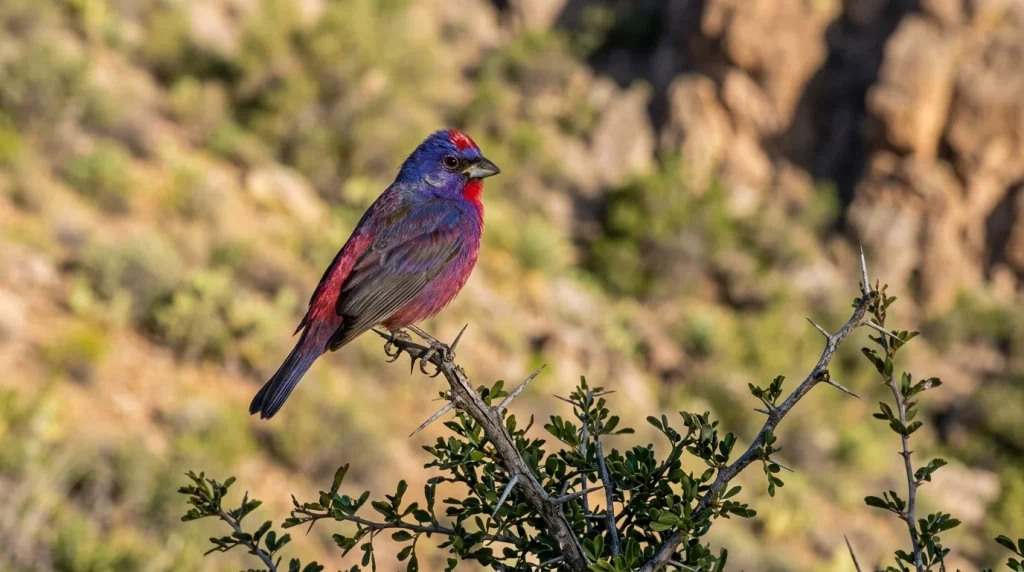
The Varied Bunting (Passerina versicolor) is a small, compact songbird of arid scrub, brushy canyons, and thorny woodland in the southwestern United States, Mexico, and parts of Central America. A breeding male can look almost black in poor light, but sunshine reveals a remarkable mixture of violet, plum, crimson, and blue. Females and immature birds are much less conspicuous, wearing subdued gray-brown plumage.
Varied Buntings often remain inside dense cover, so finding one may depend on recognizing the male’s song and watching exposed perches above a brushy slope. The Cornell Lab of Ornithology’s Varied Bunting account provides additional photographs, sounds, and distribution information.
Quick Identification
- Male: Dark, richly colored plumage combining purple, reddish plum, violet-blue, and crimson tones.
- Female: Plain grayish brown to warm brown, generally lacking strong wing markings.
- Shape: Small, stocky Bunting with a short neck, rounded head, and thick conical bill.
- Behavior: Usually stays low in thorn scrub but sings from exposed shrub tops or wires.
- Range clue: Most expected in dry brushlands of the Southwest and Mexico.
- Voice: A musical series of clear, varied phrases delivered from a prominent perch.
Appearance
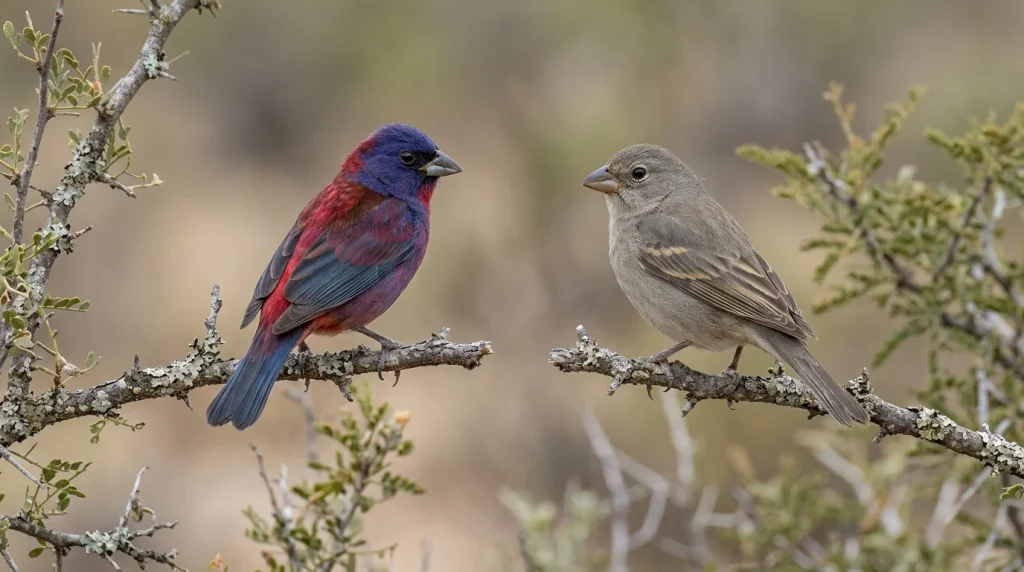
Adult breeding males are among North America’s darkest-looking buntings. Their plumage is not a single uniform color: the head and body may show blue-violet, purple, deep wine-red, and crimson areas, with a particularly rich reddish tone on the nape and upper back. The face and underparts can appear very dark purple or nearly black when shaded. Color changes dramatically with viewing angle, distance, and light quality.
The wings and tail are dusky, often washed with purple or blue. Unlike the boldly patterned Painted Bunting, a male Varied Bunting has no sharply divided red, green, and blue color blocks. Its colors blend into a darker overall plum-purple appearance.
Females are plain gray-brown or warm brown, with slightly paler underparts and few obvious field marks. Some show a subtle pale eye area, but this is not always conspicuous. The bill is stout and seed-adapted, typically grayish or horn-colored. Immature birds resemble females; young males gradually acquire irregular patches of dark purple and reddish adult plumage.
Size and Wingspan
Varied Buntings are approximately 4.3–5.5 inches (11–14 centimeters) long, with a wingspan near 8.3 inches (21 centimeters). They are similar in overall size to Indigo and Lazuli Buntings and noticeably smaller than most towhees.
At a distance, structure can be as useful as color. Look for a compact body, a relatively short tail, a rounded head, and a deep, triangular bill. The bird may adopt an upright posture while singing but often appears horizontal or hunched when feeding within vegetation.
Range and Distribution
In the United States, the Varied Bunting is a localized breeding bird of the Southwest, occurring principally in southern Arizona, southern New Mexico, and western and southern Texas. Its distribution is broader in Mexico, where it occupies suitable dry, brushy habitats across northern and central regions and, locally, farther south into Central America.
Northern populations are generally migratory, withdrawing from much of the United States after the breeding season. Many winter in western and southern Mexico, while some populations farther south are resident or make shorter seasonal movements. Spring arrival and autumn departure vary with latitude, elevation, rainfall, and local conditions. Vagrants occasionally appear beyond the normal range, but such records are uncommon.

Habitat
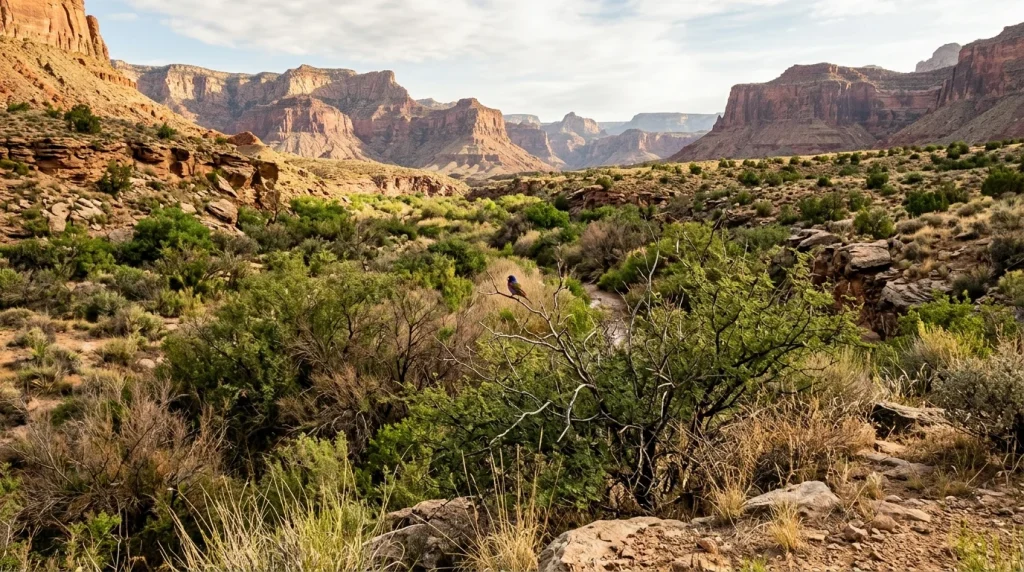
Varied Buntings favor dry, structurally dense vegetation. Typical settings include thorn scrub, desert washes, brushy canyon walls, rocky slopes, mesquite thickets, open woodland edges, and overgrown fields. They are especially associated with places offering both low cover for feeding and taller shrubs, small trees, or utility lines for singing.
In the Southwest, good habitat may include mesquite, acacia, hackberry, mimosa, or other thorn-forming shrubs. The species is not usually a bird of open, treeless desert. Even in arid country, it tends to select washes, foothills, canyon bottoms, or slopes where woody vegetation is relatively well developed.
Behavior
Varied Buntings can be secretive when they are not singing. They hop through tangled vegetation, pause to inspect seed heads, and make short flights between shrubs. A disturbed bird often drops quickly into cover rather than remaining in the open.
During the breeding season, males become easier to detect because they sing repeatedly from exposed perches. A male may use the same shrub top, dead branch, fence, or wire several times, returning after brief feeding trips. Territorial chases can be rapid, with birds disappearing into dense growth.
Outside the nesting season, Varied Buntings may occur alone, in pairs, or in small loose groups. They can also associate with other seed-eating birds where food is concentrated, though they often remain closer to cover than conspicuous open-country finches.
Diet and Hunting
The diet consists mainly of seeds and insects, with the proportions changing through the year. Grass seeds, weed seeds, and other small plant foods are important, especially outside the breeding season. Insects and other small invertebrates provide protein during spring and summer and are particularly important for growing nestlings.
Rather than hunting in sustained aerial flight, a Varied Bunting usually gleans food from leaves, twigs, flowers, and seed heads. It also hops on or near the ground beneath shrubs. Short flycatching movements may occur when an insect is flushed, but low, deliberate foraging within vegetation is more typical.

Vocalizations
The male’s song is a clear, musical series of whistles and warbled phrases. It may begin with separated notes before accelerating into a more flowing sequence. Individual songs vary, and neighboring males can differ in pacing or phrase structure.
The song may suggest an Indigo, Lazuli, or Painted Bunting, so combine voice with habitat, range, and visual details. Calls are shorter and less conspicuous, including sharp or dry notes used during contact or alarm. In dense habitat, locating the singing perch first and waiting for the bird to return is often more productive than following it through the brush.
Breeding and Nesting
Breeding generally occurs during the warmer months, although timing varies geographically and may be influenced by seasonal rainfall. Males establish territories and advertise them from prominent perches. Courtship is not always easy to observe because much of the activity occurs within dense vegetation.
The female builds a compact open-cup nest, usually placed fairly low in a thorny shrub, vine tangle, or small tree. Grasses, weed stems, bark fibers, and similar plant materials form the cup, which may be lined with finer fibers or hair. Surrounding foliage helps conceal it.
A typical clutch contains about three or four eggs, although smaller or larger clutches are possible. The eggs are pale bluish or greenish white and commonly bear brownish or reddish markings. The female performs most or all incubation. The male may remain nearby, defending the territory and sometimes assisting with food delivery after hatching.

Young and Development
Nestlings hatch helpless, with limited down and closed or partly closed eyes. Both parents may feed them, bringing soft-bodied insects and other small foods. As the young grow, their feathers develop into a plain brown juvenile plumage that resembles the female’s coloration.
The nestling period is relatively brief, as it is in many small songbirds. Recently fledged young remain dependent on adults while they improve their flight and foraging skills. They may sit quietly inside dense cover and give subtle begging calls. Observers should avoid approaching nests or stationary fledglings, since lingering nearby can expose them to predators or interrupt parental care.
Where to See
Within the United States, productive areas include brushy foothills and desert canyons in southeastern Arizona, southern New Mexico, and the Big Bend and Edwards Plateau regions of Texas. Exact abundance varies locally, and a site that looks suitable may hold only a few territorial males.
Search during late spring and summer, preferably soon after sunrise when singing is most active. Walk slowly along canyon roads, wash edges, or trails overlooking thorn scrub. Listen for repeated song, then scan the highest bare twigs, utility wires, and shrub tops. Midmorning sunlight often reveals plum and violet tones that disappear under flat or heavily shaded conditions.
Similar Species
Painted Bunting: Adult males are unmistakably brighter, with a blue head, green back, and red underparts. Females are greener than female Varied Buntings. Their ranges overlap in parts of Texas and Mexico.
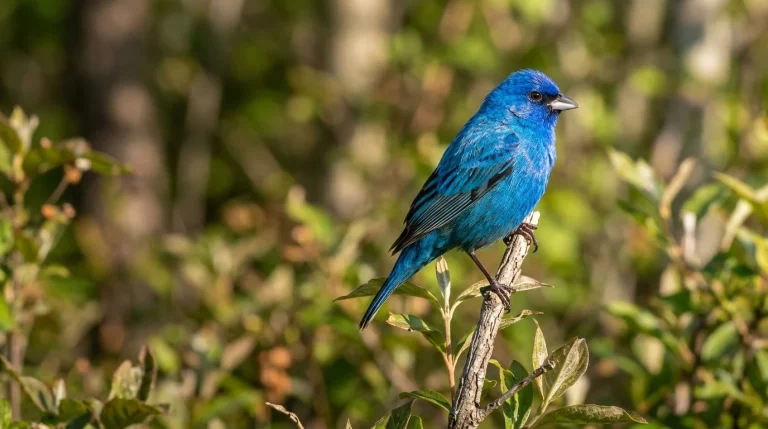
Indigo Bunting: Breeding males are predominantly blue rather than dark plum-red. Females can be difficult, but Indigo Buntings often show warmer brown tones and faint wing bars or streaking. Range and habitat are important supporting clues.
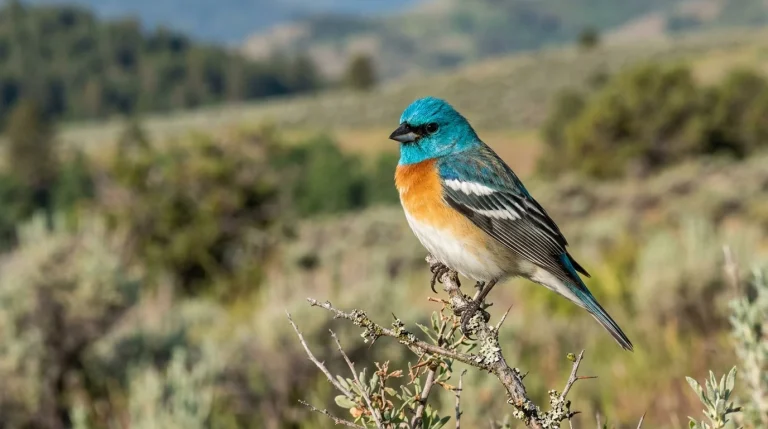
Lazuli Bunting: Males have a blue head and back, orange breast, white belly, and obvious wing bars. Females usually show two pale wing bars, unlike the plainer female Varied Bunting.
Blue Grosbeak: This species is substantially larger, with a heavier bill, longer proportions, and rusty wing bars. Female Blue Grosbeaks can resemble large brown buntings but look bulkier and often show stronger wing patterning.
Conservation
The Varied Bunting is commonly assessed as Least Concern globally. It remains widespread, particularly in Mexico, but its local distribution can be patchy. Population trends are difficult to judge in some areas because the birds inhabit remote terrain and can be inconspicuous outside the singing season.
Loss or degradation of thorn scrub, brush clearing, intensive grazing, altered fire patterns, and development may reduce habitat locally. Maintaining native shrub communities, vegetated washes, and connected canyon habitat can benefit this and many other arid-land birds. Responsible birders should remain on established routes where possible and avoid playback near active nests or repeatedly targeted territories.
Field Identification Tips
- Do not expect a male to look brightly multicolored in shade; first impressions are often of a nearly black or dark purple bird.
- Use direct sunlight to reveal violet, crimson, blue, and wine-red tones.
- For females, emphasize the small bunting shape, heavy conical bill, plain wings, habitat, and geographic range.
- Check exposed perches above dense thorn scrub after hearing a repeated musical song.
- Compare size carefully: a Blue Grosbeak should appear larger and have a heavier bill.
- Photograph uncertain females from several angles, including views of the wing pattern and bill.
- Treat song as supporting evidence rather than a stand-alone identification when other buntings are present.
Frequently Asked Questions
Why does a male Varied Bunting sometimes look black?
Its saturated purple and red plumage reflects poorly in shade. Under direct light, the same bird can show vivid violet, plum, blue, and crimson tones.
Are female Varied Buntings colorful?
No. Females are mostly plain gray-brown or warm brown. Their lack of bold pattern is itself useful, but identification should also consider bill shape, size, habitat, and range.
Do Varied Buntings visit feeders?
They may occasionally take small seeds where feeders are close to suitable brush, but they are not consistently feeder-oriented. Native seed-producing plants and dense cover are more likely to attract them naturally.
Are Varied Buntings found year-round in the United States?
Most are summer breeding visitors in the United States and move south for winter. Seasonal timing varies, and occasional birds may occur outside the expected period.
What is the best way to find one?
Visit suitable thorn scrub or brushy canyon habitat during the breeding season. Listen early in the morning for a singing male, then scan exposed perches instead of pushing into dense vegetation.