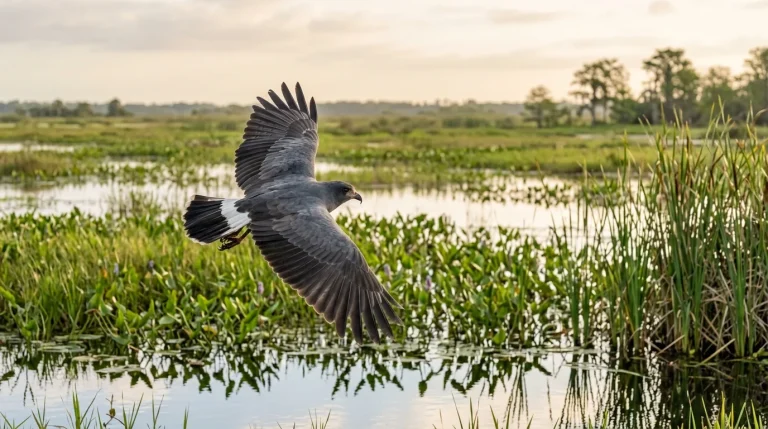
Swallow-tailed Kite Guide
Keep Track of What You See
Create a free Wild Things Guide membership to record this Swallow-tailed Kite in My Sightings and build your personal wildlife list.
Join to Add This SightingIntroduction
The Swallow-tailed Kite (Elanoides forficatus) is one of North America’s most distinctive raptors. Long, pointed wings, a deeply forked tail, and striking black-and-white plumage create a silhouette unlike that of any regularly occurring hawk. Its buoyant flight is equally memorable: the bird seems to steer through the sky with scarcely a wingbeat.
In North America, look for this warm-season visitor mainly in the southeastern United States. Finding one often means watching the sky above wooded wetlands, river corridors, or nearby open country rather than searching for a perched bird.

Quick Identification
- Shape: Slender body, long pointed wings, and an exceptionally deep tail fork.
- Color: White head and underbody; black upperparts, flight feathers, and tail.
- Underwing: White wing linings contrast sharply with black flight feathers.
- Flight: Smooth gliding, banking, and frequent tail adjustments, usually with relatively little flapping.
- Setting: Southeastern wooded wetlands and surrounding feeding areas during spring and summer.
Appearance and Field Marks
An adult’s white head, neck, breast, and belly contrast with glossy black upperparts and tail. From below, the white inner wing contrasts with a broad black trailing portion formed by the flight feathers. Strong sunlight may give the black upperparts a subtle sheen.
The small head projects only slightly ahead of the wings. The bill is dark and hooked, but it is rarely useful for identification at normal viewing distances. The tail is the decisive feature: two long outer points create a deep, elegant fork.
Watch several turns before deciding that a distant bird lacks a fork. When the tail closes, overlaps, or points directly toward you, its shape can be surprisingly difficult to read. Backlighting can also conceal the white underparts.
Male and Female Differences
Males and females have essentially the same plumage. Females average somewhat larger, but the overlap is too great for reliable sexing by size in the field. You generally cannot confidently sex a single flying or perched bird.
Courtship feeding and nesting behavior may provide clues, but ordinary photographs rarely establish sex. Do not treat tail length, brightness, or apparent bulk as dependable male-versus-female field marks.

Size and Wingspan
- Length: About 50–65 cm (20–26 in), including the long tail.
- Wingspan: About 122–136 cm (48–54 in).
Despite its substantial wingspan, this Kite looks lightly built. Compared with a Red-tailed Hawk, it has narrower, more pointed wings, a much slimmer body, and a dramatically different tail. Distance and perspective make size estimates less reliable than shape.
Range and Distribution
The regular U.S. breeding range is concentrated in Florida and the southeastern Coastal Plain, extending through parts of South Carolina, Georgia, and the Gulf states west to eastern Texas. Distribution is patchy, with especially important concentrations in Florida. Occasional wanderers appear much farther north.
Beyond the United States, the species occurs from southern Mexico through Central America and across substantial parts of South America. Some tropical populations are resident, while others move seasonally. The Cornell Lab of Ornithology’s Swallow-tailed Kite account offers useful identification photos and a broad-range map.

Habitat
Breeding birds favor landscapes that combine tall nesting trees with productive feeding areas. River swamps, cypress wetlands, pine stands, and mixed bottomland forests are typical settings. Nearby marshes, pastures, fields, and forest openings provide access to airborne insects and other prey.
The important combination is suitable nesting structure and a surrounding foraging landscape, not continuous closed forest alone. Birds may feed over agricultural land or suburban edges while relying on nearby, less disturbed woodland.

Migration
U.S. breeders are long-distance migrants that spend the nonbreeding season in South America, particularly Brazil. Birds begin returning to Florida in late winter, with arrival farther north generally occurring during early spring.
Southbound movement begins surprisingly early. Many birds gather at communal roosts in midsummer and leave during late summer; most have departed the United States by early fall. Timing varies with location, age, and conditions. Migration involves both overland travel and water crossings, making weather and safe stopover areas important.
Flight Style
Flight is often the first clue. Swallow-tailed Kites glide on long, usually level wings, banking smoothly rather than using the heavy wingbeats of many larger hawks. The tail twists, opens, and closes as the bird changes direction.
They circle in rising air, skim above treetops, and make abrupt but controlled turns while pursuing insects. Wingbeats are quick and elastic when needed. A feeding bird may bring its feet toward its bill in midair, apparently pausing its hunting to eat without landing.
Diet and Hunting
Large flying insects—including dragonflies, beetles, and wasps—are important foods. Kites catch prey with their feet and frequently eat it while flying. They also take small vertebrates, including tree frogs, lizards, snakes, and nestling birds.
Rather than routinely plunging to the ground, they often pluck prey from leaves, branches, or other exposed surfaces as they pass. Vertebrate prey is particularly important when provisioning young. Watch over sunny field edges and wetland margins, where insect activity can attract several feeding kites at once.

Voice and Calls
This raptor is usually not conspicuously noisy away from nesting or social activity. Calls include thin, high-pitched whistles and repeated squeaky notes, sometimes rendered as a sharp “klee.” Vocalizations may accompany interactions near nests or between birds.
Call descriptions are approximate. Learn the sound from recordings, but rely primarily on silhouette, plumage, and flight for identification.
Breeding and Nesting
Pairs build a stick nest high in a tree, often a tall pine or cypress with an accessible upper crown. They may line the nest with Spanish moss, lichens, or other soft plant material. Suitable trees sometimes stand above the surrounding canopy.
A typical clutch contains two eggs, although one to three may occur. Eggs are pale with darker brownish markings. Incubation lasts roughly four weeks. Both adults participate in nesting duties, with the female generally doing more incubation and the male supplying much of the food early in the cycle.
Nesting pairs may occur near one another where habitat is favorable, but that does not mean every group represents a breeding colony. Observe from a distance and never approach a nest for a closer photograph.

Young and Development
Newly hatched chicks are downy and dependent on their parents. They develop flight feathers in the nest and usually make their first flights at about five to six weeks old. Recently fledged young continue receiving food while improving their aerial skills.
Juveniles resemble adults but have a shorter, less deeply forked tail and duller dark upperparts, sometimes with pale feather edging. Tail shape is useful only when you can see it well: wear, molt, and viewing angle can also alter an adult’s outline.

Where to See
Florida offers some of the most dependable viewing opportunities, especially around large wetland and forest landscapes. Other productive areas include southeastern river floodplains and protected Coastal Plain wetlands during the breeding season.
- Scan above treelines from legal public overlooks and open trails.
- Try midmorning onward, when warming air supports soaring and insect activity increases.
- Watch adjacent fields and pastures, not just the swamp itself.
- Check recent local sightings; feeding concentrations can shift quickly.
Use established viewing areas for communal roosts and avoid disturbing birds arriving to rest.
Similar Species
- Mississippi Kite: Also graceful and aerial, but gray overall, with a much shorter, essentially square-ended tail and no bold white-body/black-wing pattern.
- White-tailed Kite: Pale below with dark shoulder patches, but has a white, unforked tail and often hovers while hunting.
- Magnificent Frigatebird: Has long wings and a deeply forked tail, but is much larger, predominantly dark, and especially associated with coastal waters. Look for its long hooked bill and strongly angular wings.
- Swallows and terns: Some have forked tails, but differ in proportions, wing action, and size. Judge scale against nearby birds or landscape features when possible.
Conservation
The IUCN classifies the Swallow-tailed Kite as Least Concern globally. That broad assessment should not obscure regional vulnerability: its U.S. breeding distribution has shrunk significantly from its historical extent.
Loss of wetland forests, removal of tall nesting trees, and disturbance at communal roosts remain concerns. Protecting connected nesting and feeding landscapes is more useful than preserving individual nest trees in isolation. Because these birds migrate internationally, conservation also depends on habitats beyond North America.
Field Identification Tips
- Start with the outline: Long pointed wings plus a deep tail fork are the strongest combination.
- Confirm the pattern: Look for a white head and body against black flight feathers and tail.
- Follow a full turn: Banking reveals plumage and tail details hidden in straight flight.
- Use behavior as support: Effortless gliding and airborne feeding fit this species.
- Document unusual records: Outside the regular range or season, obtain photographs without disturbing the bird.
Interesting Facts
- The long forked tail functions as an exceptionally responsive steering surface.
- Much feeding happens entirely in the air, including transferring captured prey from foot to bill.
- Premigration gatherings can include hundreds of birds, sometimes more, even though nesting pairs are dispersed across the landscape.
- Its swallow-like shape explains the English name, but it belongs to the hawk-and-eagle family, Accipitridae.
Frequently Asked Questions
Is a Swallow-tailed Kite a hawk?
It is a raptor in Accipitridae, the family containing hawks, eagles, and many other kites. “Kite” describes this distinctive type of raptor rather than a separate taxonomic order.
Do Swallow-tailed Kites stay in Florida all year?
Normally, no. Florida’s breeding birds migrate to South America. A winter report is unusual and deserves careful documentation.
Can color identify males and females?
No. Their plumage is essentially the same, and size differences are not reliable for identifying individual birds.
Why does the tail sometimes look only slightly forked?
The bird can close or twist its tail, hiding the notch. Juveniles also have shorter outer tail feathers. Wait for a banking view before judging the shape.