Sora Guide
Keep Track of What You See
Create a free Wild Things Guide membership to record this Sora in My Sightings and build your personal wildlife list.
Join to Add This SightingIntroduction
The Sora (Porzana carolina) is a small marsh bird that many people hear but never see. It is a rail, related to coots and gallinules. Its short yellow bill, compact body, and often-raised tail set it apart from other birds moving through wetland plants.
Soras spend much of their time hidden among cattails, sedges, and rushes. A patient observer may catch one stepping onto muddy ground at a marsh edge. Learning its calls and watching small openings in the vegetation are usually more useful than searching open water.
Quick Identification
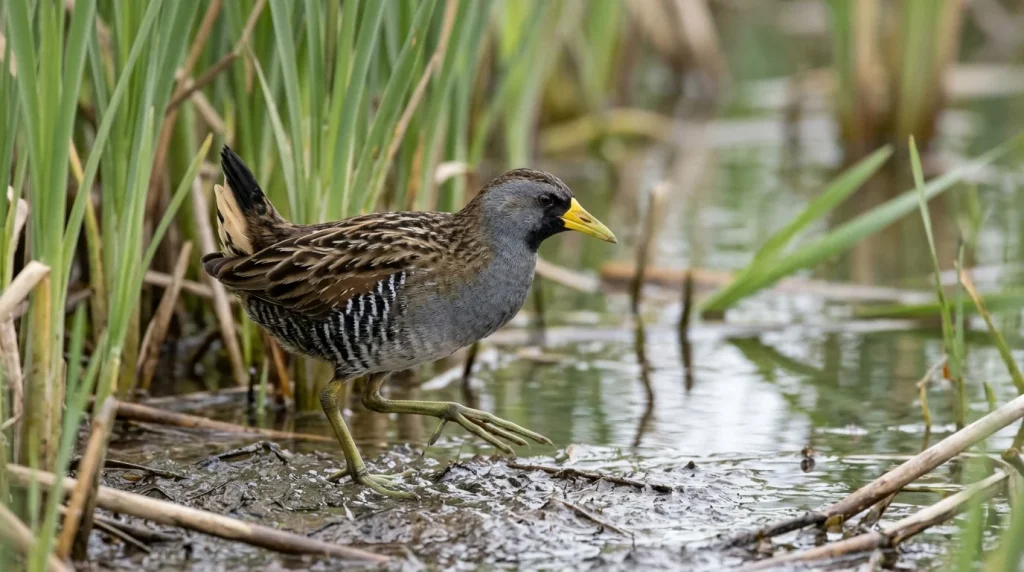
- Shape: Small, plump rail with a short neck, stubby bill, and large feet.
- Adult markings: Brown upperparts with dark and pale streaks, gray face and breast, and black-and-white bars along the sides.
- Bill: Short, thick, and yellow in adults.
- Face: Breeding adults usually have black around the bill and throat; the extent varies.
- Tail: Short and frequently cocked upward, revealing pale undertail feathers.
- Voice: A descending, whinny-like series and a sharp two-part call often written as “ker-wee.”
Appearance
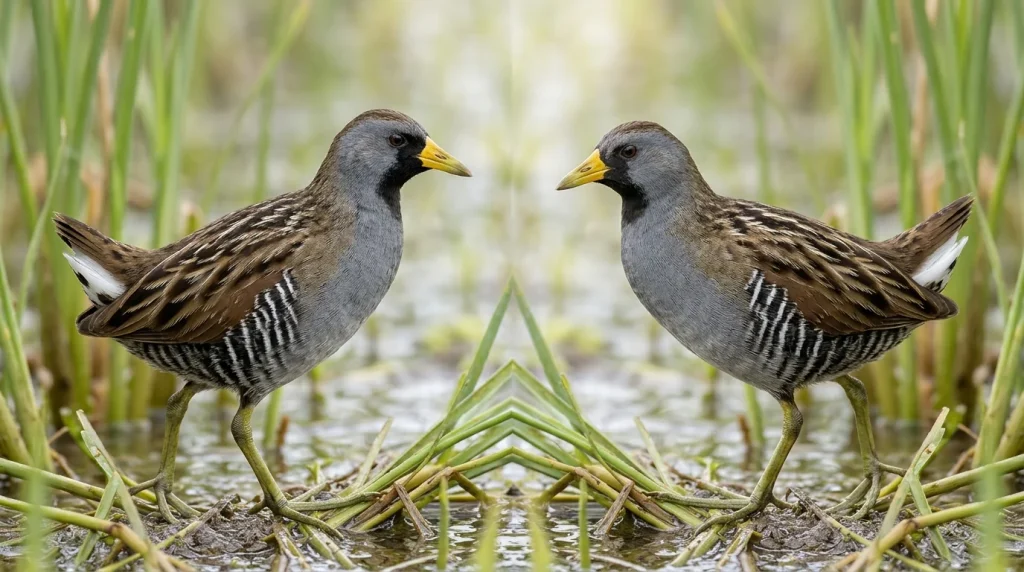
An adult Sora combines a gray face and breast with a richly patterned brown back. Pale streaks run along the back and wing feathers, while the flanks carry strong black-and-white barring. The belly is paler. Its greenish-yellow legs end in long toes that help spread its weight over soft mud and marsh plants.
Breeding males generally have a more extensive black face and throat than females. However, the sexes look very similar, and this difference isn’t reliable from every angle. Do not assign sex based only on a small dark patch.
Young birds are browner and buffier, especially on the face and breast, and lack the adult’s obvious black facial markings. Their bills may look dull yellow, olive, or partly dusky. Adults outside the breeding season can also look less sharply marked. The short bill and compact shape remain useful clues across ages.
Size and Wingspan
- Length: About 8–10 inches (20–25 cm).
- Wingspan: About 15 inches (38 cm).
A Sora is roughly robin-length but has a much shorter tail and a rounder body. At a glance, it may look surprisingly small. Its body is narrow from side to side, letting it slip between crowded stems. When flushed, it shows rounded wings and dangling legs, then usually drops back into cover.
Range and Distribution
Soras breed across much of Canada and the northern United States, with breeding populations extending through parts of the western and central United States. Suitable wetlands, rather than a continuous band of habitat, determine where they occur locally.
Most northern birds migrate. Wintering areas include the southern United States, Mexico, Central America, the Caribbean, and northern South America. During migration, Soras may appear in wetlands far from established breeding sites, including small urban ponds with thick edges.
Local numbers can change greatly with water levels. A marsh that holds several birds one year may offer poor conditions the next. Check regional records for the most useful seasonal timing.

Habitat
Look for shallow wetlands with dense plants rising above the water. Freshwater marshes with cattails, sedges, rushes, or grasses are classic habitat. Soras also use wet meadows, flooded fields, pond margins, and some brackish marshes, especially during migration and winter.
The best feeding areas often mix shallow water, soft mud, tangled stems, and floating plant material. Deep, open water is less useful. A small marsh with thick cover and muddy feeding edges can be better than a large pond with bare banks.

Behavior
Soras usually walk rather than fly when avoiding trouble. They slip through stems, pause beneath overhanging plants, and flick their short tails. They can swim, but most sightings involve birds picking their way through shallow water or across muddy ground.
Despite their weak-looking escape flights, Soras are capable migrants that travel mainly at night. Their secretive daytime habits can make their arrival seem sudden when several begin calling from a previously quiet marsh.
Watch an opening for several minutes instead of following every rustle. A bird that retreats into cover may return if you remain still. Dawn and dusk are often productive, although Soras can feed and call during daylight.
Diet
Soras eat both plants and animals. Seeds from wetland grasses, sedges, and other marsh plants are important, especially outside the breeding season. They also take insects, snails, and other small invertebrates.
Animal foods become especially important during breeding and chick growth. A feeding bird may pick items from mud, shallow water, or low plants. Its short bill suits picking and probing near the surface, unlike a Virginia Rail’s long bill. Late-season patches of seed-bearing wetland plants can attract migrants.

Vocalizations
The best-known Sora sound is a lively whinny: a series of notes that generally descends and changes pace toward the end. Another familiar call is a clear, two-part “ker-wee.” These sounds may carry across a marsh even when the bird remains completely hidden.
Calls are especially helpful during spring and early summer. Listen for several minutes, since birds may answer one another from different patches of cover. Compare recordings on the Cornell Lab of Ornithology’s Sora sound page before a visit. Avoid repeated playback, particularly around nesting birds.
Breeding and Nesting
Soras build well-hidden nests in dense wetland plants, usually over shallow water or wet ground. The nest is a cup or platform of marsh vegetation supported by surrounding stems. Nearby plants may arch over it, and a small ramp of stems can provide access.
A clutch often contains around 8–12 eggs, though larger and smaller clutches occur. The eggs range from buff to pale brown and may have darker spotting. Both parents share incubation, which lasts roughly 16–20 days.
Stable water levels help protect nests. Rapid flooding can submerge them, while falling water may make them easier for land predators to reach. Observe nesting habitat from established trails rather than entering the vegetation.

Young and Development
Newly hatched Soras are covered in black down. They can leave the nest soon after hatching, but they still rely on their parents for food, warmth, and protection. Both adults help care for the brood, and the family may split into smaller groups.
Chicks move through dense cover and can swim when needed. As they grow, they replace their down with brown juvenile feathers. They can fly at roughly three to four weeks, though development varies. A downy chick alone briefly is not necessarily abandoned; watch from a distance and allow the adults to return.
Where to See
Visit wildlife refuges, wetland preserves, and parks with marsh boardwalks or trails beside shallow pools. During migration, check managed wetlands where water has drawn down enough to expose muddy edges while leaving nearby cover.
- Scan narrow channels through cattails rather than only open water.
- Watch the boundary between dense plants and bare mud.
- Use binoculars before approaching; a Sora may freeze instead of running.
- Return at a quieter time if traffic or visitors keep birds hidden.
Local bird reports can identify active sites, but recent water conditions are often just as important.
Similar Species
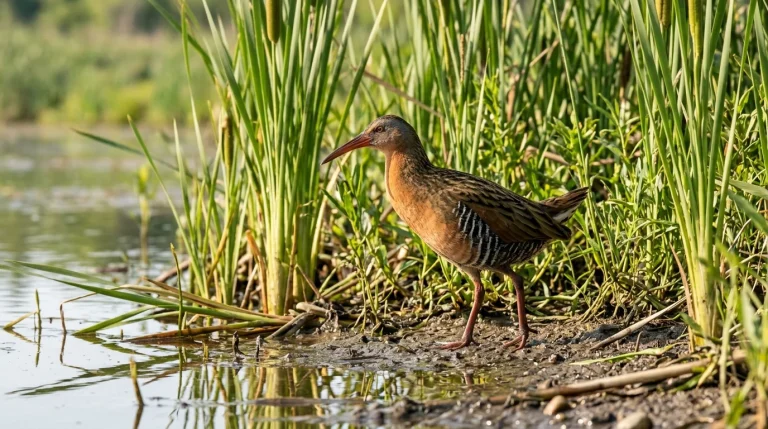
- Virginia Rail: Has a much longer, slender, reddish bill; a more stretched-out shape; and warmer, rusty underparts. Its gray cheek can resemble a Sora’s face.
- Yellow Rail: Smaller, with a very short bill and a finely patterned, buffy appearance. It lacks an adult Sora’s gray breast and black face. A white wing patch may show in flight.
- Black Rail: Much smaller and darker, with a short dark bill. Adults have a chestnut patch on the upper back and a red eye, though both may be hard to see.
- Juvenile Virginia Rail: Can look dark and poorly marked, but its longer bill remains a strong clue.
In poor light, prioritize bill length, body shape, and voice over subtle color differences.
Conservation
The Sora is commonly listed as Least Concern globally. It remains widespread, but its hidden lifestyle makes population changes difficult to measure. Healthy numbers in one marsh do not guarantee that wetlands elsewhere are secure.
Wetland drainage, pollution, and poorly timed water-level changes can reduce feeding and nesting habitat. Protecting marshes and managing water to retain shallow, plant-filled areas benefit Soras and many other wetland birds. Follow closures, keep pets away from marsh edges, and avoid trampling vegetation while searching.
Field Identification Tips
- Listen first. A whinny or “ker-wee” can reveal the right patch of marsh.
- Check the bill. A short yellow bill strongly supports adult Sora.
- Confirm the pattern. Look for gray underparts, barred flanks, and a streaked brown back.
- Allow for age. Young birds may lack the black face and clear gray breast.
- Wait quietly. A steady view of one small opening often beats walking quickly along the shore.
Frequently Asked Questions
Is a Sora a songbird?
No. It belongs to the rail family (Rallidae) in the order Gruiformes. Its loud calls do not make it a songbird.
Can Soras fly well enough to migrate?
Yes. Their short escape flights are misleading. Many Soras make long seasonal journeys, usually flying at night.
Are male and female Soras easy to tell apart?
No. Males often have more black on the face and throat, but there is enough overlap that many field views cannot establish sex.
Why can I hear a Sora but never see it?
Dense marsh plants hide its small body extremely well. Stay on the trail, stay quiet, and watch for muddy openings nearby. Hearing one is a worthwhile observation even without a sighting.