Snow Bunting Guide
Keep Track of What You See
Create a free Wild Things Guide membership to record this Snow Bunting in My Sightings and build your personal wildlife list.
Join to Add This SightingIntroduction
The Snow Bunting (Plectrophenax nivalis) is a hardy Arctic songbird whose white plumage and flashing wings enliven open winter landscapes across much of northern North America. It belongs to the longspur and snow bunting family, Calcariidae, rather than the sparrow family.
Snow Buntings breed on rocky tundra at some of the highest latitudes occupied by songbirds. In fall, many move south into Canada and the northern United States, where they gather in mobile flocks on beaches, agricultural fields, short-grass plains, and windswept roadsides. Plumage varies substantially with season, age, and sex, so identification depends on a combination of wing pattern, body shape, behavior, and habitat. The Cornell Lab of Ornithology provides additional photographs and recordings for comparison.
Quick Identification
- Small, sturdy songbird with a rounded head, short neck, and compact, seed-eating bill.
- Mostly white body combined with black or dark areas in the wings and back.
- Broad white wing patches flash conspicuously during flight.
- Winter birds usually show warm rusty, cinnamon, or buff coloring on the head, breast, and back.
- Frequently occurs in tight, swirling flocks over open ground.
- Often walks or runs while picking seeds from bare soil, snow, gravel, or low vegetation.
Appearance
Breeding males are the most distinctive Snow Buntings. They are largely white, with a black back, black wing areas, and black central tail feathers. In strong light, the contrast can make a perched male appear almost entirely white except for a dark saddle and wing markings. The bill is black during the breeding season.
Breeding females have less extensive white and retain more dark streaking or mottling across the crown, back, and wings. They may look gray-brown above while remaining pale below. Both sexes have dark eyes and relatively short, pointed bills.
Fresh autumn and winter plumage is warmer and less sharply patterned. Broad rusty-buff feather edges cover portions of the crown, cheeks, breast, shoulders, and back. The bill becomes yellowish, often with a darker tip. As these feather edges wear away through winter and spring, the cleaner black-and-white breeding pattern is gradually revealed; the birds do not acquire their full breeding appearance through a separate complete spring molt.
Females and immature birds generally show more brown, less white in the wings, and less contrast than adult males. Even so, the white inner-wing area and dark wingtip usually create a recognizable flash in flight.

Size and Wingspan
Adult Snow Buntings are typically about 15–18 cm (5.9–7.1 in) long, with a wingspan of approximately 32–38 cm (12.6–15 in). Their body is compact but not delicate, reflecting the demands of exposed Arctic and winter environments.
They are similar in overall length to many sparrows but often appear longer-winged in flight. On the ground, the rounded body, short neck, and small bill can produce a stocky silhouette. Size alone is not diagnostic because nearby longspurs, larks, and sparrows overlap with them.
Range and Distribution
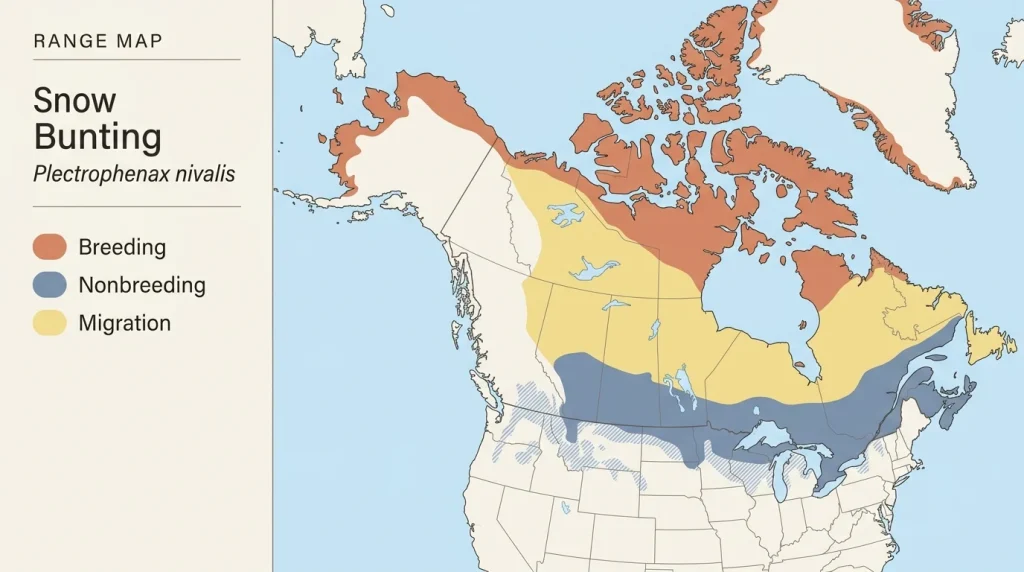
The Snow Bunting has a circumpolar distribution, breeding across Arctic regions of North America, Europe, and Asia. In North America, breeding areas include northern and western Alaska, the Canadian Arctic Archipelago, the northern mainland of Canada, and Greenland. Nesting distribution is closely associated with rocky, treeless terrain.
During fall and winter, migrants spread south through most of Canada and into the United States. They are most regular across Alaska, southern Canada, the Great Lakes, New England, the northern Great Plains, and parts of the interior West. Flocks sometimes reach farther south, especially during severe weather or years with broad movements, but reports well beyond the normal winter range require careful documentation.
Migration timing varies with latitude, weather, snow cover, and sex. Males often return to Arctic territories early, sometimes while the breeding grounds remain deeply frozen.
Habitat
Breeding Snow Buntings inhabit open Arctic tundra where broken rock, talus, cliffs, buildings, or other cavities provide protected nest sites. They tend to avoid tall, dense vegetation. Coastal headlands and rocky slopes are often suitable, as are human structures in remote northern settlements.
Winter habitat is similarly open. Productive locations include harvested grain fields, weedy field edges, short-grass plains, dunes, beaches, airport margins, gravel pits, lake shores, and sparsely vegetated roadsides. Bare patches exposed by wind are especially attractive because seeds are easier to reach there.
Behavior
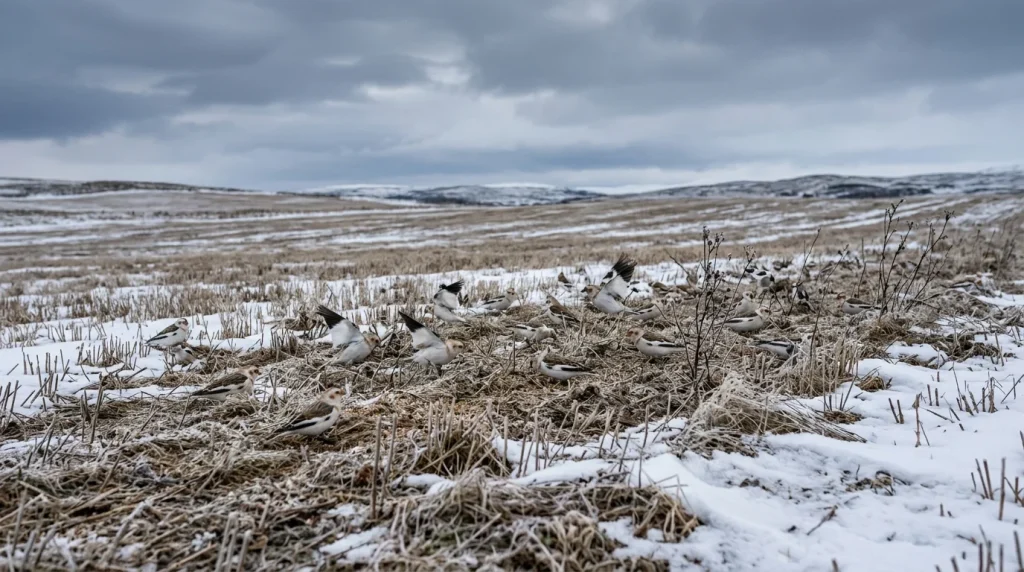
Outside the breeding season, Snow Buntings are strongly social. Flocks may contain a few birds or several hundred. Feeding groups move rapidly across the ground, with rear birds repeatedly flying over the flock and landing near the front. This rolling movement can make the entire group seem to flow across a field.
When alarmed, a flock often rises almost simultaneously and wheels in coordinated turns. Alternating views of white underparts and dark upperwing details create a flickering effect. Flight is quick and somewhat undulating, powered by pointed wings.
On the ground, Snow Buntings walk and run more often than they hop. They tolerate severe cold by seeking sheltered microsites, fluffing their feathers, and feeding efficiently whenever conditions permit. Their tameness varies; roadside birds may allow a close view from a vehicle but flush when approached on foot.
Diet and Hunting
Snow Buntings are primarily seed eaters outside the breeding season. They eat seeds from grasses, sedges, rushes, and low weeds, as well as spilled grain when available. They pick food from the ground and low plants, sometimes scratching lightly or reaching into shallow snow.
Although “hunting” is not the best description of most of their feeding, Snow Buntings take insects and other small invertebrates during the warmer months. Flies, beetles, caterpillars, spiders, and related prey provide important protein for growing nestlings. Adults may capture prey from the ground, vegetation, or occasionally during short aerial movements.

Vocalizations
The most commonly noticed calls are clear, musical notes given in flight, sometimes mixed with dry buzzes or rattling sounds. A passing flock can produce a loose chorus of soft whistles that helps observers detect birds before they are visible.
The male’s breeding song is a bright series of warbles, whistles, and trills. It may be delivered from a rock, building, or during a short display flight. Calls vary with context, and written renderings are imperfect, so learning from recordings is more dependable than relying on a single phonetic phrase.
Breeding and Nesting
Male Snow Buntings arrive early on the breeding grounds and establish territories around suitable cavities. A nest is normally hidden deep within a rock crevice, cliff opening, stone pile, or gap in a human structure. Such sites offer protection from wind and predators, although they may remain exceptionally cold.
The female builds a cup of grasses, rootlets, moss, and other plant fibers, usually adding a warm lining of feathers, fur, or fine material. Clutches often contain four to six eggs, although the number varies. Eggs are pale bluish, greenish, or whitish and carry brown or reddish markings.
The female performs most or all incubation while the male regularly brings food. Incubation lasts roughly two weeks. Both parents feed the nestlings after hatching, delivering concentrated mouthfuls of insects to the concealed nest.

Young and Development
Snow Bunting chicks hatch helpless, sparsely covered with down, and dependent on their parents for warmth and food. Their rapid growth is essential in the short Arctic summer. Nestlings generally leave the cavity after about two weeks, although development and fledging dates vary with weather and food.
Recently fledged young have muted gray-brown plumage and less crisp contrast than adults. Their wing pattern is still useful, but inexperienced birds can resemble longspurs at a distance. Families may remain together briefly before joining larger post-breeding groups. Juveniles molt into a warmer, buff-edged plumage before autumn migration.
Where to See
For most North American observers, winter provides the best opportunity. Search broad, open landscapes after cold fronts or fresh snowfall, concentrating on wind-scoured patches where grass and weed seeds remain exposed. Coastal beaches, agricultural plains, frozen-lake margins, and lightly traveled rural roads can all produce sightings.
Scan first with binoculars from a safe pullout rather than walking directly toward a flock. Watch for small pale birds rising from a seemingly empty field and listen for soft flight calls. A spotting scope is helpful because feeding groups often remain far from roads.
In the breeding range, look around rocky tundra, coastal settlements, and talus slopes. Avoid approaching apparent nest crevices: repeated disturbance can expose eggs or chicks to cold and may reveal the site to predators.
Similar Species
Lapland Longspur: This frequent winter companion is browner overall, with a more obviously streaked back, less white in the wings, and a darker facial pattern. In mixed flocks, concentrate on individual birds rather than identifying the whole group by flock behavior.
Horned Lark: Horned Larks have sandy-brown upperparts, dark facial markings, and a black breast band. Their white outer tail feathers contrast with the Snow Bunting’s broad white wing panels. Horned Larks also have a longer body and a more horizontal stance.
McKay’s Bunting: This close relative is normally associated with western Alaska and the Bering Sea region. It has more extensive white and less black in the back and wings, particularly in males. Hybrids and intermediate-looking birds occur, so identification outside the expected range should be conservative.
Leucistic sparrows or larks: Abnormally pale individuals may suggest a Snow Bunting, but they generally lack its symmetrical black-and-white wing pattern and characteristic flocking behavior.
Conservation
The Snow Bunting is commonly classified as Least Concern globally, reflecting its enormous circumpolar range. That category does not mean populations are free from pressure. Monitoring is difficult because breeding areas are remote and winter flocks move widely.
Climate change is a significant long-term concern. Altered snow conditions, vegetation growth, prey timing, and competition for nest cavities could affect breeding success and habitat suitability. Other potential pressures include pesticide exposure, collisions, disturbance near nests, and vehicle strikes where flocks feed along roads.
Observers can help by submitting well-documented sightings to community-science programs, keeping away from nests, and avoiding playback around territorial birds. Land management that retains weedy field margins and diverse open habitats may also support winter food supplies.
Field Identification Tips
- Start with the wings: Look for broad, symmetrical white panels contrasting with dark tips and other black areas.
- Expect seasonal color: Winter Snow Buntings often look rusty and buff rather than pure white.
- Study the flock: Rapid turns can expose the diagnostic wing pattern more clearly than a distant perched view.
- Check the ground behavior: Snow Buntings typically walk and run across open surfaces while gathering seeds.
- Use habitat and season carefully: An open winter field in the north supports the identification, but neither location nor weather proves it.
- Photograph unusual records: Images of the spread wing, back, and tail are especially useful for separating Snow Bunting from McKay’s Bunting or unusually pale songbirds.
Frequently Asked Questions
Do Snow Buntings turn white for winter?
No. They are often cleanest and whitest near the breeding season. Fresh fall feathers have rusty or buff edges that gradually wear away, revealing a sharper black-and-white pattern by spring.
Are Snow Buntings sparrows?
They are sparrow-like songbirds, but current taxonomy places them in Calcariidae with longspurs and McKay’s Bunting, not in the New World sparrow family Passerellidae.
Why are they called “snowflakes”?
The traditional nickname refers to the way a flock’s flashing white wings can resemble blowing or swirling snow.
Do Snow Buntings remain in the Arctic all year?
Some populations make relatively limited movements, but many North American birds migrate well south of their breeding grounds for winter. Distribution varies annually with conditions and food.
Should feeders attract Snow Buntings?
They rarely behave like typical backyard feeder birds. Ground-level seed in open rural settings may attract them, but natural fields, beaches, and roadsides are generally more productive places to search.