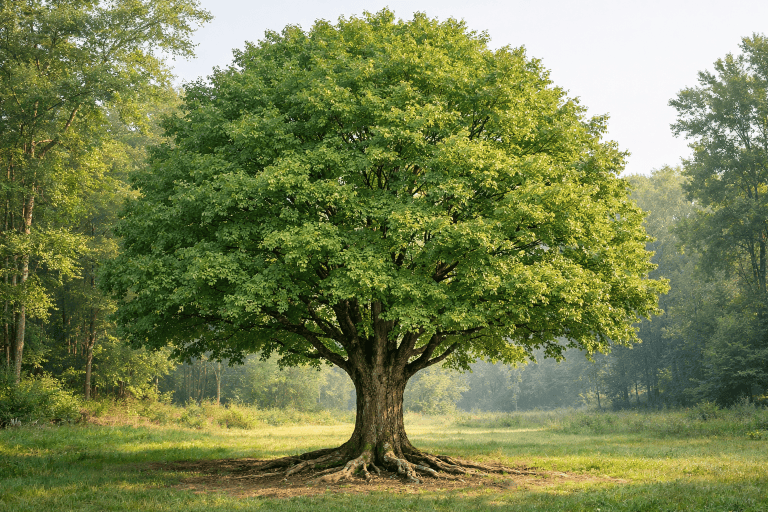
Silver Maple Tree Guide
Keep Track of What You See
Create a free Wild Things Guide membership to record this Silver Maple Tree in My Sightings and build your personal wildlife list.
Join to Add This SightingThe silver maple (Acer saccharinum) is a large, fast-growing deciduous tree native to eastern and central North America. It is especially at home along rivers and streambanks, but it also appears in swamps, parks, old farmsteads, and established neighborhoods. Its speed of growth made it a popular shade tree, so walkers may encounter it in both natural floodplains and human-planted landscapes.
The easiest identification clue arrives on a breezy day. Silver maple leaves have green upper surfaces and distinctly pale undersides. Long, flexible leaf stalks allow the blades to twist in the wind, making the crown appear to flash or shimmer silver. Deeply cut lobes, opposite branching, spring-ripening winged seeds, and shaggy mature bark help confirm the identification.
Quick field checklist
- A large tree with a broad, irregular, often open crown
- Leaves and branches arranged in opposite pairs
- Five deeply divided, sharply toothed leaf lobes
- Silvery-white leaf undersides visible in the wind
- Mature bark separating into long, loose strips
- Frequent association with rivers, wetlands, and moist low ground
Best beginner’s clue: look for a maple beside water whose deeply cut leaves flicker pale silver whenever a breeze passes through the crown.
Appearance and Growth Form
Mature silver maples commonly stand 50 to 80 feet tall, although exceptional trees can grow taller in favorable bottomland soils. Young specimens tend to have an upright or oval outline. With age, the crown expands into a broad, irregular structure supported by long, arching limbs. Fine branchlets may droop near their tips, giving the outer canopy a delicate appearance despite the tree’s substantial size.
Rapid growth comes with a trade-off: the wood is relatively weak. Older trees frequently show broken limbs, cavities, multiple trunks, or an uneven crown shaped by storms. A low fork may support several large leaders, each carrying considerable weight. These features can give an old silver maple tremendous character, but they also explain why arborists monitor mature specimens near homes, paths, and roads.
When viewing the tree from a distance, study the entire silhouette. Look for an airy canopy rather than the dense, evenly rounded crown typical of some other maples. Long branches often spread widely before curving upward, while smaller twigs hang or sway conspicuously at their ends.
Leaves: The Silver Maple’s Best Field Mark
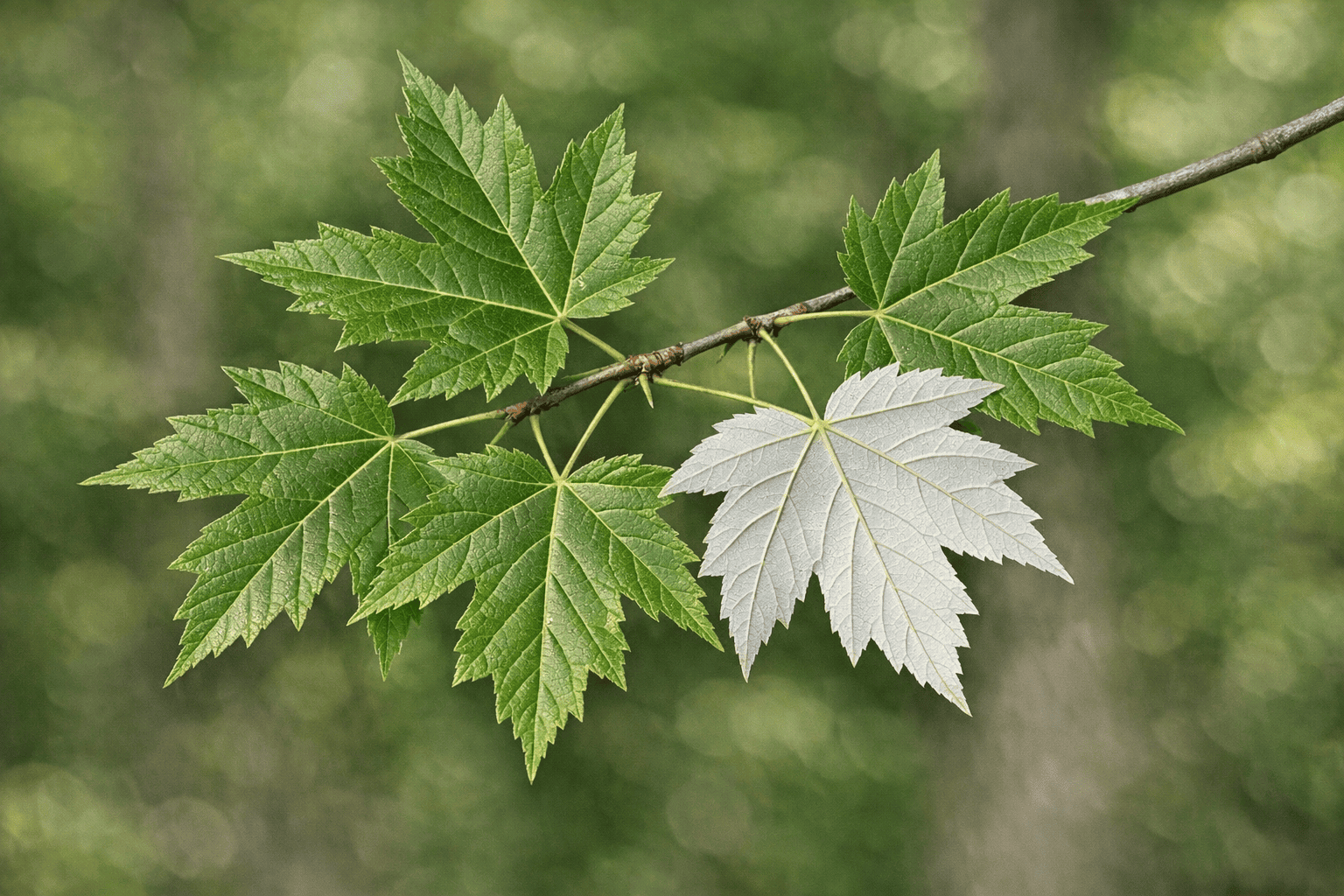
Deep V-shaped sinuses and pale undersides make silver maple leaves distinctive.
Silver maple leaves are simple, opposite, and usually 3 to 6 inches across. Most have five long, narrow lobes separated by deep V-shaped sinuses—the spaces cut into the blade between adjacent lobes. The margins carry numerous sharp, irregular teeth, and the central lobe is often notably elongated.
The upper surface ranges from light to medium green. Beneath it, the leaf is pale green, whitish, or silvery. Because each blade sits on a long, flexible stalk, even a light wind can turn the foliage and expose those bright undersides. Seen across a full crown, the effect resembles rippling light on water.
Leaf comparisons
Red maple leaves generally have shallower divisions and less dramatically pale undersides. For a closer comparison, consult the Red Maple Tree Guide. Sugar maple leaves typically have smoother margins and broad, rounded U-shaped sinuses rather than narrow, deeply cut gaps; the Sugar Maple Tree Guide illustrates those differences.
Autumn color is variable but usually modest. Most silver maples turn pale yellow, golden yellow, or yellow-brown. Some individuals develop orange or muted red patches, but the species rarely produces the consistently intense display associated with sugar or red maple.
Bark, Twigs, and Buds
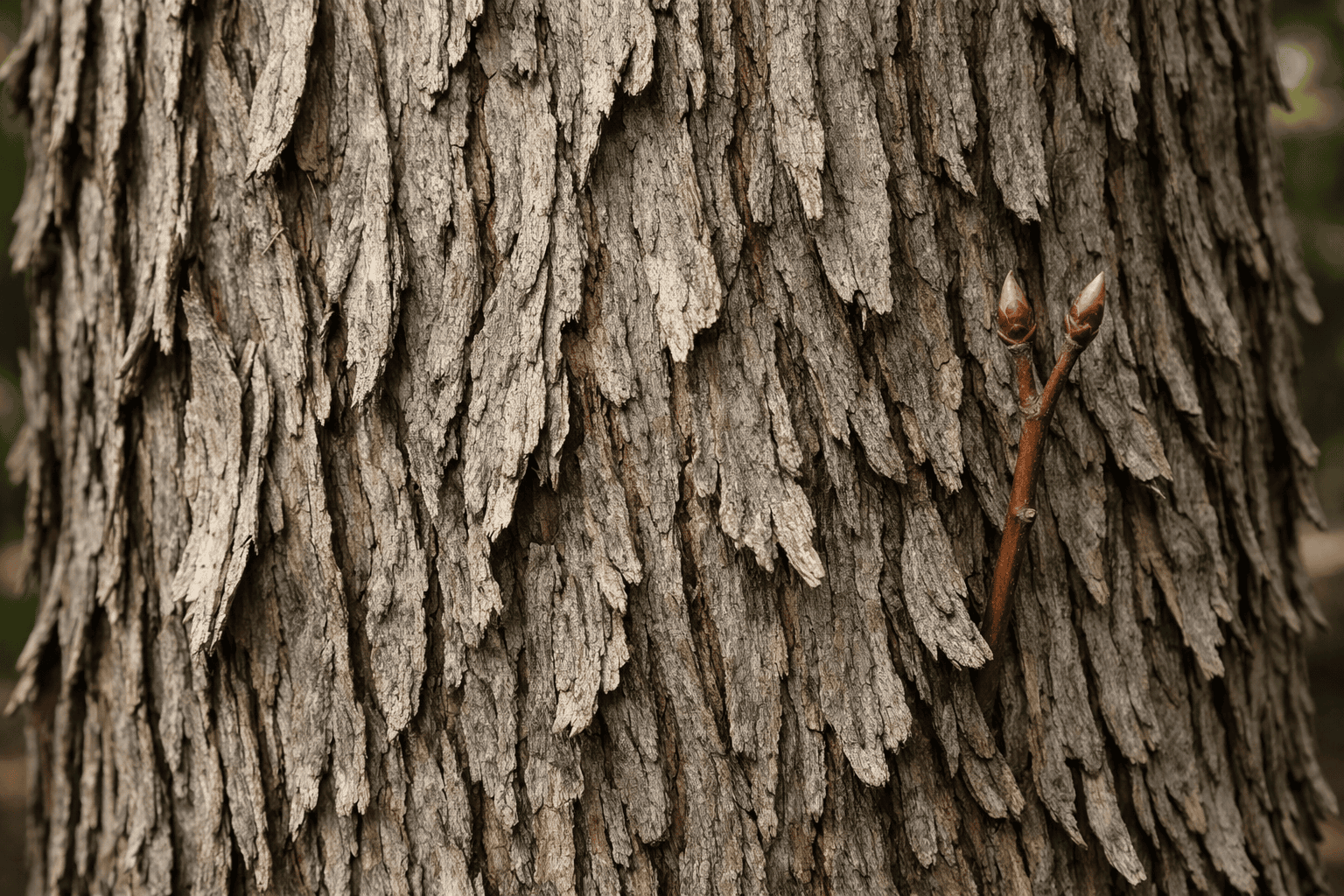
On mature trees, narrow bark plates loosen and curl away from the trunk.
Young silver maple bark is smooth and gray. As the trunk expands, it darkens to gray-brown and splits into long, narrow plates. These strips become loosely attached and may curl outward at the ends, creating the shaggy, irregular surface characteristic of mature trees.
Twigs are slender and commonly reddish-brown. Crushing a fallen twig may release an unpleasant odor, though there is no need to break living growth for identification. Buds and side branches occur in opposite pairs, an essential maple trait. Flower buds tend to be small and rounded, while leaf buds are more pointed.
On tall trees, binoculars offer a safe way to study buds and upper branches from the ground. Avoid climbing or pulling down limbs. Bark should also be treated as supporting evidence rather than a stand-alone test: mature red maples and several unrelated hardwoods can develop somewhat similar rough textures.
Flowers and Winged Fruit

Silver maples produce paired winged samaras—not acorns—and release them in spring.
Silver maple is among the first trees to show signs of spring. Small red, greenish, or yellowish flowers open in dense clusters during late winter or very early spring, usually well before leaves unfold. Their appearance may be subtle from a distance, but a flowering crown can take on a reddish haze.
Despite a common mix-up, silver maples do not produce acorns. Acorns belong to oaks, such as the white oak. Maple fruits are called samaras: paired seeds equipped with papery wings. Silver maple samaras are relatively large, with two spreading wings and swollen seed cases.
Unlike many maples whose fruit remains visible into autumn, silver maple samaras mature and fall in spring. As they descend, the wings rotate, slowing the fall and allowing the wind to carry the seeds away. Floodwater can transport them even farther through river corridors. After a productive season, pale green or tan samaras may blanket lawns, shorelines, and trails—an excellent clue when the tree itself is difficult to examine.
Range, Habitat, and Wildlife Connections
The native range extends broadly across eastern and central North America, from portions of southern Canada through much of the eastern United States and westward along major river systems. Widespread planting has carried the species beyond its original range and into many cities and towns.
In natural settings, silver maple is strongly associated with floodplains, riverbanks, stream edges, swamps, and bottomland forests. It tolerates periodic flooding and establishes rapidly in moist, disturbed sediment. A large maple growing on low ground beside moving water deserves a closer look, although habitat alone never proves identity.
Birds, mammals, and insects
Silver maples provide more than shade. Old trunks often develop hollows that can shelter cavity-nesting wildlife, including wood ducks where suitable wetlands occur. Baltimore orioles and warbling vireos forage or nest among the branches, while woodpeckers inspect bark and decaying wood for insects. Readers interested in a colorful canopy visitor can explore the Baltimore Oriole Guide.
- Mammals: gray squirrels, fox squirrels, and eastern chipmunks consume seeds or buds; beavers cut stems and use bark; white-tailed deer browse young growth.
- Moths: silver maple can host caterpillars of rosy maple, imperial, polyphemus, and maple spanworm moths.
- Butterflies and other insects: several hairstreak caterpillars use maples, while numerous beetles and other invertebrates inhabit bark, foliage, and decaying wood.
- Early-season visitors: flowers can provide pollen resources to insects emerging when relatively few woody plants are blooming.
The impressive Polyphemus Moth Guide provides more detail on a large native moth associated with maple and other broadleaf trees.
Similar Species and How to Tell Them Apart
Red maple
Red maple usually has shallower leaf sinuses, smaller samaras, and less silvery leaf undersides. Its fall color is often brighter red, though color varies. Red maple fruit also ripens in spring, so fruit timing alone does not separate the two.
Sugar maple
Sugar maple leaves have smoother edges and rounded U-shaped sinuses. The crown is generally denser, the wood is harder, and autumn foliage frequently becomes vivid orange, yellow, or red.
Freeman maple
Freeman maple is a hybrid of silver and red maple that occurs naturally and is widely planted. It may combine rapid growth and deeply lobed leaves with stronger red fall color. Intermediate specimens can be genuinely difficult to identify without examining several features.
Norway maple
Norway maple has broader, less deeply divided leaves without a strongly silver underside. Its broken leaf stalk commonly releases milky sap, whereas silver maple sap is clear. Norway maple also lacks silver maple’s close natural association with floodplains.
Reliable identification is a process of convergence. Combine leaf shape, opposite branching, pale undersides, spring fruit, bark, habitat, and overall form. Any single trait may vary, but several matching clues make the conclusion much stronger.
Seasonal Identification Throughout the Year
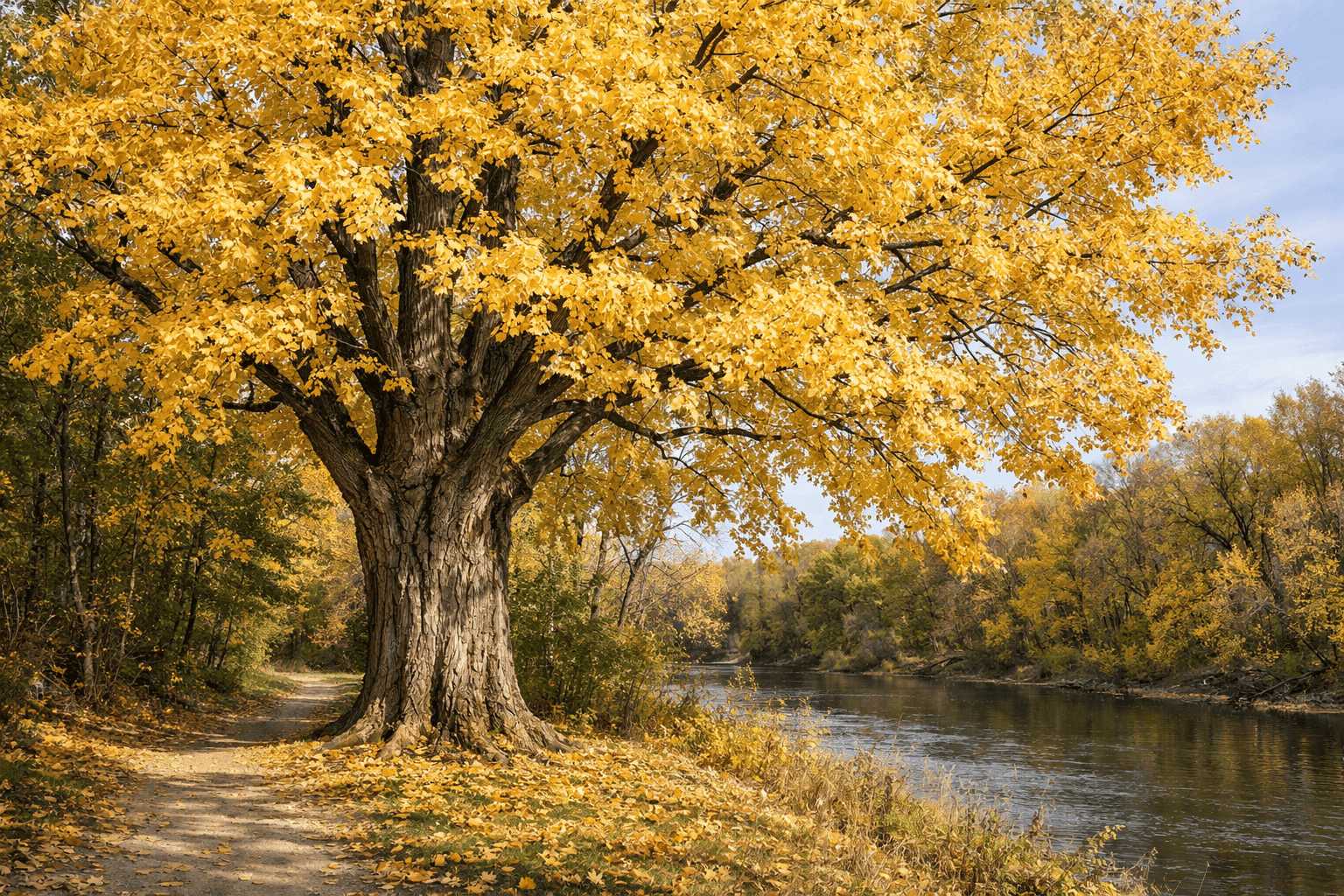
Silver maple fall color is usually yellow or yellow-brown rather than brilliant scarlet.
- Late winter and early spring: watch for clustered flowers opening on bare twigs, followed by conspicuous paired samaras before the crown is fully leafed out.
- Summer: look for five deeply cut lobes and the silver flicker produced when wind turns the pale leaf undersides toward you.
- Autumn: expect pale yellow, gold, or yellow-brown foliage, sometimes with subdued orange or red tones.
- Winter: rely on opposite twigs and buds, a broad irregular crown, reddish-brown branchlets, and shaggy bark on mature trunks.
One of the best ways to learn this tree is to revisit the same individual throughout the year. Photograph it from a consistent location and record flowering, seed fall, canopy development, autumn color, and winter structure. Seasonal repetition turns separate clues into a memorable whole.
Human Uses, History, Conservation, and Threats
Silver maple was historically planted where people wanted shade quickly. It became common along town streets, in parks, around farms, and near homesteads. Its growth rate remains appealing, but modern planting decisions must account for its eventual size, shallow roots, and vulnerability to limb failure.
The wood is softer and less durable than hard maple. It has nevertheless been used for furniture components, boxes, pulp, and other products where exceptional hardness is unnecessary. The sap can also be boiled into syrup, but it generally contains less sugar than sugar maple sap, and the tree’s early bud break shortens the useful tapping season.
Ecologically, the species helps occupy and stabilize flood-prone ground. Large trees create cavities, shade waterways, contribute woody material, and add vertical structure to bottomland forests. Standing dead portions may remain valuable habitat when they do not present an unacceptable safety risk.
Common concerns include storm breakage, internal decay, anthracnose, verticillium wilt, and drought stress. Asian longhorned beetle, an invasive insect that attacks maples, represents a serious potential threat where infestations occur. Altered flooding patterns can also change regeneration conditions. Conservation should therefore include healthy river systems, diverse age classes, and careful assessment before removing old cavity-bearing trees.
Interesting Silver Maple Facts and FAQ
The scientific name saccharinum refers to sugar, even though this species is not the principal commercial source of maple syrup. Its roots are vigorous and often shallow, helping the tree exploit moist surface soils but also making placement near pavement, foundations, drains, and underground infrastructure problematic.
Why does a silver maple look silver in the wind?
The underside of each leaf is much paler than the upper surface. Long, flexible stalks let the blades twist in moving air, repeatedly revealing those whitish undersides and producing a shimmering effect across the crown.
Are silver maple seeds poisonous?
The samaras are primarily known as wildlife food, and they are not acorns. People should not eat unidentified or unverified wild plant material, however. Anyone considering culinary use should seek guidance from a qualified local expert and account for contamination, allergies, and individual health concerns.
Is silver maple a good yard tree?
It can provide rapid shade, wildlife value, and good performance in wet soil. Against those benefits, homeowners must weigh its large mature size, surface roots, relatively weak branches, and need for regular professional assessment. It is best suited to spacious sites well away from structures, utilities, pavement, and heavily used gathering areas.
How quickly does silver maple grow?
It is among the faster-growing native maples, especially in moist, fertile soil. Growth varies with climate and site conditions, but young trees may add substantial height each year. Fast extension also contributes to the species’ comparatively weak branch unions and wood.
Conclusion: Build an Identification from Several Clues
Silver maple is easiest to recognize when you assemble a complete field picture: a large, open-crowned maple on moist ground; opposite branches; deeply cut, toothed leaves; silvery undersides; shaggy mature bark; and large paired samaras that fall in spring. No single feature is infallible, especially where hybrid Freeman maples are planted, but the combination is distinctive.
Observe from public paths or permitted areas, avoid stripping bark or breaking twigs, and give cavities and active nests plenty of space. A few notes and photographs taken in different seasons will teach you more than a one-time inspection.
Take This Silver Maple Guide on Your Next Walk
Look for deeply cut leaves, flashing silver undersides, spring samaras, shaggy bark, and a waterside habitat—then record your observations without damaging the tree or disturbing wildlife.