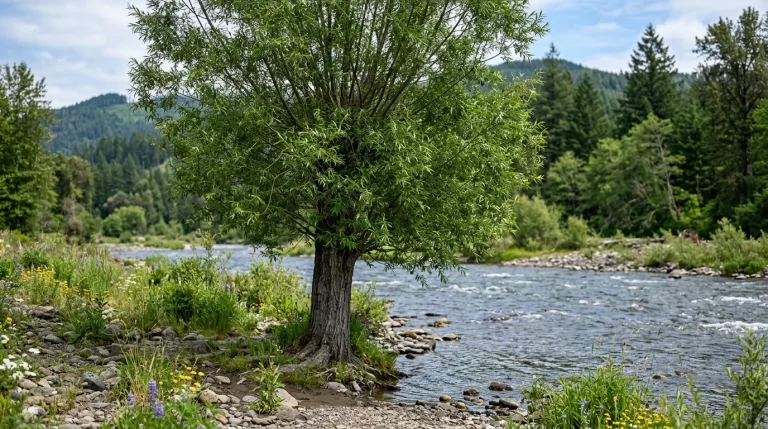
Scouler’s Willow Guide
Keep Track of What You See
Create a free Wild Things Guide membership to record this Scouler’s Willow in My Sightings and build your personal wildlife list.
Join to Add This SightingTree Name
Scouler’s willow (Salix scouleriaScouler’sdeciduous shrub or small tree native to western North America. It belongs to the willow family, Salicaceae, which also includes cottonwoods and aspens. Sometimes called upland willow, it is especially useful to recognize because it often grows away from the wet ground people associate with willows.
Look for it along forest roads, in recovering burns, at woodland edges, and on open mountain slopes. Broad leaves that widen toward their tips, pale hairy undersides, and stout twigs provide a useful starting point. Identification is strongest when several features agree; an isolated leaf is rarely enough for a confident willow identification.

Quick Identification
- Form: An upright, often multistemmed shrub or small tree, commonly about 20–40 feet (6–12 m) tall where conditions favor tree growth; much shorter on exposed sites.
- Leaves: Alternate, simple, usually 1–4 inches (3–10 cm) long, often broadest above the middle and narrowing toward the base.
- Leaf surfaces: Mature upper surfaces generally dark green; undersides pale, with grayish to rusty hairs, particularly along veins.
- Twigs and buds: Relatively stout twigs; each winter bud covered by a single caplike scale.
- Flowers: Fuzzy catkins appear before the leaves or as they begin unfolding.
- Setting: Common in disturbed upland forests as well as some moist margins and streamside habitats.
The most helpful combination is a broad, often reverse-egg-shaped leaf, rusty hairs beneath, and an upland setting. None of these features alone is exclusive to this species.
Appearance
Scouler’s willow ranges from a low thicket to a substantial small tree. Open-grown specimens develop an irregular, broadly rounded crown; crowded trees tend to be narrower and more upright. Mature tree-form plants may spread roughly 15–30 feet (4.5–9 m), although repeated cutting, browsing, or stem replacement can produce quite different outlines. Exceptional trees grow taller than the usual range.
Leaves are typically elliptic to obovate—meaning egg-shaped with the wider end toward the tip. Tips may be rounded or shortly pointed. Margins are often nearly smooth but can have small, irregular teeth. Short leaf stalks attach alternately along the twig.
Young foliage can be conspicuously hairy. As leaves mature, upper surfaces usually lose much of that hair, while the undersides remain paler. Rust-colored hairs beneath are especially helpful, but their density varies. Examine several fully expanded leaves from ordinary branches: vigorous sprouts often carry unusually large or atypically shaped foliage.

Bark, Twigs, and Buds
Young stems have relatively smooth gray to gray-brown bark. Older trunks become rougher, developing shallow fissures and irregular ridges. Bark alone is not a dependable species-level clue, but the contrast between smooth younger stems and furrowed older trunks helps explain the different appearances of shrubs and mature trees.
New shoots are often hairy; older twigs become smoother and brownish to reddish-brown. Buds sit alternately along the stem and have the single outer scale characteristic of willows. Flower buds are generally plumper than leaf buds.
In winter, look for a combination of stout twigs, alternate buds, and persistent older catkin or capsule remains, if present. Avoid stripping bark or snapping branches to test identification. A hand lens and clear photographs usually provide more useful information with less damage.

Range and Habitat
Scouler’s willow occurs from Alaska to western Canada and much of the western United States, extending south into California and the mountains of the Southwest. Its range includes both Pacific mountain systems and the Rocky Mountains. Local occurrence is uneven, especially toward dry southern limits, where elevation and available moisture strongly influence its distribution.
Unlike many familiar willows, it is not confined to streambanks. It occupies forest openings, roadsides, logged areas, burns, rocky slopes, and other disturbed ground, as well as moist woods and riparian margins. In wetter coastal regions, it may occur near sea level; farther inland and southward, mountain habitats become increasingly important.
Its tolerance of upland conditions does not mean seedlings establish readily in severe drought. Open, moist seedbeds help establishment. The U.S. Forest Service’s Fire Effects Information Service’s account of Scouler’s willow provides detailed information on its habitat, regeneration, and response to disturbance.

Flowers, Fruit, Nuts, or Cones
Scouler’s willow produces catkins and shows no showy petaled flowers. Male and female flowers normally occur on separate plants. Before flowering, the dense hairs surrounding developing flowers give catkins their familiar soft, silvery appearance.
Male catkins become more conspicuous as pollen-bearing anthers emerge. Female catkins contain small ovaries that later develop into capsules. Flowering usually precedes leaf expansion, although timing shifts with elevation, latitude, and spring weather. Calendar dates are therefore less useful than watching the local sequence of bud break.
Female plants release tiny seeds furnished with cottony hairs. These travel on air currents and may also move with water. Fresh seed generally has a short opportunity to reach a suitable seedbed, making exposed, moist ground important. The fruits are capsules—not nuts, berries, or cones—and male plants do not produce the floating seed fluff.

Wildlife Connections
Early catkins provide pollen and nectar for insects active during spring, including bees and flies. Willow foliage supports numerous plant-eating insects, including caterpillars; those insects in turn become food for birds. Dense stems can offer cover and potential nesting sites, particularly where willow grows among other shrubs.
Moose, elk, deer, and other browsing mammals eat willow shoots and foliage, with use varying by region and season. Repeated browsing can keep Scouler’s willow low and dense. Scouler’s Beavers may use it where plants grow within reach of water. However, many upland stands are outside typical beaver foraging areas.
A ragged leaf edge or chewed shoot is not automatically a sign of poor health. Some feeding is part of the tree’s ecological role.
Seasonal Identification
Spring: Look for fuzzy catkins on still-bare branches. Record whether a plant has male or female flowers, and return after leaves mature. Catkins confirm you are looking at a willow, but they usually don’t settle the species without closer examination.
Summer: This is generally the easiest season for identification. Compare several leaves for their wider outer half, tapered base, pale underside, and rusty hairs. Include twig thickness and habitat in your assessment.
Autumn: Leaves usually turn yellow, sometimes unevenly, before falling. Fall color is attractive but not distinctive enough to identify the species.
Winter: Growth form, bark, and single-scaled buds remain available. Identification without leaves or flowers is harder; marking the location for a spring visit is often best.

Human Uses and History
The species name honors John Scouler, a Scottish naturalist who collected plants in western North America during the nineteenth century. Indigenous peoples knew and used regional willows long before that botanical naming. Documented uses of western willows include basketry, ties, implements, and medicines, but practices differ among communities and should not be assigned indiscriminately to every willow species.
Willow bark contains salicylate-related compounds, but this is not a recommendation for homemade medicine. Strength varies, and adverse reactions and drug interactions are possible.
Today, Scouler’s willow can be useful in native habitat restoration and revegetation of disturbed forest land. Choose locally appropriate material and allow space for multiple stems. Do not assume it roots from cuttings as readily as streamside willows; propagation success depends on the species and method.
Conservation and Threats
Scouler’s willow is widespread and is not generally regarded as globally threatened. Nevertheless, individual stands can be affected by clearing, repeated heavy browsing, drought, altered disturbance patterns, and competition as forest canopies close.
It commonly recovers after top damage by sprouting from surviving basal tissues. This helps it occupy disturbed sites, but severe fire or repeated injury can still kill plants. Cankers, rusts, leaf spots, and boring insects may occur; their significance depends on the organism, severity, and overall plant condition.
For stewardship, retain healthy native stands where practical, protect establishing plants from excessive browsing, and avoid herbicide drift. A diverse patch with different stem ages usually provides more habitat structure than uniformly cutting every plant at once.
Similar Species
- Sitka willow (Salix sitchensis): Often has strikingly silky, silvery leaf undersides with hairs lying close to the surface. It commonly occupies moist sites. Scouler’s often shows more rusty hairs and is frequently encountered on uplands, but overlap is substantial.
- Bebb’s willow (Salix bebbiana): May have broad leaves with pale hairy undersides. Its upper leaf surface often looks more wrinkled or strongly veined. Mature female catkins and a regional botanical key can help separate difficult plants.
- Hooker’s willow (Salix hookeriana): A coastal look-alike with broad leaves, often conspicuously woolly beneath. Coastal wetlands and dune-associated habitats favor Hooker’s, but habitat is supporting evidence, not proof.
Willows vary considerably, and hybridization can blur boundaries where compatible species meet. For an uncertain specimen, photograph both leaf surfaces, twig buds, catkins, and the whole plant. You may need a regional flora or herbarium specialist.

Interesting Facts
- Its frequent presence on upland slopes challenges the assumption that every willow marks a stream or wetland.
- A large thicket may reflect repeated basal sprouting rather than many independently established trees.
- Rusty leaf hairs are useful identification evidence, but their abundance changes with leaf age and individual variation.
- Rapid early growth helps it occupy openings; increasing shade can later favor other trees.
Frequently Asked Questions
Is Scouler’s willow a tree or a shrub?
Both forms occur. Favorable sites can support a small tree, while exposure, browsing, and repeated damage often maintain a multistemmed shrub.
Does it need constantly wet soil?
No. Established plants can occupy comparatively dry uplands, though young plants benefit from dependable moisture. It is not a desert tree.
How fast does it grow, and how long does it live?
Young plants and sprouts can grow rapidly with adequate light and moisture. Annual height gain is too dependent on conditions for one reliable figure. It is generally short-lived compared with neighboring conifers, often persisting for decades; sprouts may replace individual stems.
What is the best field clue?
Use the combination of broad leaves widest above the middle, pale undersides with rusty hairs, stout twigs, and suitable western habitat. Confirm with flowers or fruit when similar willows occur nearby.