

Ruddy Duck Guide
Keep Track of What You See
Create a free Wild Things Guide membership to record this Ruddy Duck in My Sightings and build your personal wildlife list.
Join to Add This SightingIntroduction
The Ruddy Duck (Oxyura jamaicensis) is one of North America’s most distinctive and entertaining waterfowl species. Small, stocky, and full of character, this compact diving duck belongs to the stiff-tailed duck subfamily. During the spring breeding season, adult males undergo a striking transformation, showing off a bright sky-blue bill, a deep chestnut-red body, a black cap, and crisp white cheek patches. Their habit of fanning their stiff tail feathers straight up makes them easy to identify even from a distance.
Unlike many duck species that readily take flight when startled, the Ruddy Duck relies on its diving skills to escape danger. Its legs are positioned far back on its body, making it an extraordinary swimmer and diver, though nearly helpless on land. Whether you are scanning prairie wetlands in the summer or coastal bays in the winter, understanding this unique duck’s natural history and identification traits will enrich your birding trips. According to the Cornell Lab of Ornithology, the Ruddy Duck’s unique physical adaptations make it a fascinating subject for both beginner and experienced birdwatchers.

Quick Identification
Recognizing a Ruddy Duck in the field relies on observing its compact shape, tail posture, and facial markings. Here are the main quick-identification features to keep in mind:
- Tail Posture: Often swims with its long, stiff tail feathers cocked vertically, like a tiny fan.
- Body Shape: Very small, thick-necked, and chunky with a wide, scooped bill.
- Breeding Male: Bright blue bill, dark chestnut-red body, black crown, and stark white cheek patch.
- Female & Non-Breeding Male: Dusky brown body, grey bill, and pale cheek divided by a dark horizontal stripe across the face.
- Water Profile: Rides low in the water, frequently diving completely beneath the surface rather than dabbling at the top.
Appearance
The Ruddy Duck’s appearance changes noticeably with season and sex. During the spring and summer breeding months, the adult male is unmistakable. He wears a rich, rusty chestnut coat on his back, sides, and chest. His head has a solid black cap that extends to his eyes, contrasting sharply with bright white cheeks. The most eye-catching feature is his bill, which turns a vibrant, almost artificial-looking turquoise blue.
In the autumn, males molt into a basic, non-breeding plumage. Their bright blue bills fade to dull greyish-black, and their body plumage becomes drab greyish-brown. However, they retain their solid white cheek patches year-round, which helps separate them from females.
Female Ruddy Ducks maintain a more subdued appearance year-round. They are mostly dark brown or greyish-brown with fine dark barring on their sides. The head features a dark brown cap and a pale, off-white cheek patch. Crucially, a dark brown line cuts horizontally across the cheek from the base of the bill to the back of the head. Juvenile ducks closely resemble adult females, showing streaked underparts and a similar dark facial stripe.

Size and Wingspan
The Ruddy Duck is a distinctly small waterfowl species, noticeably smaller than a Mallard and roughly comparable in length to a Green-winged Teal or Bufflehead.
- Length: 14.2 to 17.0 inches (36 to 43 cm)
- Wingspan: 22.0 to 24.4 inches (56 to 62 cm)
- Weight: 1.1 to 1.8 pounds (500 to 800 grams)
Because their wings are relatively short and stubby for their body weight, Ruddy Ducks must patter frantically across the water’s surface to build enough speed to take flight. In flight, their wingbeats are extremely fast and buzzing, giving them a heavy, labored aerial appearance.
Range and Distribution
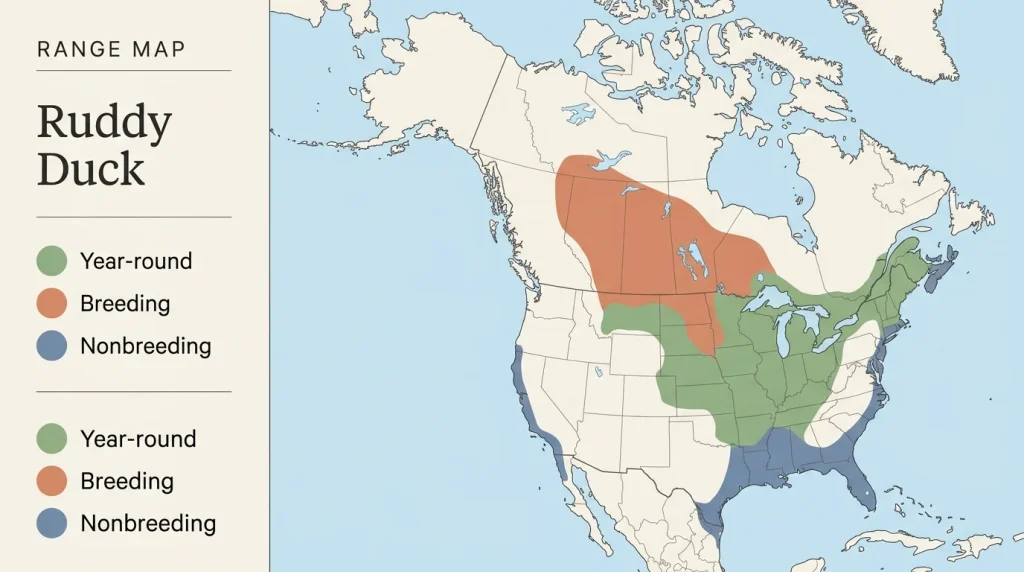
The Ruddy Duck is native to North America, Central America, and parts of the Caribbean, with a wide distribution that shifts seasonally based on ice cover and breeding needs.
During the breeding season, Ruddy Ducks concentrate in the Prairie Pothole region of the northern Great Plains, spanning western Canada and the north-central United States. They also breed in scattered freshwater wetlands across the western US, southwestern Canada, and locally in northern Mexico.
When autumn arrives and northern waters freeze over, Ruddy Ducks migrate to milder climates. Their winter range encompasses the Pacific, Atlantic, and Gulf coasts of North America, as well as inland lakes, reservoirs, and rivers throughout the southern United States, Mexico, and Central America.
People introduced Ruddy Ducks to the United Kingdom in the mid-20th century. From there, they spread into mainland Europe, where their presence raised conservation concerns about hybridization with the endangered native White-headed Duck.
Habitat
The habitat choices of the Ruddy Duck vary depending on whether they are nesting or spending the winter months:
- Breeding Habitat: Shallow, permanent or semi-permanent freshwater marshes, prairie potholes, ponds, and small lakes. They require dense stands of emergent vegetation—such as cattails, bulrushes, and reeds—along the shoreline to anchor their nests and provide shelter.
- Winter Habitat: Larger, open bodies of water including ice-free lakes, coastal lagoons, brackish bays, estuaries, and sewage treatment lagoons. They prefer shallow waters where they can easily dive to the bottom to forage.

Behavior
Ruddy Ducks display several unique behaviors that make them entertaining to watch. Because their legs are positioned far back on their bodies to aid swimming, they walk on land very awkwardly. As a result, they spend almost their entire lives on the water.
When threatened, a Ruddy Duck rarely takes flight. Instead, it prefers to sink slowly into the water like a submarine or execute a sudden, clean dive to swim away underwater. Its dive typically lasts 15 to 30 seconds.
During the spring courtship season, males perform a remarkable display to attract females. A male erects his tail, swells his neck, and rapidly slaps his bill against his inflated chest. This action creates a drumming noise and forces air out from under his feathers, causing the water around his chest to bubble vigorously. He finishes the display with a low belching call while kicking his feet.
Diet
The Ruddy Duck is primarily a benthic feeder, meaning it forages along the muddy bottoms of lakes, ponds, and wetlands. They dive down to shallow lake bottoms and use their broad, scoop-like bills to sift through soft sediment.
- Insect Larvae: Aquatic midge larvae (commonly called bloodworms) make up a large portion of their diet, especially in spring and summer.
- Other Invertebrates: Aquatic insects, crustaceans, amphipods, freshwater snails, and caddisfly larvae.
- Plant Material: Seeds, roots, and vegetative parts of aquatic plants such as pondweeds, sedges, coontail, and muskgrass, particularly in late autumn and winter.

Vocalizations
For most of the year, Ruddy Ducks are exceptionally quiet birds. Unlike Mallards or other dabbling ducks, they rarely produce loud quacks or far-reaching calls.
The primary sound associated with the species is produced by the male during his chest-slapping courtship display. As he strikes his bill against his throat, he generates a rhythmic, mechanical ticking or drumming noise that speeds up toward the end: tick-tick-tick-tick-tock-ptoo. This sound finishes with a short, low-pitched belch or squeak. Females occasionally emit a low, raspy croak or squeak when alarmed or when defending their ducklings.
Breeding and Nesting
Ruddy Ducks begin forming pairs on their wintering grounds or during spring migration. They nest between late spring and mid-summer in dense wetland vegetation.
The female builds a cup-shaped nest from dead cattail stems, bulrushes, and reeds. She weaves the structure into growing marsh plants several inches above the water. She often pulls surrounding living vegetation over the top to form a concealed canopy that hides the nest from aerial predators. A sloping ramp of plant stems lets her slip in and out of the water easily.
The female lays a clutch of 5 to 10 eggs. Remarkably, Ruddy Duck eggs are extraordinarily large relative to the mother’s body size—among the largest relative egg sizes of any waterfowl species. The eggs are dull white with a rough, pebbly texture. Incubation lasts approximately 20 to 26 days and is performed entirely by the female.

Young and Development
Ruddy Duck hatchlings are highly precocial, hatching covered in down and able to swim and dive within hours. The downy ducklings are greyish-brown above, with pale cheeks crossed by a dark line that closely matches the female’s pattern.
While the female guards her brood and leads them to good feeding areas, the ducklings find all their own food right from the start. Ruddy Duck ducklings mature quickly and become independent earlier than those of many other duck species, often wandering off on their own at 3 to 4 weeks of age. Fledging (gaining the ability to fly) takes around 42 to 60 days after hatching.
Where to See
Finding Ruddy Ducks is relatively easy if you visit the right aquatic habitats during the appropriate season:
- Summer (Breeding Season): Visit wetland reserves, wildlife management areas, and prairie potholes across North Dakota, South Dakota, Montana, central Canada, and the Great Basin. Look for shallow lakes surrounded by thick cattails.
- Winter Season: Scan open water bodies in southern states and along both coasts. Top locations include public parks with large lakes, coastal estuaries, and municipal wastewater lagoons. Wastewater ponds are famous among birders for hosting large wintering flocks of Ruddy Ducks.
- Scanning Tip: Look low on the water surface for small brown or chestnut shapes with tails held straight up at a 45- to 90-degree angle.
Similar Species
While a breeding male Ruddy Duck is unmistakable, non-breeding males, females, and juveniles can be confused with a few other species:
- Masked Duck (Nomonyx dominicus): A rare tropical relative found in South Texas and Florida. Both sexes have two dark horizontal stripes across a pale cheek, whereas the female Ruddy Duck has only one dark stripe. The Masked Duck also shows white wing patches in flight.
- Bufflehead (Bucephala albeola): Small diving duck, but the male Bufflehead has a large white patch on the back of his head (not the cheek) and a white body. The female Bufflehead has a small oval white patch behind the eye, not a full pale cheek with a dark line.
- Pied-billed Grebe (Podilymbus podiceps): Similar low-floating posture, but grebes have thin, pointed bills, lack stiff fan-like tail feathers, and have dark heads without broad white cheek patches.
Conservation
The Ruddy Duck is currently listed as Least Concern on the global IUCN Red List. Population estimates indicate that North American numbers are healthy and stable or slightly increasing in some regions.
The main long-term conservation challenge for the Ruddy Duck is the loss and degradation of wetland habitats. Draining agricultural prairie potholes and polluting shallow water bodies directly reduce suitable breeding grounds. Protecting seasonal wetlands and water quality across the Great Plains is vital for maintaining healthy populations.
In Europe, the Ruddy Duck is classified as an invasive alien species. The UK and neighboring countries have implemented control programs to prevent interbreeding with the rare, native White-headed Duck (Oxyura leucocephala).
Field Identification Tips
Keep these handy field rules in mind next time you suspect you have spotted a Ruddy Duck:
- Check the tail first: Is the tail held cocked straight up out of the water?
- Examine the face: Does the bird have a solid white cheek (male) or a light cheek with a distinct dark stripe running through it (female)?
- Observe the profile: Is the bird small, low-riding, and thick-necked with a scooped bill?
- Watch the escape response: Does the bird dive underwater or sink slowly rather than taking off into the air?
Frequently Asked Questions
Why do male Ruddy Ducks have bright blue bills?
Seasonal hormonal changes during the spring breeding season cause the vibrant blue coloration. Blood flow and pigment shifts turn the bill a brilliant sky-blue to attract females. In winter, the bill fades back to dull charcoal grey.
Why do Ruddy Ducks hold their tails straight up?
Holding the tail upright is part of the species’ communication and posture. It signals courtship and territorial displays. It also helps balance their low profile in the water.
Can Ruddy Ducks walk on land?
Ruddy Ducks can move on land, but very poorly. Their legs are set far back on their bodies to maximize paddling efficiency underwater. On land, they waddle awkwardly and often have to push themselves along on their bellies.


