Rosy Maple Moth Guide
Keep Track of What You See
Create a free Wild Things Guide membership to record this Rosy Maple Moth in My Sightings and build your personal wildlife list.
Join to Add This SightingIntroduction
The rosy maple moth (Dryocampa rubicunda) is a small North American silk moth celebrated for its pink-and-yellow coloration. Despite its vivid appearance, it can be surprisingly easy to overlook. Adults fly mainly at night and often spend daylight hours resting beneath leaves, on tree trunks, or near outdoor lights.
This species belongs to the giant silk moth family, Saturniidae, although it is much smaller than familiar relatives such as the luna and cecropia moths. Its caterpillar, called the greenstriped mapleworm, feeds chiefly on maples. Adult moths live briefly, do not feed, and devote their energy to mating and egg-laying.
Quick Identification
- Size: Usually about 1.25–2 inches (3.2–5.1 cm) across the wings; females tend to be larger than males.
- Forewings: Creamy yellow to pale ivory through the middle, bordered by rosy pink at the base and outer portion.
- Hindwings: Primarily yellow, often with a pink outer margin.
- Body: Woolly-looking and generally yellow above, with pink along the underside and legs.
- Antennae: Males have broader, more featherlike antennae; those of females are narrower.
- Posture: At rest, the wings are normally held rooflike over the body rather than spread flat.
Color varies considerably. Some individuals have deep magenta markings, while others are pale pink, cream, or nearly yellow. This variation can alter the proportions of the colored wing bands, but the combination of a fuzzy yellow body and pink-and-yellow wings remains highly characteristic.

Caterpillar Identification
The larva is known as the greenstriped mapleworm. Mature caterpillars are roughly 1.5–2 inches (3.8–5.1 cm) long, although size varies with age. They are usually yellow-green to bright green, with several narrow pale or darker longitudinal lines. The head may be reddish or orange-red.
A pair of prominent dark horns rises from the thorax just behind the head. Rows of shorter dark spines or tubercles occur along the body. These structures make the caterpillar look formidable, but it is not generally regarded as a medically significant stinging caterpillar. Handling any unfamiliar hairy or spiny larva is still best avoided.
Young larvae feed together and may line up along leaf edges. Older caterpillars become less social and can be found individually among maple foliage. Their green striping provides effective camouflage against leaves and veins.

Eggs, Chrysalis, or Cocoon
Females deposit pale eggs in clusters, most often on the undersides of host-tree leaves. The number in a cluster varies, and several groups may be placed on one or more trees. Eggs hatch after roughly one to two weeks under favorable summer conditions, although temperature can change the timing.
Like other moths, this species has a pupa rather than a butterfly-style exposed chrysalis. A full-grown caterpillar leaves the foliage and enters loose soil or leaf litter. There it forms a shallow earthen chamber and pupates. It does not construct the conspicuous silken cocoon associated with many larger silk moths. In northern portions of the range, the pupa is typically the overwintering stage.
Life Cycle
Adults emerge from pupae during warm weather, usually at night. Females release chemical signals that males detect with their sensitive, feathered antennae. After mating, females seek suitable maples or other accepted host trees and place eggs beneath the leaves.
Newly hatched larvae initially feed in groups, skeletonizing or consuming portions of leaves. They pass through several growth stages, shedding their skins as they enlarge. Later-stage caterpillars disperse and consume larger sections of foliage before descending to the ground to pupate.
Generally, one generation occurs per year near the northern edge of the range. Two, and sometimes more, broods may occur in warmer southern areas. Local weather, latitude, and elevation all influence emergence dates. Adults survive only long enough to reproduce because their mouthparts are reduced and nonfunctional.
Range and Distribution
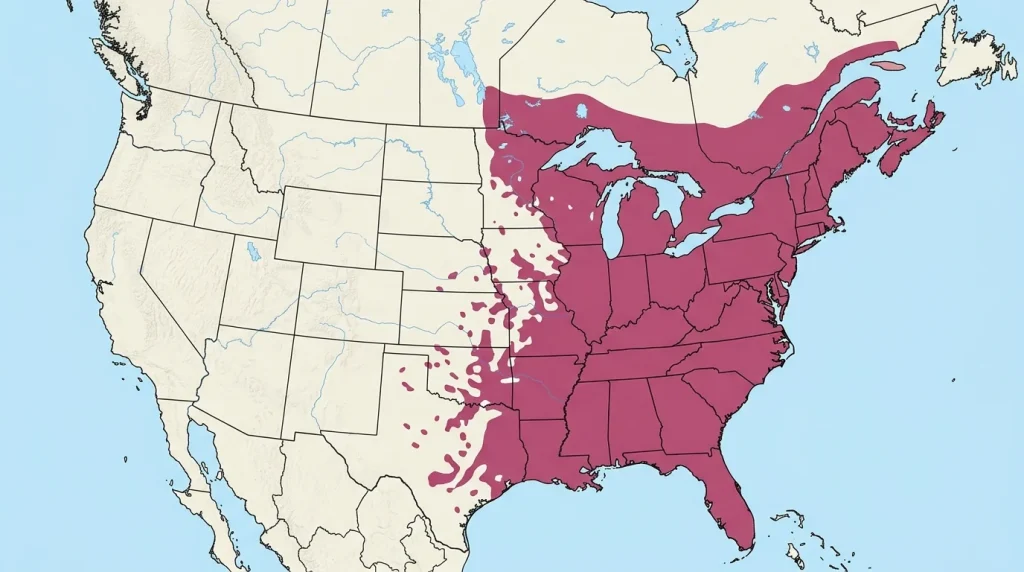
The rosy maple moth is native to eastern North America. Its range extends from parts of southern Canada through much of the eastern United States, reaching Florida and the Gulf Coast. Westward records extend into portions of the Great Plains and eastern Texas, but distribution becomes more scattered near the range margins.
It is most consistently encountered where maples are common. Records from an isolated porch light do not necessarily indicate a large local population, because adults can fly some distance and are strongly attracted to artificial illumination.
Habitat
Rosy maple moths inhabit deciduous and mixed woodlands, forest edges, shaded suburban neighborhoods, parks, and other landscapes containing mature host trees. Moist woods with red maple are especially suitable, but the moth also occurs in upland forests and planted settings with sugar, silver, or other maples.
Adults use the broader landscape rather than a particular flower patch. Suitable habitat includes leafy host-tree canopies for larvae, undisturbed litter or loose soil for pupation, and relatively dark nighttime conditions for adult activity.
Adult food sources
Adult rosy maple moths do not eat or drink. They emerge with energy reserves accumulated during the caterpillar stage and lack functional feeding mouthparts. Consequently, they do not visit flowers for nectar and cannot be attracted with fruit or sugar-water feeders.
The larval host plant is therefore the species’ essential food source. Red maple, sugar maple, and silver maple are commonly used. Caterpillars may also occur on boxelder, which is itself a maple, and they have occasionally been reported from a limited number of other deciduous trees.

When and Where to Look
Look for adults from late spring through summer, with the broadest season in warmer parts of the range. Northern observations are more concentrated around a single summer flight, while southern populations may produce successive broods.
Adults are easiest to detect shortly after dark near woodland edges or maples. They frequently appear at porch lights, illuminated walls, and lighted buildings. During the day, inspect shaded trunks, the undersides of leaves, and vegetation close to lights. Caterpillars are most likely during summer and early fall. Search host foliage for chewed edges, clustered young larvae, or solitary striped caterpillars resting along leaf veins.
Is It Harmful?
The adult is harmless. It does not bite, sting, damage clothing, or infest stored foods. Caterpillars eat maple leaves and can occasionally become abundant enough to cause noticeable defoliation. Healthy, established trees usually replace lost foliage and survive an isolated episode.
Repeated heavy defoliation could stress young, recently planted, or already weakened trees, but routine treatment is rarely justified for a few larvae. Hand removal, where practical, is preferable to broad-spectrum insecticides. The University of Florida Featured Creatures account of the rosy maple moth provides additional identification and biology details.
Conservation and Ecological Importance
The species is widely distributed and is not generally considered globally threatened. NatureServe commonly ranks it as globally secure, and the IUCN Red List has not given it a global assessment. Local abundance can nevertheless change with forest removal, pesticide use, severe weather, and artificial nighttime lighting.
Greenstriped mapleworms convert maple foliage into food for predators and scavengers. Birds, bats, spiders, predatory insects, and small mammals may eat caterpillars and adults. Their role in woodland food webs is more important than their occasional, usually temporary leaf damage suggests.
How to Attract or Support It
- Retain healthy native maples, especially red and sugar maples suited to the local region.
- Allow some leaf litter and loose, unsprayed soil to remain beneath host trees.
- Avoid preventive insecticide treatments and systemic pesticides on maples.
- Reduce unnecessary outdoor lighting, particularly from late spring through summer.
- Use shielded, warm-colored fixtures on timers or motion sensors where lighting is necessary.
- Maintain a layered landscape with native trees, shrubs, and undisturbed woodland edges.
A moth found at a light can usually be left in place. If it is exposed to heavy foot traffic or predators, gently encourage it onto a leaf or container, then move it to sheltered vegetation nearby without rubbing its wings.
Similar Species
Pink-striped oakworm moth: This related saturniid is usually rusty orange, reddish brown, or pinkish, with a pale spot on each forewing. It lacks the rosy maplmoth’s broad yellow-and-pink pattern.
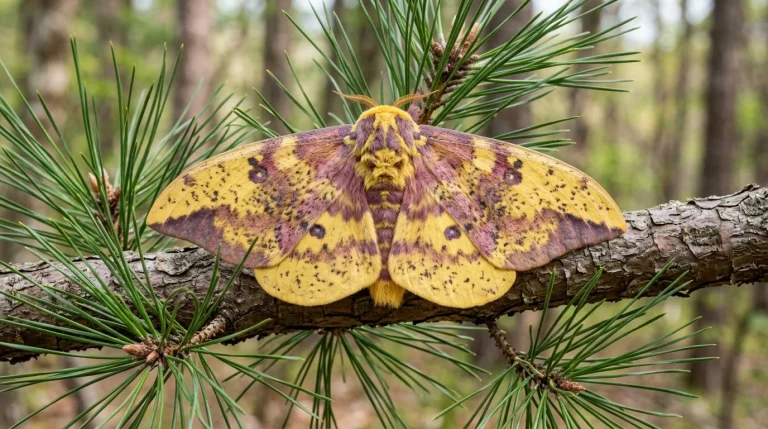
Imperial moth: The imperial moth is substantially larger and has yellow wings marked with irregular purple-brown patches and speckles rather than clean pink bands.
Io moth: A resting io moth can appear mostly yellow or brown, but its opened hindwings reveal large black-and-blue eyespots. Rosy maple moths have no comparable eyespots.
Primrose moth: This smaller pink-and-cream noctuid is often associated with evening primrose flowers. It has a slimmer body, different wing shape, and lacks the rosy maple moth’s plush saturniid appearance.
Interesting Facts
- The bright colors vary from pale blush and cream to saturated rose and yellow.
- Males use broad antennae to detect female pheromones in the night air.
- The green caterpillar and colorful adult look so different that people often mistake them for unrelated species.
- Adults cannot feed, making successful larval growth essential to reproduction.
- Although part of the “giant silk moth” family, this is one of the family’s smaller North American members.
Frequently Asked Questions
Are rosy maple moths rare?
They are not considered globally rare, but they may seem uncommon because adults are nocturnal and short-lived. Their abundance also varies from year to year and between locations.
Do rosy maple moths sting?
Adults cannot sting. Caterpillars have visible spines but are not generally classified among the strongly stinging North American caterpillars. Avoid unnecessary handling.
Why is one sitting near my porch light?
Adults are attracted to artificial light and may remain on a wall or nearby plant after sunrise. Reducing overnight lighting helps prevent exhaustion and exposure to predators.
Will the caterpillars kill my maple tree?
A small number will not. Even substantial one-time defoliation is usually tolerated by a healthy mature maple, although repeated outbreaks can add stress.
Can I keep an adult alive by feeding it?
No food is required or accepted. The best assistance is to place the moth in sheltered outdoor vegetation near suitable habitat and allow it to complete its natural reproductive cycle.