

Ring-necked Duck Field Guide
Keep Track of What You See
Create a free Wild Things Guide membership to record this Ring-necked Duck Field in My Sightings and build your personal wildlife list.
Join to Add This SightingIntroduction
The Ring-necked Duck (Aythya collaris) is a small to medium-sized diving duck native to North America. Despite its name, its chestnut collar is rarely seen in the field. Birdwatchers usually identify this duck by the striking white band around its bill and its distinctive, high-peaked head shape. While classified as a diving duck, it often feeds in shallower freshwater ponds and wooded marshes than other species in its family.
For birders, learning to spot the Ring-necked Duck offers a great lesson in noticing subtle field marks. Its bold black back, bright white side marks, and unique bill patterns make it a favorite sight on northern lakes in summer and southern wetlands in winter. Detailed observations recorded by the Cornell Lab of Ornithology highlight this species’ wide distribution and adaptability across North American freshwater habitats.
Quick Identification
When observing a flock of waterfowl, you can quickly spot a Ring-necked Duck by looking for these key features:
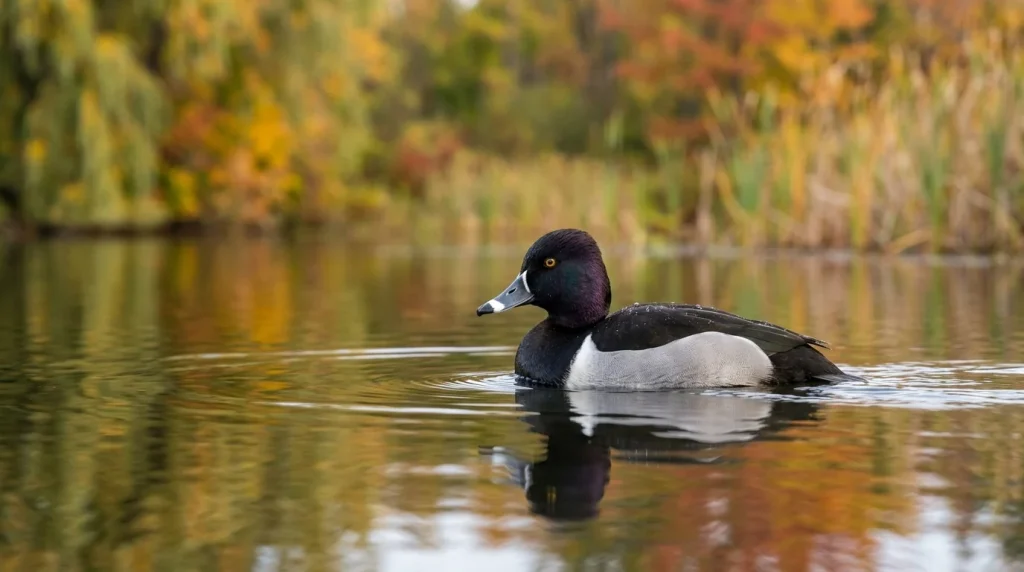
- Head Shape: A uniquely tall, crested crown that comes to a soft point at the back of the head.
- Bill Markings: A dark bill with a bright white ring behind the black tip, plus a thin white line around the base.
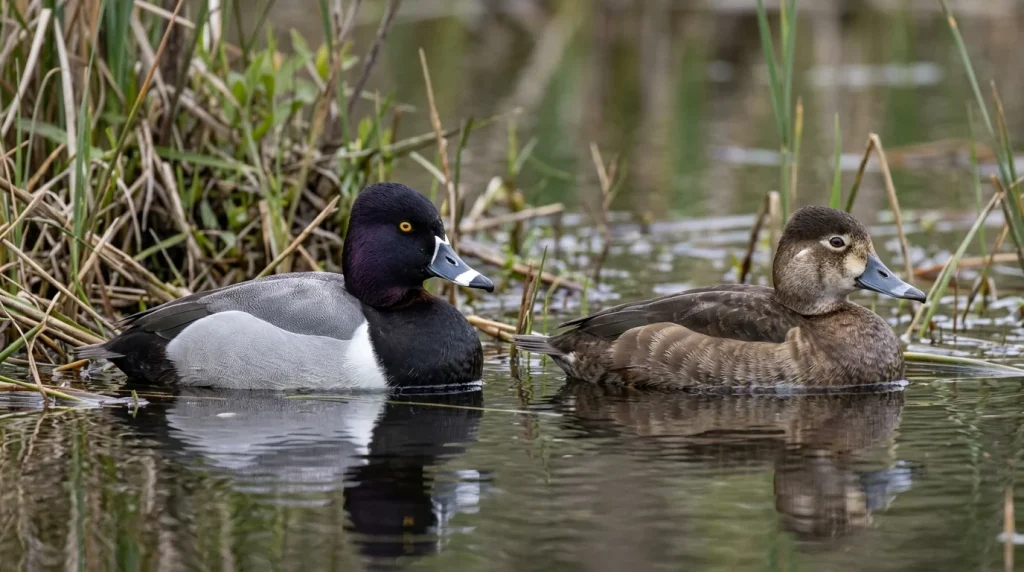
- Male Plumage: Black head, chest, and back, with pale grey sides separated from the dark breast by a prominent vertical white spur.
- Female Plumage: Soft greyish-brown overall with a whitish patch around the base of the bill and a delicate white eye-ring.
- Wing Pattern: In flight, both sexes show a smooth grey stripe along the trailing edge of the inner wing rather than a bright white speculum.
Appearance
The adult breeding male Ring-necked Duck displays a sharp, high-contrast plumage. Its head appears dark black with purplish reflections under good light. The breast, back, and tail coverts are deep jet-black. Its flanks are light grey, capped by a distinct vertical white triangle or spur at the shoulder. This white mark stands out clearly even at a distance across open water. The bill is dark blue-grey, with a white outline at the base and a vivid white band near the tip.
The female Ring-necked Duck is muted and brown, providing excellent camouflage while nesting. Her body is mostly warm grey-brown, with lighter pale feathers on her cheeks and chin. A faint white ring circles her eye and extends backward into a delicate pale line. Her bill is grey with a less intense version of the male’s white band. Non-breeding males in late summer eclipse plumage resemble females but usually retain dark eyes and darker back feathers.
Size and Wingspan
The Ring-necked Duck is a compact waterfowl species, noticeably smaller than a Mallard and slightly smaller than a Lesser Scaup.
- Length: 15.0 to 18.1 inches (38 to 46 cm)
- Wingspan: 24.4 to 29.5 inches (62 to 75 cm)
- Weight: 1.1 to 2.0 pounds (500 to 910 grams)
Because of its broad wings relative to its body weight, the Ring-necked Duck can spring directly into flight off the water’s surface, unlike many larger diving ducks that require a long running start.
Range and Distribution
The Ring-necked Duck ranges across nearly all of North America depending on the season. During the breeding season, its core population occupies the northern boreal forests and wetlands of Canada, Alaska, and the northern tier of the United States, including the Great Lakes region and the Pacific Northwest.
During autumn, birds migrate south along all major flyways. They winter extensively across the southern United States, Central America, the West Indies, and northern Mexico. Small numbers winter along both the Atlantic and Pacific coasts, though they generally prefer inland freshwater bodies over salty ocean bays.

Habitat
Unlike sea ducks or deep-water divers, the Ring-necked Duck strongly prefers shallow freshwater environments. Its ideal habitats include:
- Boreal lakes surrounded by conifers
- Beaver ponds, wooded swamps, and flooded river bottomlands
- Freshwater marshes and shallow agricultural reservoirs
- Settling basins, sewage lagoons, and suburban park ponds
Water depths in preferred feeding areas typically range from 3 to 6 feet, allowing the duck to dive easily to the bottom for food without expending excessive energy.

Behavior
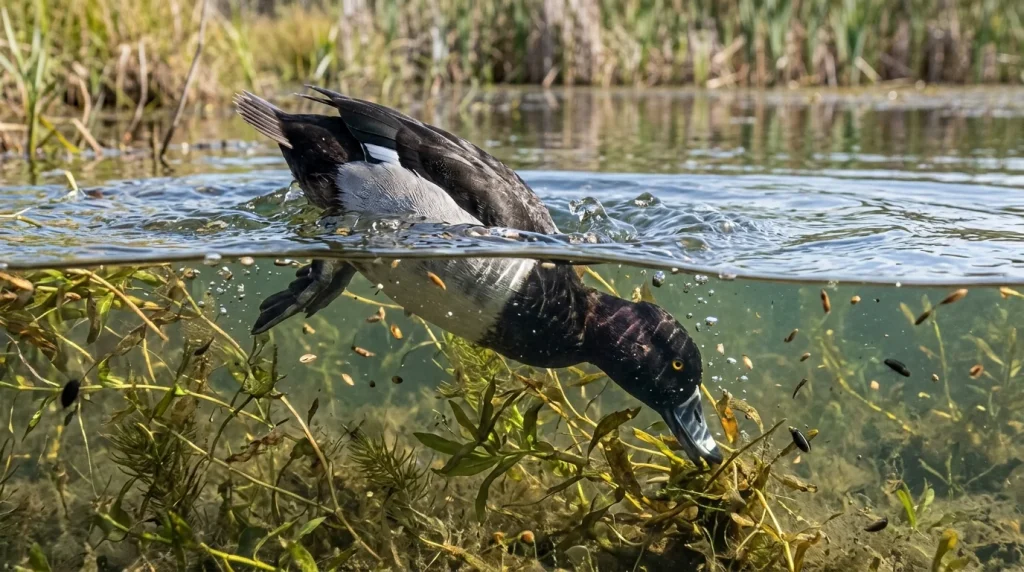
Ring-necked Ducks are active foragers that propel themselves underwater using their webbed feet. Dives usually last between 10 and 30 seconds. While they are true diving ducks, they also regularly dabble at the surface or tip up in shallow water like dabbling ducks.
On land, they are somewhat clumsy because their feet are set far back on their bodies to aid in swimming. In the air, they fly with fast, steady wingbeats, often traveling in small, tight flocks that swoop low over wetland vegetation before landing gently in open patches of water.
Diet
The Ring-necked Duck is an omnivore, though plant matter makes up the majority of its annual diet, especially during autumn and winter migration. Common food items include:
- Submerged aquatic vegetation such as pondweeds, coontail, and wild celery
- Seeds of sedges, rushes, smartweeds, and water lilies
- Aquatic invertebrates, including dragonfly nymphs, caddisfly larvae, and water beetles
- Mollusks such as small snails and freshwater clams
- Crustaceans, including amphipods and small crayfish
During the spring breeding season, females consume more invertebrates to get the proteins and minerals needed to lay healthy eggs.
Vocalizations
Ring-necked Ducks are generally quiet birds outside of courtship displays. Males produce a soft, high-pitched whistle during spring courtship displays as they nod their heads toward females. Females generate a low, growling karr-karr call when alarmed or while flying with their ducklings. Overall, field identification relies far more on visual field marks than on vocalizations.
Breeding and Nesting
Courtship begins during late winter and peaks during spring migration. Once pairs form, they seek out shallow marshy sites surrounded by dense vegetation. The female selects the nest site, usually built directly over water on a floating mat of vegetation, a sedge tussock, or an overturned beaver lodge.
The female constructs the nest from dead sedges, rushes, and grasses, lining it thickly with soft down feathers plucked from her breast. The female lays a single clutch of 6 to 11 pale buff or greenish-olive eggs. She incubates the eggs alone for approximately 25 to 29 days while the male leaves to join molting flocks elsewhere.

Young and Development
Ring-necked Duck chicks are precocial, hatching fully covered in down feathers and opening their eyes within hours. Shortly after hatching, the mother leads her ducklings to water, where they can swim and forage for small insects.
The mother guards her brood from predators like hawks, snapping turtles, and large fish, though the ducklings feed themselves independently. Young birds grow rapidly and learn to fly around 49 to 56 days old, after which they become fully independent.
Where to See
Finding Ring-necked Ducks is straightforward if you visit the right aquatic habitats during the cooler months of the year:
- Wintering Grounds: Look for them in shallow southern impoundments, wildlife refuges, and wooded lakes from late October through March.
- Migration Stops: Check small inland lakes, agricultural ponds, and wastewater plants across the central and northern states in April and October.
- Breeding Season: Visit quiet boreal marshes and beaver ponds in northern states and Canada during May through July.
Similar Species
Because several diving ducks share similar black-and-grey patterns, careful observation is necessary to distinguish the Ring-necked Duck from similar species:
- Lesser Scaup: Has a rounded or tufted head top (not peaked at the rear), a clean white patch on the wing in flight, and lacks the bright white bill ring and white shoulder spur.
- Greater Scaup: Noticeably larger, with a rounded, green-tinted head, a broader bill without a mid-bill white ring, and a light grey back.
- Redhead: Has a bright rusty-red head, broad grey bill with a black tip, and a grey back rather than a black back.
- Tufted Duck: An Asian and European visitor with a long, drooping head crest and pure white flanks, but lacks the vertical shoulder spur.
Conservation
The Ring-necked Duck population is stable and has expanded its range eastward over the past century. The International Union for Conservation of Nature (IUCN) lists the species as Least Concern. Because it breeds in northern boreal wetlands that face fewer human disturbances, its nesting success remains relatively high.
However, wetland loss, water pollution, invasive aquatic plants, and lead toxicosis from ingested fishing sinkers or shot remain potential threats. Conservation programs that protect boreal freshwater wetlands play a critical role in keeping Ring-necked Duck populations healthy.
Field Identification Tips
Keep these quick pointers in mind next time you observe ducks on the water:
- Look at the bill first: search for the prominent white ring near the tip.
- Check the head profile: look for a steep forehead and high peak at the back of the crown.
- Scan the male’s side: look for the distinct vertical white spur separating the dark chest from the pale grey flank.
- Note the back color: male Ring-necked Ducks have solid black backs, unlike the pale grey backs of scaups.
Frequently Asked Questions
Why is it called a Ring-necked Duck if you cannot see the ring?
Early museum collectors named the species after examining dead specimens by hand. Up close, a subtle chestnut ring is visible on the male’s black neck, but it’s almost impossible to spot in the field on living birds.
Is the Ring-necked Duck a dabbler or a diver?
It is biologically a diving duck (genus Aythya), but it frequents shallow waters and often dabbles or tips up like a dabbling duck.
How can I distinguish a female Ring-necked Duck from a female Scaup?
A female Ring-necked Duck has a pale eye-ring with a line extending behind it, a white ring on the bill, and a peaked head. Female scaup have a plain face, a bold white patch at the base of the bill, and a rounder head profile.


