Ridgway’s Rail Guide
Keep Track of What You See
Create a free Wild Things Guide membership to record this Ridgway’s Rail in My Sightings and build your personal wildlife list.
Join to Add This SightingIntroduction
Ridgway’s Rail (Rallus obsoletus) is a secretive, chicken-sized bird found in the tidal salt marshes and desert river corridors of western North America. For many years, scientists considered this bird a western population of the Clapper Rail. However, recent genetic studies showed that it is a distinct species. Scientists named the bird after Robert Ridgway, a famous American ornithologist who studied North American birds in the late nineteenth and early twentieth centuries.
Because Ridgway’s Rail lives in dense wetland vegetation, people hear it far more often than they see it. Its loud, rhythmic clapping calls echo across coastal estuaries, revealing its presence even when hidden deep inside stands of cordgrass and pickleweed. Understanding Ridgway’s Rail’s natural history and how to identify it provides valuable insight into the health of fragile Pacific coastal ecosystems.

Quick Identification
When trying to spot a Ridgway’s Rail in the field, look for these key visual features:
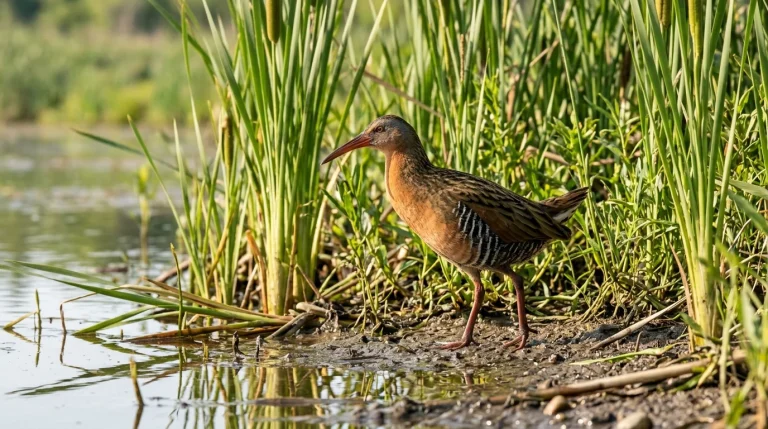
- Body Size: Hen-sized bird with a slender, compressed body built for walking between narrow marsh stems.
- Bill: Long, slightly downcurved bill with a warm orange-yellow base and a dark tip.
- Breast and Neck: Rich cinnamon-buff coloration across the chest and neck.
- Flanks: Striking vertical black-and-white bars along the belly sides.
- Face: Slate-gray cheek patch framed by a subtle light eyebrow line.
- Tail: Short, stubby tail often held upright, showing bright white under-tail feathers.
Appearance
Ridgewail Rail is built specifically for life in dense wetlands. Its body is laterally compressed—flattened side to side—allowing it to slip easily through thick cordgrass and cattail stems without making noise. Its upperparts are dark olive-brown to grayish-brown, heavily marked with dark brownish-black streaks that blend seamlessly with marsh mud and dead vegetation.
The underparts feature a warm cinnamon-orange breast that fades into a pale cream or whitish belly. The flanks (sides) display clean, alternating vertical stripes of brownish-black and white. Its face has a grayish cheek patch, a warm cinnamon throat, and a short, light-colored eyebrow stripe above the eye. Its long legs and flexible toes are dull yellowish-brown or olive-gray, designed to spread the bird’s weight over soft, muddy ground.

Size and Wingspan
RidgwRail Rail is a medium-sized marsh bird. It is noticeably larger than smaller marsh relatives like the Virginia Rail and the Sora.
- Length: 13 to 19 inches (33 to 48 cm)
- Wingspan: 19 to 24 inches (48 to 62 cm)
- Weight: 8.8 to 14.1 ounces (250 to 400 grams)
Male Ridgway’s Rails average slightly larger than females in overall length, bill size, and weight. However, this size difference is rarely noticeable in the field unless a mated pair is standing directly next to each other on an open mudflat.
Range and Distribution
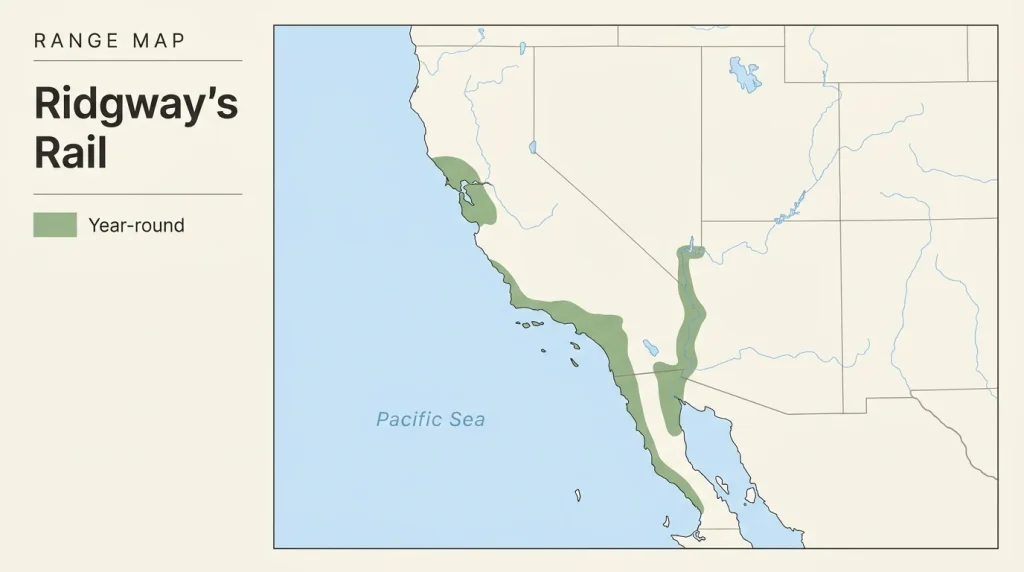
RidgwRail Rail has a limited geographical distribution restricted to parts of California, Nevada, Arizona, and northwestern Mexico. Unlike many other North American birds, most Ridgway’s Rails do not migrate long distances and remain resident in their local marsh habitats year-round.
Ornithologists recognize three main subspecies, each occupying a distinct geographic range:
- California Ridgway’s Rail (R. o. obsoletus): Restricted almost entirely to the tidal salt marshes of San Francisco Bay and nearby estuaries in northern California.
- Light-footed Ridgway’s Rail (R. o. levipes): Inhabits coastal salt marshes from Santa Barbara County southward to northern Baja California, Mexico.
- Yuma Ridgway’s Rail (R. o. yumanensis): Found in freshwater and brackish marshes along the lower Colorado River basin, the Salton Sea, and parts of Arizona, Nevada, and northwestern Mexico.
Habitat
Habitat preferences vary by subspecies, but all Ridgway’s Rails require dense wetland cover near rich foraging areas. Coastal populations rely on tidal salt marshes dominated by Pacific cordgrass (Spartina foliosa) and pickleweed (Salicornia species). These plants provide shelter, nesting materials, and concealment from predators during high tides.
Interior populations live in freshwater and brackish marshes populated by dense stands of cattails (Typha) and bulrushes (Schoenoplectus). Essential habitat components include tidal channels, exposed mudflats for low-tide foraging, and elevated ground or dense vegetative canopies where birds can seek shelter during extreme high-water events.

Behavior
Ridgway’s Rails are famously secretive. They prefer to walk, run, or creep stealthily through marsh vegetation rather than take flight. When startled, a rail typically freezes or slips quickly into deep cover. If forced to fly, its flight appears weak and awkward, with legs dangling low, lasting only a few yards before the bird drops back into the safety of the reeds.
While foraging on mudflats, Ridgway’s Rails walk deliberately, constantly probing the mud with their long bills. They frequently flick their short tails upward as they walk, exposing the clean white feathers beneath. This tail-flicking action may signal to other rails or confuse predators in dimly lit marsh corridors.
Diet
The ridgewail rail is an opportunistic predator that feeds on a wide variety of small animals found in marsh environments. Its diet shifts depending on location, tide, and season:
- Salt Marsh Diet: Striped shore crabs, fiddler crabs, yellow shore crabs, ribbed mussels, clams, and marsh snails.
- Freshwater Diet: Crayfish, aquatic insects, water beetles, dragonfly larvae, and small fish.
- Additional Prey: Amphipods, small frogs, earthworms, bird eggs, and occasionally small rodents or plant seeds during winter.
The long, slender bill acts like a pair of precise forceps. Rails probe soft mud burrows to extract hidden crabs and mollusks. Before swallowing hard-shelled prey like shore crabs, rails often snap off claws and legs or smash shells against hard mud or rocks.

Vocalizations
Because thick marsh vegetation makes visual contact difficult, vocalizations are essential for territorial defense and pair bonding. Ridgewail Rail makes a wide variety of harsh, echoing calls. The most recognizable call is a loud, clapping sequence often transcribed as “kek-kek-kek-kek-kek” or a dry clatter. This call starts rapidly and gradually slows toward the end.
Mated pairs frequently sing in duets. One bird begins with a harsh, rapid clatter call, and the mate immediately joins in with lower-pitched, rhythmic response notes. They also make soft grunts, sharp alarm squawks, and low murmurs when communicating with young chicks.
Breeding and Nesting
The breeding season generally extends from March through July. Mated pairs are monogamous and work together to establish and defend a territory. They build woven platform nests hidden inside dense vegetation above typical high-tide water levels.
In coastal marshes, they build nests from dried cordgrass and pickleweed stems; in freshwater marshes, they use cattail leaves and bulrushes. The nest bowl is elevated several inches above the mud. Ridgway’s Rails often weave an arched canopy or dome over the nest using living plants to shield their eggs from aerial predators like hawks and gulls. They also construct small ramps made of vegetation leading up to the nest rim to make entry easy as water levels rise and fall.
Female rails lay a clutch of 6 to 11 buff-colored eggs speckled with reddish-brown and lavender spots. Both parents share incubation duties for about 21 to 23 days.

Young and Development
Ridgway’s Rail chicks are precocial, hatching fully developed and covered in dense, jet-black down. Within hours of hatching, chicks can leave the nest and follow their parents through the marsh pathways. Although they can walk early on, young chicks depend on their parents for food and brooding warmth during their first few weeks of life.
Parents lead the chicks to feeding areas and offer soft food, such as small pieces of crab meat or insect larvae. Within a week or two, chicks begin probing the mud for food on their own. Young rails grow rapidly, develop flight feathers, and reach adult size by 7 to 9 weeks of age.
Where to See
Spotting a Ridgway’s Rail requires patience and good timing. The best strategy is to visit coastal salt marshes during high tides, when rising water forces the birds out of deep channels toward higher, exposed marsh edges. Important viewing sites include:
- Don Edwards San Francisco Bay National Wildlife Refuge (California): Excellent viewing from designated boardwalks for the California subspecies.
- Bolsa Chica Ecological Reserve (Southern California): A prime spot to view the Light-footed subspecies in coastal wetland habitat.
- Imperial National Wildlife Refuge (Arizona/California): Marsh habitats along the lower Colorado River support populations of the Yuma subspecies.
- Tijuana Slough National Wildlife Refuge (California): Located near the southern border, offering protected salt marsh habitat.
Always stay on established trails, boardwalks, and observation platforms to avoid damaging sensitive marsh vegetation or disturbing nesting birds.
Similar Species
It is important to distinguish Ridgway’s Rail from several similar marsh species:
- Clapper Rail (Rallus crepitans): Virtually identical in appearance but found exclusively along the Atlantic and Gulf coasts. RidgwRail Rail is found only in western North America.
- Virginia Rail (Rallus limicola): Much smaller (9 to 10 inches long) with a distinctly reddish bill, gray cheek patch, and bright rust-colored wing coverts.
- King Rail (Rallus elegans): Larger with brighter, richer rufous plumage on the breast and shoulders; inhabits freshwater marshes in central and eastern North America.
- Sora (Porzana carolina): Small, plump marsh bird with a short, stubby yellow bill and a black face mask.
Conservation
RidgwRail Rail faces serious conservation challenges throughout its limited range. Subspecies like the California Ridgway’s Rail and Light-footed Ridgway’s Rail are federally listed as Endangered under the U.S. Endangered Species Act. In contrast, the Yuma Ridgway’s Rail is listed as Threatened.
Over the past century, people drained, filled, or developed more than 80 percent of historic Pacific coastal salt marshes for urban and agricultural use. Remaining populations face ongoing threats from climate-change-driven sea-level rise, urban runoff, and predation by non-native species such as red foxes, feral cats, and Norway rats.
The U.S. Fish and Wildlife Service coordinates comprehensive recovery efforts to restore tidal wetlands, build high-tide floating islands for shelter, control non-native predators, and run captive breeding programs. You can review species profiles and distribution maps through resources like the Cornell Lab of Ornithology.
Field Identification Tips
When searching for Ridgway’s Rail in the field, keep these practical tips in mind:
- Check the Location: Confirm you are within the western range (California, Arizona, Nevada, or Baja California).
- Listen First: Learn the sharp, clapping call; auditory identification is often much easier than visual sightings.
- Look for the Orange Bill Base: Look for a long bill with an orange-yellow base, not a short or completely dark bill.
- Inspect the Flanks: Look for bold, vertical black-and-white striping along the rear sides of the body.
- Plan Around Tides: Arrive at coastal salt marshes during rising high tides to catch birds moving out of flooded vegetation.
Frequently Asked Questions
Is Ridgway’s Rail the same as the Clapper Rail?
They were once considered the same species. In 2014, taxonomic authorities split the former Clapper Rail complex into three distinct species based on genetic and morphological research: Clapper Rail (Atlantic/Gulf coasts), Ridgway’s Rail (Pacific coast and Southwest), and Mangrove Rail (Central and South America).
Can Ridgway’s Rails fly?
Yes, they can fly, but they prefer to walk or run through vegetation. Their flight appears fluttery and brief, typically used only to cross narrow water channels or escape immediate threats.
Why are Ridgway’s Rails endangered?
They rely on specialized tidal salt marshes and desert river wetlands. Coastal development destroyed most of their habitat, while introduced predators and sea-level rise continue to threaten remaining populations.