Morelet’s Crocodile Guide
Keep Track of What You See
Create a free Wild Things Guide membership to record this Morelet’s Crocodile in My Sightings and build your personal wildlife list.
Join to Add This SightingIntroduction
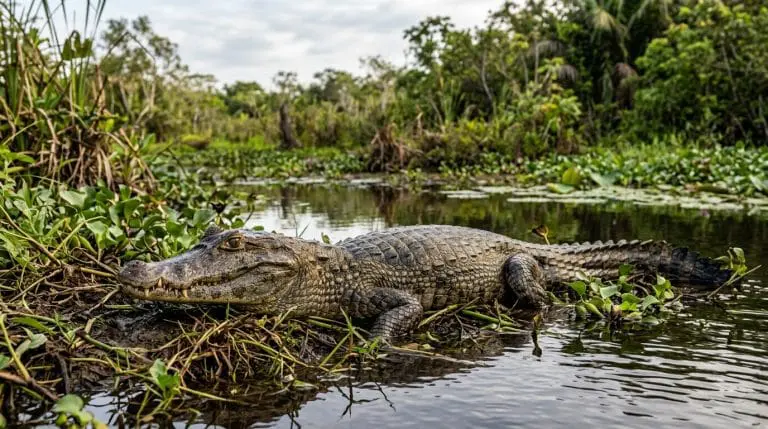
Morelet’s crocodile (Crocodylus moreletii) is a medium-to-large crocodilian native to Mexico, Belize, and Guatemala. It is primarily associated with freshwater wetlands, although individuals also enter brackish water. Its broad snout, dark coloration, and preference for wooded swamps can make it look surprisingly alligator-like.
This field guide emphasizes traits useful in southern North America and northern Central America, particularly where Morelet’s crocodiles may occur near American crocodiles. Identification should combine head shape, body proportions, habitat, and geographic location rather than relying on a single feature.
Identification
Look for a robust crocodilian with a broad but distinctly crocodile-shaped snout, dark gray-brown body, heavily armored back, and a muscular tail. Adults often appear darker and more compact than American crocodiles. When the jaws are closed, some lower teeth—especially the enlarged fourth tooth—may remain visible, although angle, age, and tooth wear can obscure this feature.
Overall appearance
Morelet’s crocodile has a low, elongated body, short powerful legs, and a large head. The dorsal surface is generally dark olive, gray-brown, or nearly black, while the underside is much paler. Adults may retain irregular darker markings on the sides and tail, but these are less sharply defined than the bands of juveniles.
Snout shape
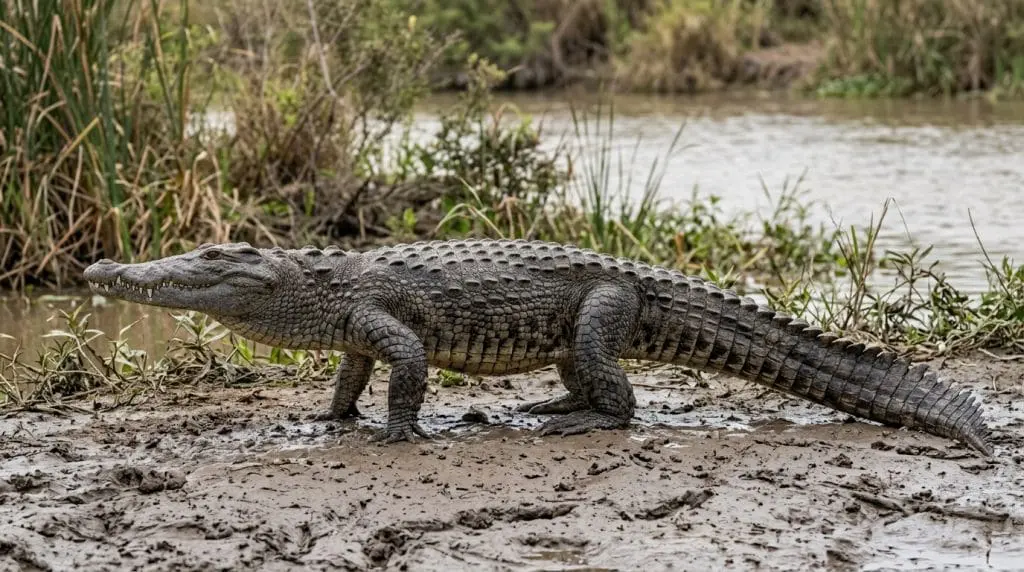
The snout is moderately short and broad for a true crocodile. Viewed from above, it usually tapers toward the nose but lacks the strongly narrow, pointed profile typical of many American crocodiles. Large Morelet’s crocodiles can develop especially wide, heavy heads. Snout shape varies with age and sex, so it should not be used alone.
Teeth and jaw
The jaws contain conical teeth suited to gripping rather than chewing. As in other members of Crocodylus, the enlarged fourth tooth of the lower jaw fits into a notch along the upper jaw and is often visible when the mouth is closed. In an American alligator, that tooth normally fits into a socket and is less exposed. Missing, broken, or irregular teeth are common in older animals.
Skin, scales, and scutes
Thick, rectangular scutes cover the back and contain bony plates called osteoderms. Raised keels create a rugged, armored appearance, while smaller scales cover the flanks. The skin is not uniformly smooth between the large scutes. Morelet’s crocodiles tend to look dark and strongly patterned in shaded wetland habitats, but mud, algae, and lighting can alter apparent color.
Tail and feet
The deep, laterally flattened tail provides most of the animal’s swimming power. Two rows of raised tail scutes merge farther toward the tip. The legs are used mainly for steering, walking, and pushing off the bottom. The hind feet are more strongly webbed than the front feet, helping the crocodile maneuver through marshes and flooded forest.
Size and Weight
Many adults measure about 2–3 meters (6.5–10 feet) long. Mature females are generally smaller, while large males may exceed 3 meters; exceptional historical reports approach 4 meters or more. Many adults weigh roughly 40–100 kilograms (88–220 pounds), but a large male may be substantially heavier. Reliable maximum weights are limited and should be treated cautiously.
Male vs. Female
Males and females have similar coloration and body pattern. Mature males are usually longer, heavier, and more broad-headed. Sex cannot be determined reliably from a distant photograph unless size can be evaluated within a known population. A trained wildlife professional must perform a physical examination for confident sex determination.
Juveniles
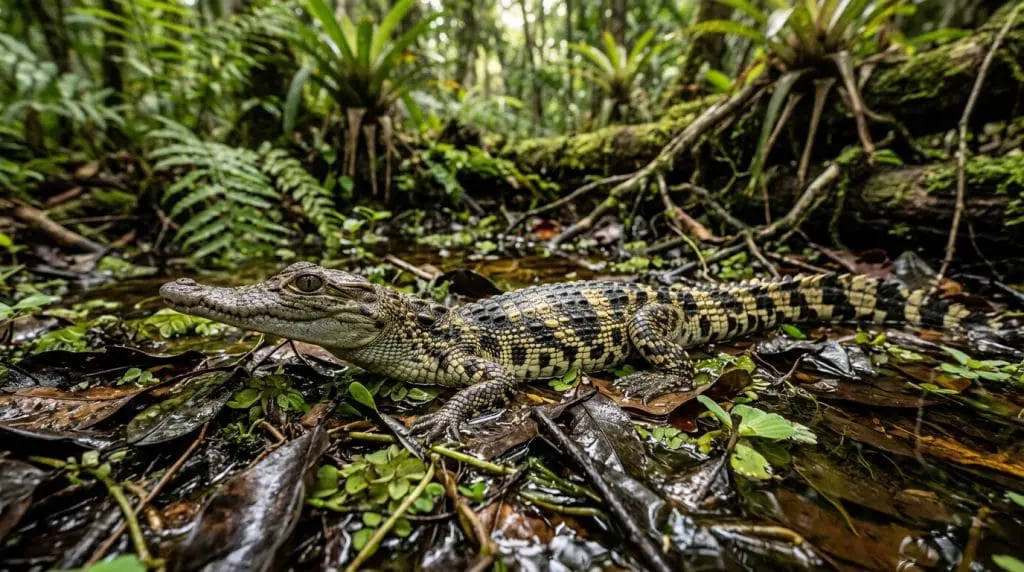
Hatchlings and juveniles are dark brown to nearly black with conspicuous yellow or cream crossbands and spots along the body and tail. Their snouts appear relatively slender compared with the massive heads of old males. Juvenile patterning provides camouflage among floating vegetation, roots, shadows, and leaf litter, gradually becoming less distinct as the animal matures.
Similar Species
The American crocodile has a generally longer, narrower snout, often looks paler, and is strongly associated with coastal lagoons, estuaries, and mangroves. Morelet’s crocodile is usually darker, broader-snouted, and more closely tied to inland freshwater. The American alligator also has a broad snout, but it is native mainly to the southeastern United States and far northeastern Mexico. Geographic ranges, however, should never replace physical identification.
Hybridization between Morelet’s and American crocodiles has been documented in parts of their shared region. Hybrids and unusually shaped individuals may not match standard field marks, so expert confirmation or genetic evidence may be necessary in some cases.
Especially useful for American Alligator vs. American Crocodile
The familiar alligator-versus-crocodile rules are helpful but imperfect. Alligators usually have a broadly rounded, U-shaped snout and fewer exposed lower teeth when the mouth is closed. American crocodiles generally show a narrower, more tapered snout and visible upper and lower teeth. Morelet’s crocodile demonstrates why these rules require caution: it is a true crocodile with a relatively broad, alligator-like head.
For field identification, compare several features at once: snout outline, exposed fourth lower tooth, coloration, habitat, and location. Never approach an animal to inspect its teeth.
Habitat
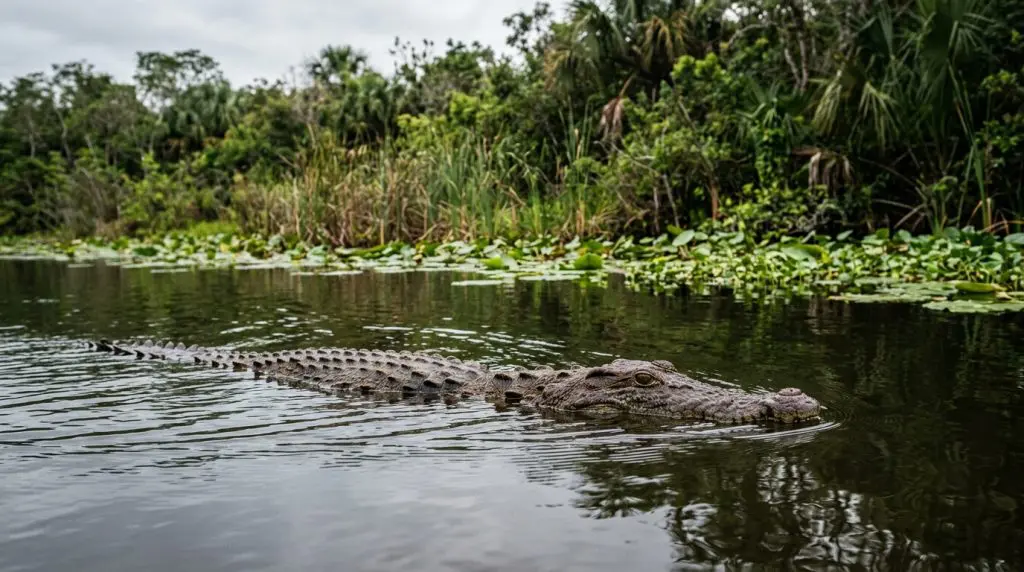
Morelet’s crocodiles inhabit freshwater marshes, wooded swamps, ponds, lakes, slow rivers, canals, and seasonally flooded forest. Dense shoreline vegetation and quiet backwaters are especially characteristic. They can tolerate brackish conditions and may occur in coastal wetlands, but they are generally less marine-oriented than American crocodiles.
Geographic Range
The native range includes the Gulf and Caribbean lowlands of eastern and southeastern Mexico, much of Belize, and northern Guatemala. Distribution is patchy because suitable wetlands are interrupted by drier uplands, development, and drainage projects. In Mexico, the range extends from the Gulf coastal region south through the Yucatán Peninsula and adjacent lowlands.

Behavior
Morelet’s crocodiles spend much of their time floating at the surface, resting in shallow water, or remaining concealed beside vegetation. Only the eyes, nostrils, and upper head may be visible. They bask to raise body temperature and retreat to water when disturbed. Adults can be territorial, particularly around breeding sites, nests, or concentrated dry-season pools.
Diet and Hunting
Young crocodiles consume insects, aquatic invertebrates, small fish, frogs, and other small prey. Larger animals take fish, turtles, snakes, birds, mammals, and carrion. Morelet’s crocodiles are primarily ambush predators. They wait near shorelines or travel quietly through shallow water, seizing prey with a rapid sideways or forward movement of the head.
They swallow prey in pieces or whole. Large items may be torn apart with forceful head movements or body rolls; crocodilians do not chew in the mammalian sense.
Activity and Seasonal Behavior
Activity often increases from dusk through night, although basking and feeding can occur during daylight. Water level and temperature strongly influence movement. During dry periods, crocodiles may gather in remaining pools or use excavated dens and sheltered banks. Wet-season flooding opens routes into temporary marshes, forest pools, and feeding areas.
Breeding and Courtship
Courtship generally intensifies before the principal nesting season and may include head slaps, bubbling, low-frequency bellows, close following, and physical contact. Large males may compete for access to females. Timing varies geographically and with rainfall, so breeding cannot be assigned a single reliable calendar date across the species’ range.
Nesting and Eggs
Females commonly construct mound nests from soil, leaves, sticks, and other vegetation near water. A typical clutch contains several dozen hard-shelled eggs, often roughly 20–40. Decomposing vegetation helps warm the nest, while temperature influences incubation and the sex of developing young. Flooding, drought, predators, and human disturbance can reduce nest success.
Hatchlings and Parental Care
Near hatching, young crocodiles produce high-pitched calls from inside the eggs. The female may open the nest, help hatchlings reach water, and remain near a nursery group. She may carry young gently in her mouth, even though the same jaws can capture large prey. Protection is significant but does not prevent heavy juvenile mortality.
Tracks and Other Signs
Tracks may show five toes on the front foot and four on the hind foot, although not every toe registers clearly. Hind prints can show webbing in soft mud. A broad tail drag, belly slide, trails through aquatic plants, flattened basking sites, or smooth ramps between water and land may also indicate crocodilian activity. Tracks alone rarely identify the species with certainty.
Predators and Threats
Eggs and hatchlings are vulnerable to raccoons and similar mammals, birds, snakes, large fish, and other crocodilians. Adult Morelet’s crocodiles have few natural predators beyond larger members of their own species and humans. Habitat loss, wetland alteration, road mortality, entanglement, illegal killing, pollution, and conflict near fishing or livestock areas remain important threats.
Conservation and Population
Morelet’s crocodile is commonly listed as Least Concern by the IUCN Red List. Populations declined severely during the twentieth-century skin trade but recovered in many areas after legal protection and harvest controls. Recovery is not uniform, and local populations can still be threatened by wetland loss or killing. The University of Michigan’s Animal Diversity Web species account provides additional natural-history context.
Living Around People
Morelet’s crocodiles may occupy canals, farm ponds, village wetlands, roadside pools, and waterways used for fishing. Never feed them or discard fish remains at boat ramps and swimming areas. Feeding encourages crocodiles to approach people and can increase the likelihood of future conflict. Keep pets and livestock away from vegetated banks, especially at night and during low-water periods.
Safety Around Crocodilians
Treat any large crocodilian as potentially dangerous. Observe only from a substantial distance and follow local closures, warning signs, and guidance. Do not swim, wade, clean fish, or collect water where crocodiles are known to occur, particularly near dawn, dusk, or night. Keep children close, and dogs leashed well away from the shoreline.
Never approach a nest, hatchlings, or an animal lying on land. If a crocodile changes direction toward you, raises its body, opens its mouth, or enters the water in response to your presence, increase your distance immediately. Report animals creating an immediate public hazard to local wildlife authorities rather than attempting capture or relocation.
Interesting Facts
- Morelet’s crocodile was scientifically described in 1851 and named for French naturalist Pierre Marie Arthur Morelet.
- Its broad snout once contributed to confusion with both American crocodiles and American alligators.
- Eyes and nostrils positioned high on the head allow the animal to see and breathe while most of its body remains submerged.
- A muscular valve at the back of the mouth helps keep water out of the throat when the crocodile captures prey underwater.
- Young crocodiles communicate with adults and siblings through chirps and other calls.
Frequently Asked Questions
Is Morelet’s crocodile an alligator?
No. It belongs to the crocodile family, Crocodylidae, and the genus Crocodylus. Its broad snout can nevertheless resemble that of an alligator.
Does it live in the United States?
Morelet’s crocodile is not considered native to the United States. Its established native range lies in Mexico, Belize, and Guatemala. Reports outside that range require careful verification.
Can it live in salt water?
It can tolerate some brackish water and may use coastal wetlands, but it is principally a freshwater crocodile. The American crocodile is generally more strongly associated with saline coastal habitats.
Is it dangerous to people?
It is capable of seriously injuring or killing a person. Most animals avoid close human activity when given space, but behavior is not predictable enough to justify swimming or approaching them.
What is the best field mark?
No single mark is conclusive. The most useful combination is a broad, moderately tapered snout, a visible lower fourth tooth, a dark, robust body, a freshwater habitat, and a location within the species’ known range.