Luna Moth Guide
Keep Track of What You See
Create a free Wild Things Guide membership to record this Luna Moth in My Sightings and build your personal wildlife list.
Join to Add This SightingIdentification, Life Cycle, Habitat & Host Plants
The Luna Moth (Actias luna) is one of North America’s most unforgettable insects. With pale green wings, long flowing tails, delicate eyespots, and a ghostly glow in evening light, this large moth often feels almost magical when it appears on a porch screen, tree trunk, or forest edge. Despite its dramatic beauty, the adult Luna Moth is short-lived and surprisingly quiet, spending only a brief part of its life as the winged insect most people recognize.
This guide explains how to identify Luna Moths as adults and caterpillars, what their eggs and cocoons look like, where they live, which host plants they use, when to look for them, and how to tell them from similar moths. It is written for the general public, naturalists, gardeners, and anyone lucky enough to encounter this remarkable species.
Quick Identification

Adult Luna Moths are large, pale green moths with very long, tapering tails on the hindwings. Each wing has a transparent eyespot, and the leading edge of the forewing may be reddish, pinkish, purple, or brownish. The body is white and fuzzy, and the wings may have a yellowish border. Freshly emerged adults are often a bright lime green, while older individuals can fade to a paler green or yellow-green.
The combination of large size, soft green color, and long tails makes the Luna Moth one of the easiest North American moths to recognize. Adults typically have a wingspan of about 3 to 4.5 inches. Males often have especially feathery antennae, which they use to detect female pheromones at night.
| Common name | Luna Moth |
| Scientific name | Actias luna |
| Adult size | About 3 to 4.5 inches across |
| Main colors | Pale green wings, white body, reddish or purplish forewing edge |
| Key markings | Long hindwing tails and eyespots on all four wings |
| Host plants | Hickory, walnut, sweetgum, birch, persimmon, and other hardwoods |
Caterpillar Identification
Luna Moth caterpillars are plump, smooth-looking, and green, often blending almost perfectly with leaves. Mature caterpillars may show a pale yellow side stripe and small reddish or orange spots along the body. They are not hairy or spiny like some other moth caterpillars, though they may have small raised bumps. Their green coloration helps them hide among leaves of host trees.
Because caterpillars feed high in trees as well as on lower branches, they can be difficult to find. Host plant association is an important clue. Luna Moth caterpillars use several deciduous trees, including hickory, walnut, sweetgum, birch, persimmon, and others depending on region. A large green caterpillar on one of these trees may be worth a closer look, but many green caterpillars look similar, so identifying the host plant and body details helps.
Eggs, Chrysalis, or Cocoon

Female Luna Moths lay small eggs on or near host plant leaves. The eggs are usually laid singly or in small groups, and they hatch into tiny caterpillars that begin feeding on leaves. As they grow, caterpillars molt several times, becoming larger and greener with each stage.
Unlike butterflies, many moths do make cocoons, and the Luna Moth is one of them. A mature Luna Moth caterpillar spins a thin silken cocoon, often wrapped in leaves. Inside that cocoon, the caterpillar becomes a pupa. The cocoon may fall with autumn leaves and rest in leaf litter through winter in colder areas. In warmer parts of the range, more than one generation may occur in a year.
People sometimes use the word chrysalis for butterflies and cocoon for moths. More precisely, the pupa is the developing stage inside; a cocoon is the protective silk covering around many moth pupae. Luna Moths pupate inside a cocoon rather than forming an exposed butterfly-like chrysalis.
Life Cycle & Behavior
The Luna Moth life cycle includes egg, caterpillar, pupa inside a cocoon, and adult moth. The caterpillar stage is the feeding and growth stage. The adult stage is focused almost entirely on reproduction. Adult Luna Moths do not feed because they lack functional mouthparts. They live on energy stored from the caterpillar stage and usually survive only about a week.
Adults are nocturnal. Males fly at night searching for females by following scent trails called pheromones. Their large, feathery antennae are highly sensitive and help them locate mates. Females tend to remain more stationary after emerging and release pheromones to attract males. After mating, females lay eggs on suitable host plants.
The long tails of the adult Luna Moth may help confuse bats. When bats use echolocation, the tails can create misleading echoes, drawing attacks away from the moth’s body. This is one reason those elegant tails may be more than decoration.
Range and Distribution
Luna Moths occur across much of eastern North America. Their range extends from parts of southern Canada through the eastern United States and into portions of the Great Plains and Gulf Coast region. They are most closely associated with areas where suitable hardwood host trees grow.
Seasonal timing depends on climate. In northern areas, adults are most often seen in late spring and summer, sometimes with one main generation per year. In warmer southern areas, multiple broods may occur, and adults may appear over a longer season. Local sightings often peak around warm, humid nights when adults are active and attracted to lights.
Habitat & Host Plants

Luna Moths live in and around deciduous forests, woodland edges, wooded neighborhoods, parks, river corridors, and mixed hardwood habitats. They are not usually insects of open lawns alone, but they may appear around homes near suitable trees. Adults are frequently noticed at porch lights, windows, and building walls because they are attracted to artificial light at night.
Host plants vary regionally, but commonly include hickories, walnuts, sweetgum, birches, persimmon, sumac, and other hardwoods. The best habitat supports both caterpillars and adults by providing host trees, leaf litter, dark nighttime conditions, and relatively low pesticide exposure. Leaving mature native trees in the landscape is one of the most useful ways to support this species.
When and Where to Look
The best time to look for adult Luna Moths is at night or early morning during the warmer months. They may come to porch lights, moth sheets, or lit windows, especially near woods. Early morning is often a good time to find one resting quietly on a wall, a screen, a tree trunk, or a leaf after being active overnight.
To look for caterpillars, inspect host trees during the growing season, especially lower branches of young trees or saplings. Finding caterpillars is harder than finding adults at lights, but careful searching can be rewarding. Cocoons may be hidden in leaf litter, so avoid excessive leaf cleanup beneath host trees if you want to support overwintering moths.
Is It Harmful?
Luna Moths are not harmful to people, pets, homes, or gardens. Adults do not bite, sting, or feed. Caterpillars eat leaves of host trees, but they rarely cause noticeable damage in healthy natural settings. A Luna Moth found on a porch or wall is simply resting and can be admired without concern.
If you need to move an adult moth away from a doorway, gently encourage it onto your hand, a leaf, or a piece of paper and place it on a nearby tree or shrub. Handle as little as possible because moth wings are delicate. Turning off unnecessary outdoor lights can reduce stress and help it return to normal nighttime behavior.
Conservation
Luna Moths remain fairly widespread, but they benefit from healthy forests, native trees, reduced pesticide use, and darker night skies. Like many moths, they can be affected by habitat loss, broad insecticide use, and artificial lighting. Bright outdoor lights may attract adults away from natural behavior and expose them to predators or exhaustion.
To help Luna Moths, keep native hardwood trees where possible, plant regionally appropriate host trees, avoid spraying pesticides, and leave some leaf litter under trees. Use outdoor lighting only when needed, choose warm-colored bulbs, shield lights downward, and turn them off overnight. These choices also support many other moths, fireflies, bees, and nighttime wildlife.
Interesting Facts & Similar Species
- Adult Luna Moths do not eat; their only job is to reproduce.
- The name “luna” refers to the moon, fitting for a pale nocturnal moth.
- The long hindwing tails may help confuse hunting bats.
- Males have larger, more feathery antennae than females.
- Cocoons are often hidden among leaves, making leaf litter an important shelter.
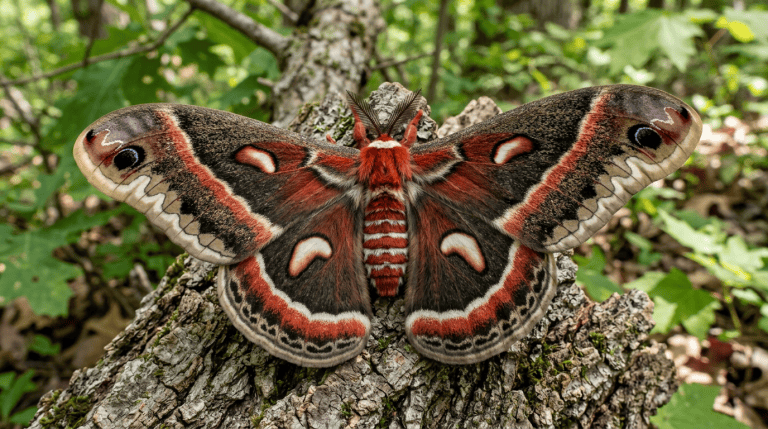
Similar large silk moths include the Polyphemus Moth, Cecropia Moth, Imperial Moth, and Promethea Moth. None have the Luna Moth’s exact combination of pale green wings and long flowing tails. Polyphemus Moths have large round eyespots and brown wings, while Cecropia Moths are larger and reddish brown with white and red markings. The green color and tails make the Luna Moth distinctive even among spectacular giant silk moths.
Identification Summary
Identify the Luna Moth by its large size, pale green wings, long hindwing tails, transparent eyespots, fuzzy white body, and reddish or purplish leading wing edges. Adults are nocturnal and often appear near lights in wooded areas. Caterpillars are plump and green, feeding on hardwood host plants such as hickory, walnut, sweetgum, birch, and persimmon.
The strongest identification clues are the moth’s soft green color, elegant tails, eyespots, eastern woodland range, and association with deciduous host trees. Once you have seen a Luna Moth well, it is difficult to confuse with anything else.
Frequently Asked Questions
Do Luna Moths bite or sting?
No. Adult Luna Moths do not bite or sting, and they do not feed. They are harmless to people and pets.
What do Luna Moths eat?
Adult Luna Moths do not eat. Caterpillars feed on leaves of host trees such as hickory, walnut, sweetgum, birch, and persimmon.
Do Luna Moths make cocoons?
Yes. Luna Moth caterpillars spin silk cocoons, often wrapped in leaves. The pupa develops inside the cocoon.
Why do Luna Moths come to porch lights?
Like many moths, Luna Moths can be attracted to artificial lights at night. Reducing outdoor lighting can help them behave more naturally.
How can I attract Luna Moths?
Plant and protect native hardwood host trees, avoid pesticides, leave some leaf litter beneath trees, and reduce unnecessary nighttime lighting.