
Harris’s Hawk Guide
Keep Track of What You See
Create a free Wild Things Guide membership to record this Harris’s Hawk in My Sightings and build your personal wildlife list.
Join to Add This SightingIntroduction
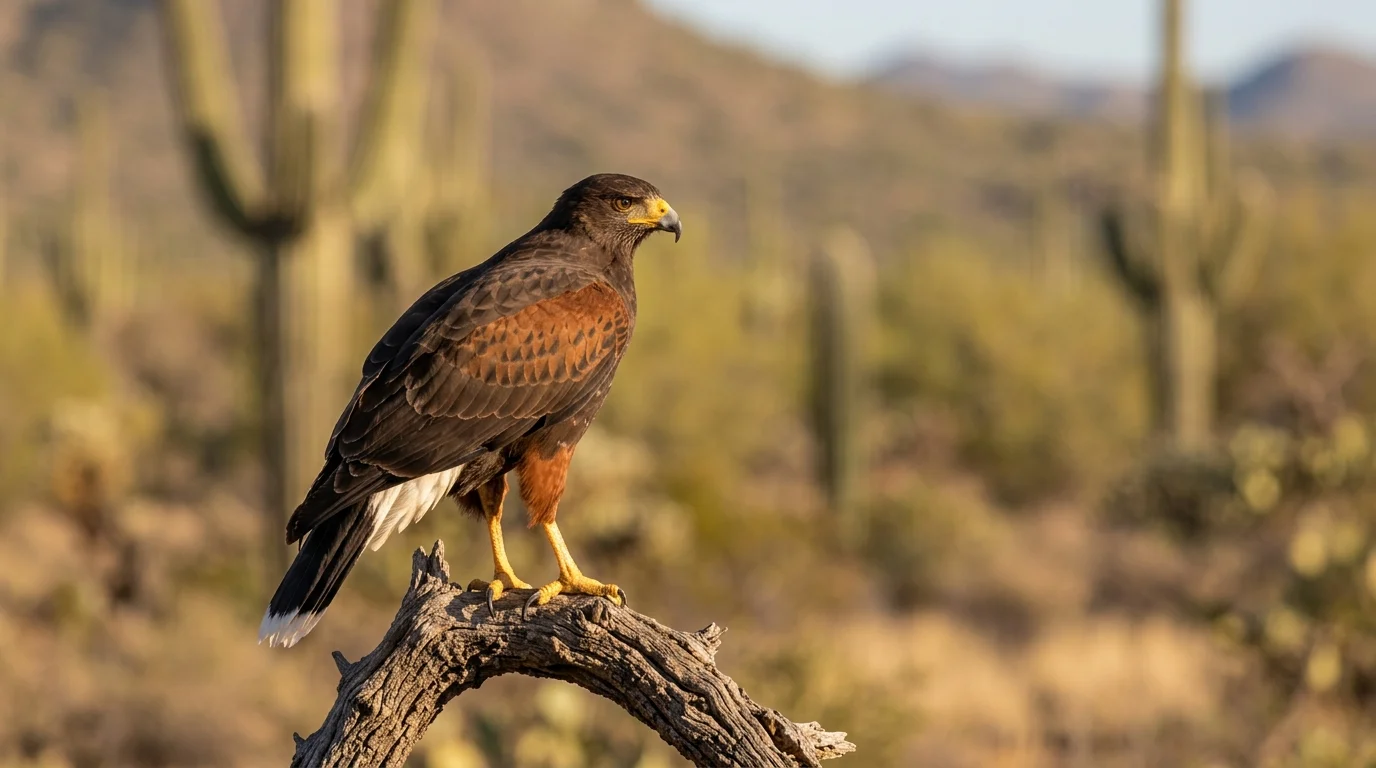
Harris’s Hawk (Parabuteo unicinctus) is a long-legged, dark hawk of desert scrub, thorn woodland, and other open country. In North America, it is especially associated with the southwestern United States and Mexico. Rich chestnut shoulders and thighs, together with a bold black-and-white tail, make adults distinctive when seen well.
Its social behavior is equally memorable. Unlike most North American raptors, Harris’s Hawks regularly live and hunt in groups. Several hawks perched near one another may therefore be a useful clue, although a solitary bird is perfectly normal.
Quick Identification
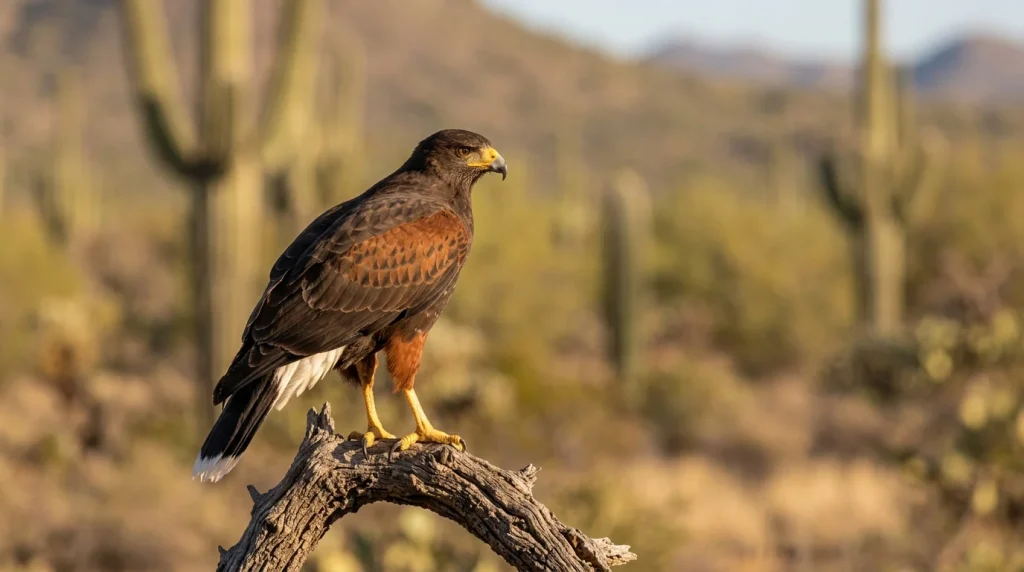
- Overall: Medium-large, mostly dark brown Hawk with long yellow legs and a relatively long tail.
- Adult colors: Chestnut shoulder patches, chestnut thighs, and dark brown body.
- Tail: Broad black central area contrasting with a white base and white terminal band.
- In flight: Broad, rounded wings; chestnut wing coverts contrast with darker flight feathers.
- Behavior: Often perches conspicuously on cacti, poles, or trees; sometimes hunts cooperatively.
- Best supporting clue: Several similarly marked hawks sharing a small area in suitable southwestern habitat.
Appearance and Field Marks
Adults look chocolate brown to nearly black at a distance. In good light, rusty chestnut patches become visible on the shoulders, upperwing coverts, underwing coverts, and thighs. The head and breast remain dark, without the pale belly and dark belly band typical of many Red-tailed Hawks.
The tail is particularly useful: a white base and white tip frame a broad black middle. A perched bird may conceal some of the white base beneath its folded wings, so watch for a turn or takeoff. The cere and bare legs are yellow, while the hooked bill has a dark tip.
Backlighting can hide the chestnut areas. In those conditions, concentrate on proportions, tail pattern, and behavior rather than apparent body color alone.
Male and Female Differences
Males and females share essentially the same plumage. Females average substantially larger and heavier, but size overlaps and is difficult to judge without a direct comparison.
Two adults perched together may reveal a larger female and smaller male, but perspective can mislead. Do not assign sex solely from apparent bulk, color intensity, or a single photograph. Group membership also does not establish whether birds are a breeding pair, helpers, or offspring.

Size and Wingspan
- Length: About 46–59 cm (18–23 in).
- Wingspan: About 103–119 cm (41–47 in).
- Build: Broad-winged, long-tailed, and noticeably long-legged.
Harris’s Hawk is generally smaller and less bulky than a Red-tailed Hawk, though a large female can appear impressive. Sex, posture, and distance all affect perceived size. Use measurements as context, not as a substitute for plumage and structure.
Range and Distribution
In the United States, the species occurs chiefly in southern Arizona, southern New Mexico, and southern Texas. Distribution is uneven, and birds can be locally common in one district but scarce nearby. Occasional records beyond the main range require careful interpretation.
The broader range extends through much of Mexico and parts of Central America into South America, reaching central Chile and Argentina. It is not continuously distributed across every intervening landscape.
Because Harris’s Hawks are widely kept for falconry, an unexpected bird outside the normal range could be an escape rather than a wild wanderer. For additional identification photos and a broad-range reference, consult the Cornell Lab of Ornithology’s Harris’s Hawk guide.

Habitat
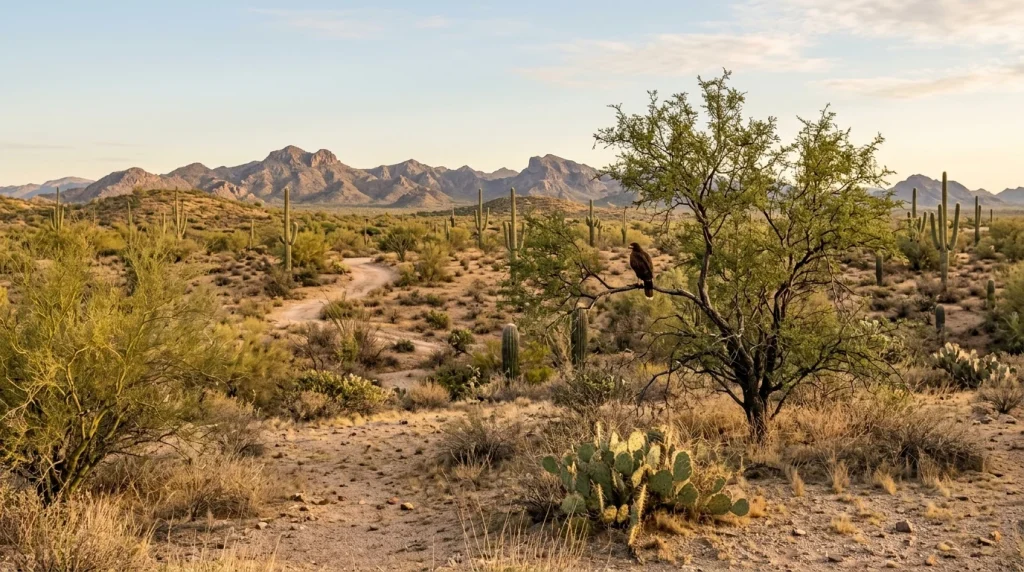
Look for a mixture of open hunting ground and elevated perches. Typical habitats include Sonoran Desert scrub, mesquite woodland, thornscrub, savanna, and brushy agricultural margins. Tall cacti, scattered trees, and utility structures provide lookout and nesting sites.
Some populations use suburban landscapes, golf courses, and irrigated edges where prey and suitable nest supports remain available. Dense continuous forest is generally unsuitable. Within desert country, vegetation structure and prey availability matter more than a landscape simply looking dry.
Migration
Harris’s Hawk is primarily resident rather than a regular long-distance migrant. Established groups may remain within the same general area throughout the year.
Young birds disperse, and local movements can occur as food or habitat conditions change. A sighting away from familiar locations does not necessarily represent seasonal migration. In the northern part of the range, winter weather may influence survival and local occurrence.
Flight Style
Flight combines steady wingbeats, short glides, and soaring on broad wings. The long tail helps with maneuvering among shrubs and trees. A bird leaving a perch may fly low over open ground before rising to another lookout.
When soaring, look for rounded wings and the conspicuous tail pattern. Harris’s Hawks can circle high like other hawks, so flight behavior alone is not diagnostic. Chestnut underwing coverts become especially helpful when lighting and distance allow.
Diet and Hunting
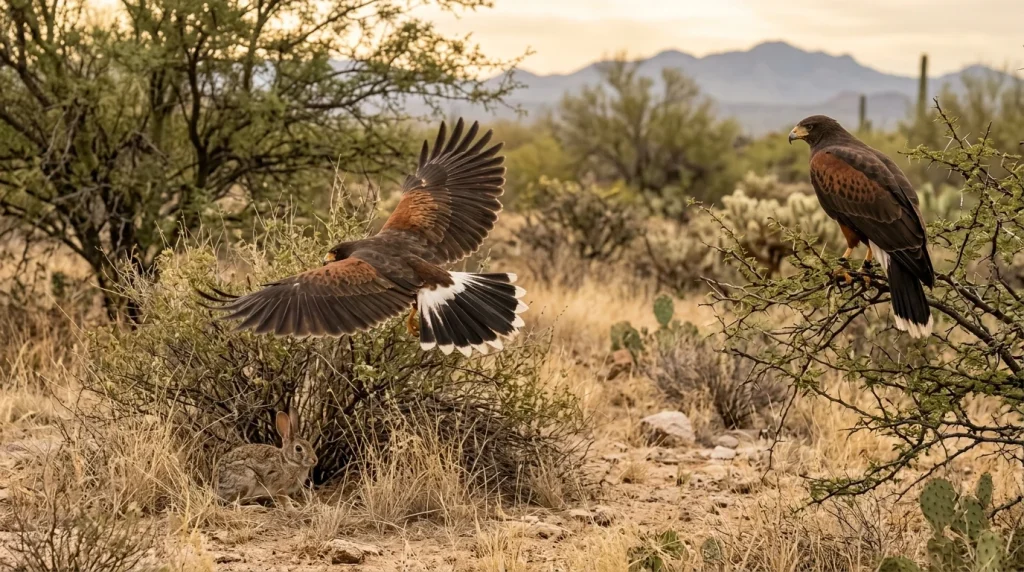
Harris’s Hawks eat mammals, birds, and reptiles. Rabbits and other small to medium-sized mammals can be important prey, with the balance varying by locality and availability. Many hunts begin from a perch, followed by a rapid approach or ground pursuit.
Cooperative hunting is the species’ best-known adaptation. Group members may approach prey from different directions, flush it from cover, or pursue it in succession. Such coordination can make prey accessible that would be difficult for one Hawk to capture.
Not every hunt involves a group, and not every nearby bird plays an obvious role. Watch quietly from a distance rather than approaching a kill or attempting to provoke a hunting response.
Voice and Calls
The voice includes harsh, raspy cries, squeals, and shorter social calls. Repeated, agitated calling may accompany an intruder near a nest or a disturbance within the group.
Calls can help locate birds concealed in trees, but they are less reliable than plumage for identification. Young birds may give persistent food-begging calls. If adults begin alarm-calling in response to your presence, move away rather than searching for the nest.
Breeding and Nesting
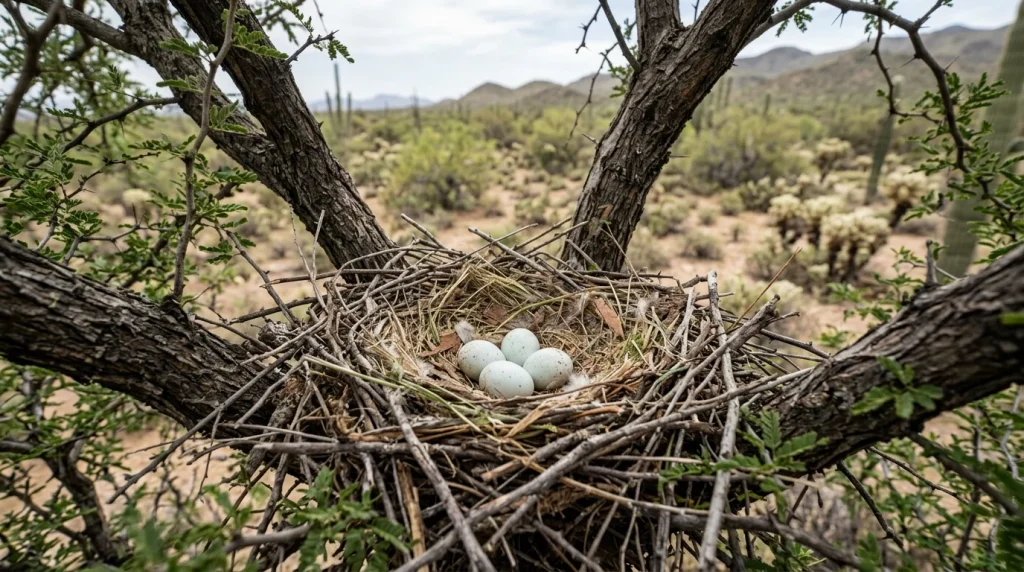
Nests are bulky stick platforms placed in trees, large cacti, and sometimes human-made structures. Softer material lines the cup. Nest timing varies with region and conditions; in favorable circumstances, breeding can extend over a long season, and more than one brood may be raised.
A clutch commonly contains two to four pale bluish-white eggs, sometimes with light brownish markings. Incubation lasts roughly 31–36 days and is performed mainly by the female.
Social arrangements vary. Besides the principal breeding birds, additional group members may help defend the territory, bring food, or assist with young. Avoid assuming that every group is a simple pair with its offspring.
Young and Development
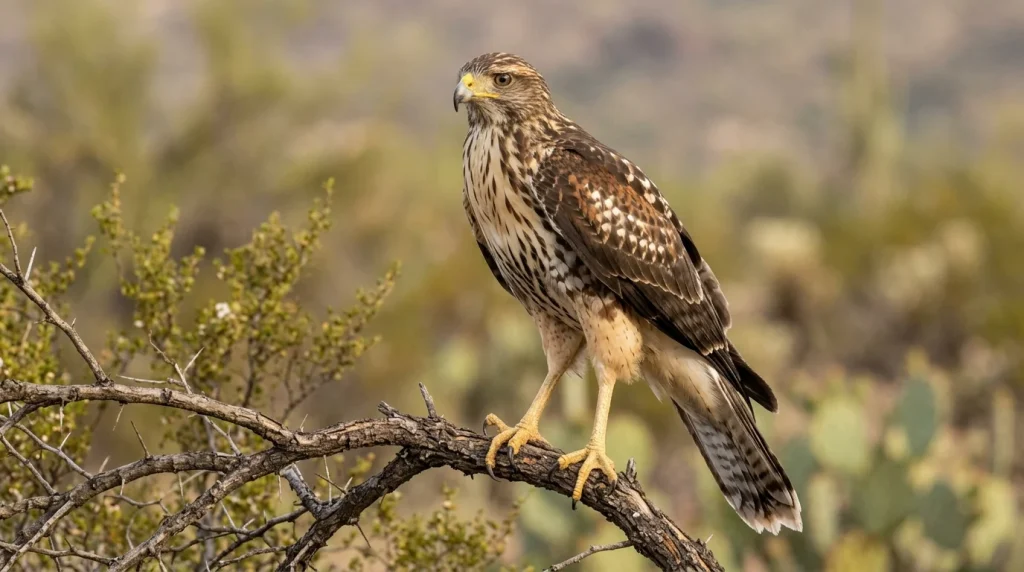
Nestlings begin covered in pale down. Juveniles develop a much paler, streakier underside than adults, often with buff or whitish areas heavily marked in brown. Their upperparts can show pale spotting, and the tail may show narrow barring in addition to the contrasting white areas.
Young usually leave the nest at roughly six to seven weeks, although first branching and sustained flight are different milestones. They continue receiving food afterward and may remain associated with their family group for months. A recently fledged youngster on a low perch is not necessarily abandoned.
Where to See
Southern Arizona is a particularly useful starting point, including suitable desert and suburban edges around Tucson and Phoenix. South Texas brush country also offers opportunities. Check recent local reports because occupancy varies considerably between sites.
Scan tall saguaros, mesquites, utility poles, and exposed branches during the cooler morning hours. After finding one Hawk, inspect nearby perches for others. Use public trails and safe pullouts; never stop in traffic or enter private land to improve a view.
Similar Species
- Red-tailed Hawk: Usually bulkier and shorter-tailed. Most adults have a reddish tail; many pale birds show a belly band. Dark morphs require closer study.
- Common Black Hawk: Dark overall, with especially broad wings and a shorter tail bearing a prominent white band. It lacks Harris’s Hawk’s chestnut shoulders and thighs and often occurs near water.
- Zone-tailed Hawk: More uniformly dark, with contrasting pale tail bands and a Turkey Vulture-like soaring profile. It lacks the chestnut patches.
- Juvenile hawks: Young Harris’s Hawks lose some of the adult’s obvious color contrast. Combine streaking, long legs, tail pattern, and association with identifiable adults.
Conservation
Harris’s Hawk is globally classified as Least Concern, but that broad assessment does not mean every population is secure. Habitat conversion, persecution, collisions, and electrocution can affect local birds. Their tendency to gather on utility structures can increase exposure to electrical hazards.
Useful conservation measures include retaining native scrub and nest supports, making power infrastructure safer, and reducing rodenticide exposure. Observers can help by keeping their distance from nests and avoiding baiting or feeding wild raptors.
Field Identification Tips
- Start with the dark body, long tail, and long yellow legs.
- Look for chestnut shoulders and thighs in favorable light.
- Confirm the white tail base and white tip around a broad black center.
- Check nearby perches for additional hawks.
- Consider age, habitat, and range before ruling out alternatives.
Interesting Facts
- Group members sometimes stand on one another when suitable elevated perches are limited, a behavior often called back-standing.
- Cooperative hunting is unusually well developed for a North American raptor.
- Some young remain with their group and later assist with breeding activities.
- Its adaptability allows it to occupy both relatively natural desert and some developed landscapes.
Frequently Asked Questions
Are Harris’s Hawks always found in groups?
No. Groups are characteristic, but individuals also perch, travel, and hunt alone. Do not exclude a solitary bird on behavioral grounds.
Can you identify males and females by color?
Not reliably. Their plumage is similar. Females are on average larger, but a confident field assessment usually requires more than one distant view.
What is the quickest way to recognize an adult?
Combine the dark body, chestnut shoulders and thighs, and black tail with a white base and tip. That combination is much stronger evidence than any single feature.


