Four-toed Salamander Guide
Keep Track of What You See
Create a free Wild Things Guide membership to record this Four-toed Salamander in My Sightings and build your personal wildlife list.
Join to Add This SightingThe Four-toed Salamander (Hemidactylium scutatum) stands as one of North America’s most distinctive small salamanders, immediately recognizable by the four toes on its hind feet—a characteristic unique among salamanders in its range, which typically possess five. This diminutive woodland species inhabits the northeastern United States and southeastern Canada, where it occupies specialized microhabitats around sphagnum bogs, seeps, and forested wetlands. Despite its wide distribution, the Four-toed Salamander remains uncommon and patchily distributed, largely due to its exacting habitat requirements. Adults rarely exceed three inches in total length, and their retiring habits keep them hidden beneath moss, logs, and leaf litter for much of the year. The species exhibits fascinating reproductive behavior, with females nesting communally in suspended moss above water—a strategy that allows larvae to drop directly into aquatic habitats upon hatching.

Quick Identification
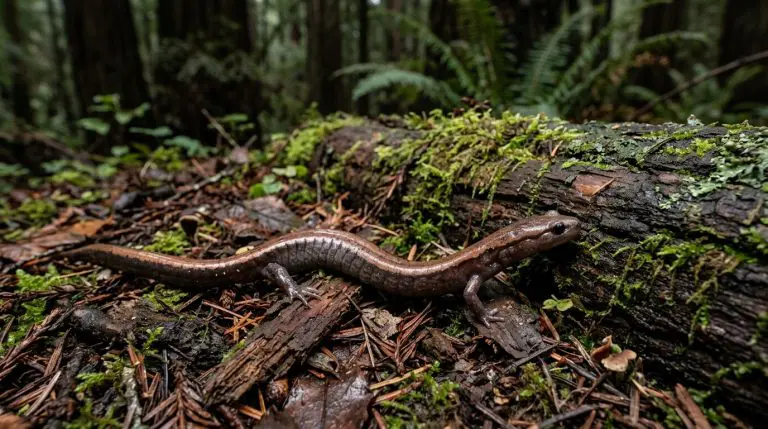
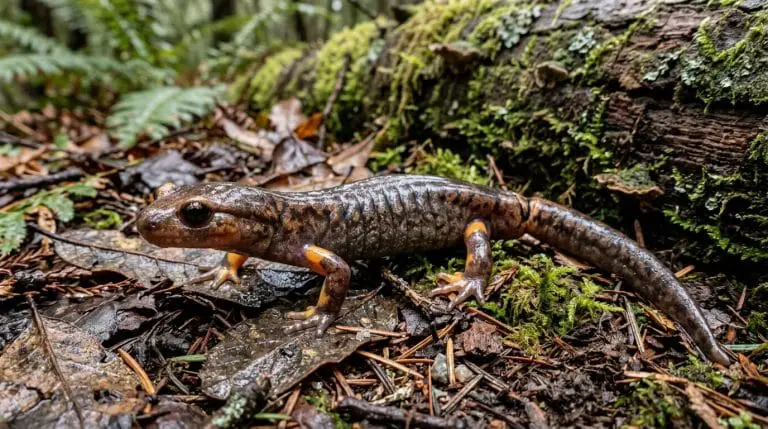
Look for a very small, slender salamander with a notably constricted tail base, reddish-brown to chestnut upperparts, and a bright white belly heavily marked with black spots. The four toes on each hind foot distinguish this species from all other salamanders in eastern North America. The tail appears somewhat prehensile and can be autotomized at the constricted base when the animal is threatened. Adults measure 2 to 4 inches in total length, with roughly half that length comprising the tail.
Appearance and Field Marks
The Four-toed Salamander has a distinctive appearance that makes it easy to identify, even for novice observers. The dorsal coloration ranges from reddish-brown to russet or chestnut, occasionally appearing more grayish-brown in some individuals. This dorsal surface is typically unpatterned, though subtle mottling may be visible in certain lighting conditions. The most striking field mark is the ventral surface: the belly is porcelain white to creamy white, boldly marked with irregular black spots that vary in size and density among individuals. These dark ventral markings provide excellent camouflage when the salamander is viewed from below against leaf litter.
The tail has a pronounced constriction at its base, creating an obvious narrowing where it meets the body. This constriction serves as a predetermined breaking point for autotomy—the voluntary shedding of the tail when grasped by predators. The tail itself is relatively long and cylindrical, often held in a slightly curved or coiled position. The head is small and slightly flattened, with prominent eyes that sit relatively high on the skull. Costal grooves—the vertical furrows along the sides—number 13 to 14 and are clearly visible. The skin appears smooth and moist, typical of lungless salamanders in the family Plethodontidae.
Size and Measurements
Adult Four-toed Salamanders are among the smaller salamanders in eastern North America. Total length typically ranges from 2 to 4 inches (5.1 to 10.2 cm), with most adults measuring between 2.5 and 3.5 inches (6.4 to 8.9 cm). The snout-to-vent length (SVL)—the measurement from the tip of the snout to the posterior margin of the vent—generally spans 1.2 to 2 inches (3 to 5.1 cm). The tail accounts for approximately 40 to 50 percent of the total length when intact, though many individuals in the field exhibit regenerated tails that may be shorter and blunter than originals.
Body proportions are notably slender throughout, with the trunk appearing cylindrical and elongate. The limbs are small and delicate, with the forelimbs only slightly more robust than the hind limbs. Sexual dimorphism in size is subtle; males and females appear similar in length, though gravid females may appear more robust during the breeding season due to developing eggs.
Range and Distribution
The Four-toed Salamander occupies a broad but fragmented range across eastern North America. The species extends from southern Quebec and Nova Scotia southward through New England and the Appalachian Mountains to northern Florida and the Gulf Coast. The western limit of distribution reaches eastern Oklahoma, Missouri, Illinois, Wisconsin, and Michigan. Within this broad range, populations occur patchily, closely tied to suitable wetland habitats.
The distribution appears more continuous in the northern portions of the range, particularly through the northeastern states and southeastern Canada, where appropriate bog and seep habitats are more abundant. Southern populations become increasingly disjunct, particularly in the Coastal Plain regions. Isolated populations have been documented in the Ozark Highlands of Arkansas, Missouri, and eastern Oklahoma, representing the western extent of the range. The species is notably absent from many areas that appear superficially suitable, likely reflecting both current habitat limitations and historical biogeographic factors. Elevational distribution extends from sea level to approximately 4,000 feet (1,220 m) in the Appalachian Mountains.

Habitat
The Four-toed Salamander exhibits highly specific habitat requirements, which largely account for its patchy distribution. The species is strongly associated with forested wetlands, particularly those containing sphagnum moss (Sphagnum spp.), which provides essential nesting substrate. Suitable habitats include sphagnum bogs, forested seeps, swamp margins, vernal pools, and the edges of woodland streams where moss accumulates. The presence of elevated moss hummocks or moss-covered logs and stumps near shallow water appears critical for successful reproduction.
Adults occupy the terrestrial-aquatic interface, spending considerable time in the forest floor adjacent to wetlands. They shelter beneath logs, bark, leaf litter, and moss mats, typically within several meters of water. The microhabitat must maintain high moisture levels throughout the active season, as these small salamanders are highly susceptible to desiccation. Canopy cover is typically moderate to dense, maintaining cool, humid conditions at ground level. Substrate preferences include organic-rich soils with abundant decomposing plant material. Water chemistry in associated wetlands tends toward acidic conditions (pH 4.5 to 6.5), typical of sphagnum-dominated systems, though the species can be found near circumneutral waters where moss is present.

Behavior
Four-toed Salamanders are primarily nocturnal and fossorial, remaining hidden beneath surface cover objects during daylight hours. Activity increases during wet weather, particularly on rainy nights when individuals may be encountered moving across the forest floor or foraging on moss mats. The species demonstrates limited vagility, with most individuals remaining within relatively small home ranges centered on suitable microhabitats. Movement patterns appear closely tied to moisture conditions, with surface activity declining rapidly during dry periods.
When threatened, Four-toed Salamanders typically remain motionless, relying on crypsis for initial defense. If touched or grasped, particularly on the tail, the animal readily autotomizes the tail at the constricted base. The detached tail continues to writhe vigorously, potentially distracting predators while the salamander escapes. Tail regeneration occurs over subsequent months, though regenerated tails are often shorter and lack the original pigmentation pattern. The species exhibits little aggressive behavior toward conspecifics, and communal nesting suggests considerable tolerance among females during the reproductive period.
Diet and Hunting
The Four-toed Salamander is an opportunistic predator of small invertebrates. The diet consists primarily of microinvertebrates commensurate with the salamander’s small size. Documented prey items include springtails (Collembola), mites (Acari), small spiders, ants, small beetles, flies, and various larval insects. Worms, including small earthworms and aquatic oligochaetes, are also consumed. During the aquatic larval stage, prey shifts to aquatic microinvertebrates such as ostracods, copepods, cladocerans, and various aquatic insect larvae.
Foraging occurs primarily at night on the surface of moss mats, beneath logs, and within the leaf litter. The salamander uses visual and chemical cues to detect prey, employing a sit-and-wait strategy combined with slow, deliberate searching movements. When prey is detected within striking distance, the salamander lunges forward and captures the item with its tongue, which bears sticky mucus to secure small prey. Feeding activity appears most intense during spring and fall when moisture conditions are favorable, and prey abundance is high. The species’ small size and specialized habitat likely restrict it to prey substantially smaller than those taken by sympatric salamanders of larger body size.

Vocalizations
Four-toed Salamanders, like all members of the lungless salamander family Plethodontidae, lack lungs and vocal cords and therefore produce no vocalizations. The species relies entirely on chemical, visual, and tactile cues for communication. Chemical signaling through pheromones plays a role in reproductive behavior, with males likely using scent trails to locate females during the breeding season. No sounds are produced during courtship, territorial disputes, or defensive behaviors.
Breeding and Nesting
Breeding activity occurs primarily in autumn, typically from September through November, though timing varies with latitude and local climate conditions. Courtship has been observed less frequently than in many other salamanders, likely due to the species’ secretive habits. Males approach females and engage in nosing and body contact; details of spermatophore deposition and transfer remain incompletely documented in natural settings but are presumed to follow patterns typical of plethodontid salamanders, with the female picking up a spermatophore deposited by the male.
Nesting behavior in the Four-toed Salamander is remarkable and distinguishes the species from most other woodland salamanders. Following fertilization in autumn, females retain developing eggs through winter. In spring—typically March through May depending on latitude—gravid females migrate short distances to nest sites. These sites consist of sphagnum moss, moss-covered logs, or other moss accumulations suspended immediately above shallow water. Females excavate small cavities within the moss, creating a humid chamber where they deposit eggs. A typical clutch contains 15 to 50 eggs (average approximately 30), which are attached individually to the moss substrate by short stalks. The eggs are relatively large, measuring 3 to 4 mm in diameter, unpigmented, and enclosed in gelatinous capsules.
Communal nesting is common, with multiple females depositing eggs in close proximity or even within the same moss clump. Aggregations of several dozen eggs from multiple females have been documented. Females remain with their eggs throughout the incubation period, which lasts 38 to 60 days depending on temperature. Attending females are believed to provide protection from predators and may help maintain optimal moisture conditions. According to information from the AmphibiaWeb species account, this brooding behavior is critical for successful development. Females typically abandon the nest shortly before hatching commences.

Reproduction
Eggs hatch in late spring or early summer, typically May through July. Upon hatching, larvae drop directly from the suspended nest into the water below—a distance of a few centimeters to more than a meter depending on the height of the moss substrate. This remarkable adaptation allows larvae to enter the aquatic environment immediately without requiring female transport. Newly hatched larvae measure approximately 10 to 12 mm in total length and possess external gills, a broad tail fin, and well-developed eyes.
The larval period is relatively short, lasting 4 to 8 weeks under favorable conditions. Larvae inhabit shallow, often temporary pools, seeps, and bog margins where they feed on aquatic microinvertebrates. Growth is rapid during the larval stage, with individuals metamorphosing at approximately 18 to 22 mm snout-to-vent length. Metamorphosis involves the resorption of gills and tail fin, development of adult pigmentation including the characteristic white belly with black spots, and the transition to terrestrial respiration through the skin. Metamorphs typically emerge onto land in mid to late summer, seeking shelter in moist terrestrial microhabitats near the natal wetland.
Sexual maturity is reached at 2 to 3 years of age in most populations. Adult lifespan in the wild is not well documented but is estimated at 5 to 8 years based on recapture studies and comparisons with related species. Individuals may breed annually once mature, though not all adults necessarily breed every year.
Similar Species
The Four-toed Salamander is unlikely to be confused with other species once the distinctive four toes on the hind feet are noted. However, superficial resemblance to several small woodland salamanders may cause initial confusion, particularly when the feet are not examined carefully.
Red-backed Salamanders (Plethodon cinereus) occupy similar habitats and are commonly encountered throughout much of the Four-toed Salamander’s range. Red-backed Salamanders typically possess a prominent dorsal stripe (red or gray color phase), have five toes on the hind feet, lack the constricted tail base, and have dark bellies with white or silver mottling rather than the white belly with black spots. The Zigzag Salamander (Plethodon dorsalis) and related Plethodon species also have five hind toes and different ventral coloration patterns.
Small individuals of the Northern Two-lined Salamander (Eurycea bislineata) and related Eurycea species may occur in similar wetland habitats but are distinguished by five hind toes, prominent lateral stripes, and different ventral patterns. The tail base in Eurycea species is not constricted. Additionally, larval Four-toed Salamanders, with their short larval period and rapid development, might be confused with larvae of other small stream salamanders, but the seasonal timing and specific moss-overhung microhabitats are distinctive.
Conservation
The Four-toed Salamander is not currently listed as threatened or endangered at the federal level in the United States, but conservation status varies considerably among states and provinces. Several states classify the species as threatened, endangered, or of special concern, reflecting local rarity and habitat vulnerability. In Canada, the Committee on the Status of Endangered Wildlife in Canada (COSEWIC) has assessed the species.
The primary conservation concern for this species is habitat loss and degradation. Development, wetland draining, and hydrological alterations threaten the specialized sphagnum bog and seep habitats required for breeding. Forestry practices that remove canopy cover or disturb moss mats can render sites unsuitable. Pollution and acidification of wetlands, though the species naturally inhabits acidic waters, may affect prey availability and water quality beyond tolerable thresholds. Climate change poses potential long-term threats through altered precipitation patterns, increased drought frequency, and shifts in sphagnum distribution.
Conservation of the Four-toed Salamander requires protection of wetland complexes and adjacent upland forests. Buffer zones around breeding wetlands are critical, as adults range into surrounding terrestrial habitats. Maintaining canopy cover and protecting moss accumulations during forest management activities support population persistence. Several states have established monitoring programs to track population trends and identify critical habitats requiring protection.
Field Identification Tips
When searching for Four-toed Salamanders, focus efforts on forested wetlands with abundant sphagnum moss, particularly in spring and fall when surface activity is highest. Check beneath logs, bark, and moss mats within several meters of water. Rainy spring nights provide optimal conditions for encountering active individuals.
If you locate a small, reddish-brown salamander, carefully examine the hind feet by gently restraining the animal in a clear container or cupped hands. Count the toes: four on each hind foot confirms identification as a Four-toed Salamander. Note the pronounced constriction at the tail base—a field mark visible even from a short distance. Observe the bright white belly with black spots by carefully turning the animal or allowing it to crawl across a clear surface.
During the nesting season (typically April through June), inspect sphagnum moss overhanging shallow water for the presence of eggs or attending females. Exercise extreme care to avoid disturbing nests, as disruption may cause nest abandonment. Replace all cover objects carefully after searching to maintain microhabitat quality. Handle salamanders minimally and with wet hands to protect their permeable skin, and always return animals to their exact point of capture.
Interesting Facts
The Four-toed Salamander is the only member of its genus, Hemidactylium, making it phylogenetically unique among North American salamanders. The genus name translates to “half finger,” referring to the reduced number of toes.
The constricted tail base and tail autotomy in this species are among the most pronounced in any salamander. Unlike many lizards that regenerate tails closely resembling the original, salamander tail regeneration is often incomplete, and regenerated tails in Four-toed Salamanders are frequently shorter and less well-defined.
Communal nesting, while not unique among salamanders, is particularly well-documented in this species. Some nesting aggregations have contained eggs from more than a dozen females, suggesting either limited suitable nesting habitat or possible social attraction to occupied nest sites.
The species’ reliance on sphagnum moss for reproduction creates an interesting ecological linkage: the distribution of this salamander is partly dependent on the distribution and health of sphagnum bogs, which are themselves sensitive indicators of environmental conditions and climate patterns.
Four-toed Salamanders have been successfully maintained and bred in captivity, providing valuable insights into their reproductive biology. However, their specialized habitat requirements make them challenging to maintain long-term compared to more generalist salamander species.