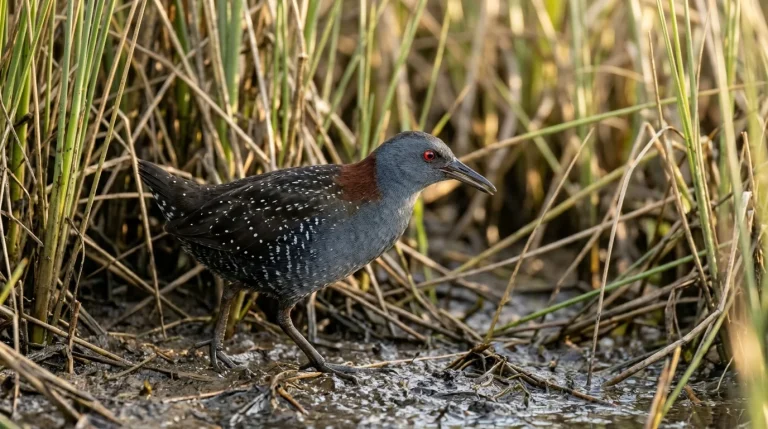
Common Gallinule Guide
Keep Track of What You See
Create a free Wild Things Guide membership to record this Common Gallinule in My Sightings and build your personal wildlife list.
Join to Add This SightingIntroduction
The Common Gallinule (Gallinula galeata) is a chicken-shaped wetland bird with a bright red forehead shield, a yellow-tipped bill, and surprisingly long toes. It swims along marsh edges, walks over floating plants, and often disappears into reeds before you get a clear look. Although bird guides sometimes group it with songbirds, it is a rail, not a songbird.
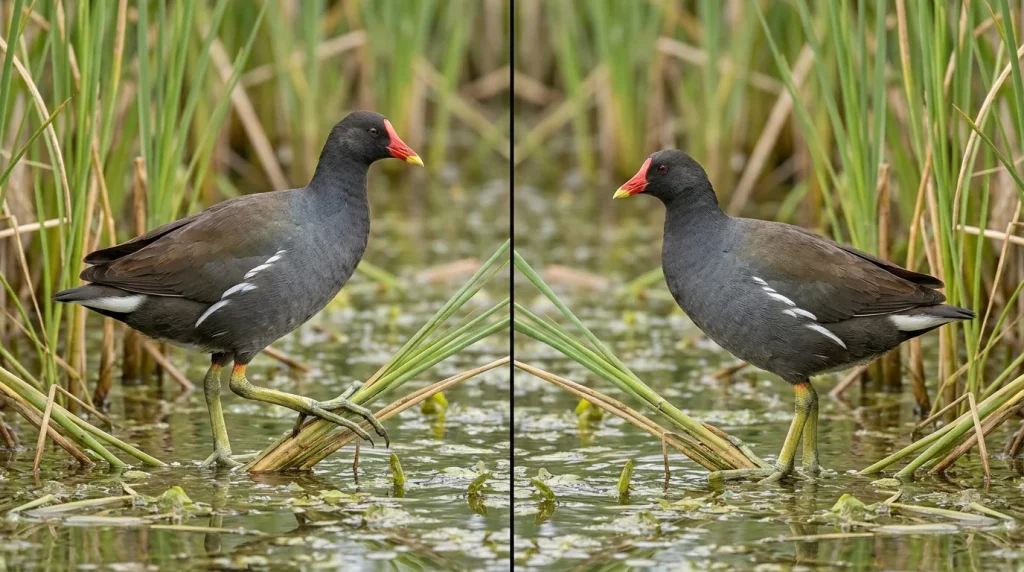
For quick identification, look for a dark body, a white stripe along the side, and white patches beneath a tail it often raises. These marks help separate it from coots, ducks, and other gallinules.

Quick Identification
- Shape: Rounded body, small head, short pointed bill, and long legs and toes.
- Adult color: Dark gray head and underparts with a browner back.
- Bill: Red with a yellow tip; a red shield extends onto the forehead.
- Side marking: A narrow, sometimes broken white stripe above the lower edge of the folded wing.
- Tail: Often flicked upward, showing white undertail patches divided by a dark center.
- Movement: Bobs its head while swimming and steps carefully across floating vegetation.
- Voice: Loud clucks, cackles, and short, sharp calls from marsh cover.
Appearance
Adults look nearly black at a distance, but good light reveals a charcoal head and breast, brownish back, and gray flanks. The red bill and forehead shield are especially noticeable on breeding birds. Legs are yellowish to greenish, often with red near the upper leg.
Males and females have very similar plumage. Males average slightly larger, but size alone rarely provides a reliable field identification of sex. Do not expect different color patterns between males and females.
Juveniles are duller brownish gray, with a paler throat and a dull bill. Their white flank stripe and undertail pattern are more useful than bill color.
Size and Wingspan
- Length: About 12.6–13.8 inches (32–35 cm).
- Wingspan: About 19.7–24.4 inches (50–62 cm).
A Common Gallinule is smaller and slimmer than a typical Mallard and roughly similar in length to an American Coot. Its long, unwebbed toes are most obvious when it leaves the water. Distance and posture can make size comparisons misleading.
Range and Distribution
Common Gallinules occur from parts of southern Canada through the United States, Mexico, Central America, the Caribbean, and much of South America. In the United States, they are especially widespread in suitable eastern and southern wetlands, with more scattered populations in the West.
Northern breeders generally migrate south for winter. Many birds in warmer areas remain year-round, particularly where marshes stay wet and food remains available. Local numbers can change sharply as water levels rise or fall.
Hawaii also supports a resident subspecies, the Hawaiian Common Gallinule. Older North American books may call this species Common Moorhen; that name now generally refers to the related Old World species.

Habitat
Look for shallow freshwater wetlands where open water meets thick plant cover. Typical settings include cattail marshes, reed beds, pond margins, wet ditches, and sheltered lake edges. Birds also use some brackish wetlands and human-made ponds with suitable vegetation.
The best habitat combines hiding places with openings for feeding. Floating leaves, low mats of plants, and muddy edges provide places to walk and forage. A pond with neatly mowed banks and little cover is usually less promising than one with a thick, uneven marsh edge.

Behavior
Common Gallinules move easily between swimming, wading, and walking. Their long toes spread their weight over soft mud and floating plants. Unlike ducks, they lack webbed feet. They often swim with a steady head-bobbing motion and flick their tails, revealing white undertail patches.
Although often shy, birds at quiet park ponds may feed in plain view. Breeding pairs defend territories and may chase other gallinules. Outside the breeding season, several birds may gather where food and cover are plentiful.
When startled, a bird may rush into reeds, swim away, dive, or take a short flight, trailing its legs.
Diet
This species eats both plants and small animals. Its menu changes with season and local food supplies. It eats seeds, leaves, shoots, and other parts of aquatic plants.
- It also eats seeds, leaves, shoots, and other parts of aquatic plants.
- Insects and their larvae.
- Snails and other small aquatic invertebrates.
- Occasional small aquatic vertebrates or other available foods.
Watch for birds picking food from the water’s surface, nibbling vegetation, or probing along muddy edges. They may reach forward while swimming or tip down to feed. Observe natural feeding rather than offering bread or other human food.

Vocalizations
A gallinule may announce itself long before it appears. Its calls include sharp clucks, rough cackles, squeaks, and repeated nasal notes. Some sound surprisingly loud for a bird hidden deep in vegetation. Calls serve several purposes, including keeping contact and responding to intruders.
No single written sound captures the full range. Listen to recordings from the Cornell Lab of Ornithology before visiting a marsh. In the field, use calls to locate a likely bird, then confirm it by sight when possible.
Breeding and Nesting
Pairs usually nest in dense marsh vegetation near or over shallow water. The nest is a platform or bowl of plant material, supported by stems or resting on a low base. Nearby vegetation may help hide it, and some nests have a ramp-like approach.
A clutch often contains about 5–10 eggs, though larger and smaller clutches occur. Eggs range from buff to tan and may have darker spots or blotches. Both parents help incubate, which usually takes about three weeks.
Both adults also care for the young. In favorable conditions, pairs may raise more than one brood. Never push through vegetation to inspect a nest.

Young and Development
Newly hatched chicks have black down and bright, bare skin around their heads. They can leave the nest and swim soon after hatching, but this early mobility does not mean they are independent. Adults lead them to cover and feed them while they learn to find food.
As birds grow, they gradually replace their down with dull brownish-gray feathers. Older young sometimes help care for chicks from a later brood. Family groups may stay near dense vegetation and hide when people, dogs, or predators approach.
Where to See
In North America, freshwater marshes in Florida, the Gulf Coast region, and other warm southern areas offer good year-round opportunities. During the breeding season, suitable marshes farther north can also hold birds. Western observers should check local wetland reports because the species is patchier there.
- Scan the edges of cattails, not just the center of a pond.
- Check floating plant mats and small openings between reeds.
- Visit during quiet early morning or late afternoon.
- Wait at a boardwalk or viewing platform instead of pursuing a hidden bird.
Similar Species
- American Coot: Usually has a white bill and forehead shield, not a red bill with a yellow tip. It lacks the long white flank stripe of the gallinule. Coot toes have broad lobes; gallinule toes do not.
- Purple Gallinule: Adults have rich blue-purple underparts, a greenish back, pale blue forehead shield, and bright yellow legs. Juveniles are harder to spot but usually lack the crisp white side stripe of the Common Gallinule.
- Sora: Much smaller, with a short yellow bill and strongly patterned brown upperparts. Adults show black around the face and throat.
- Common Moorhen: A very similar Old World relative. Location and current species treatment matter more than a quick plumage comparison; it is not the expected gallinule across mainland North America.
Conservation
The Common Gallinule is generally listed as Least Concern globally, but that broad status does not mean every population is secure. Wetland drainage, loss of shoreline plants, pollution, and poorly timed water-level changes can reduce feeding and nesting habitat.
The Hawaiian subspecies is federally listed as endangered in the United States and faces distinct local threats, including introduced predators and wetland loss. Protecting shallow wetlands, retaining native marsh plants, controlling invasive species, and managing water carefully can benefit gallinules and many other wetland birds.
Field Identification Tips
- Start with shape: Look for a small-headed, chicken-like swimmer near cover.
- Check the bill: Red with a yellow tip strongly supports an adult Common Gallinule.
- Find the white side stripe: This is useful even when the head is hidden.
- Watch the tail: Repeated flicks often expose the divided white undertail patches.
- Allow for age: Young birds lack the adult’s bright bill and shield.
- Combine clues: Behavior, habitat, and several markings are safer than any single feature.
Frequently Asked Questions
Is a Common Gallinule a duck?
No. It belongs to the rail family (Rallidae) in the order Gruiformes. Its swimming habits can suggest a duck, but its pointed bill and long, unwebbed toes tell a different story.
Are Common Gallinule and Common Moorhen the same bird?
Older guides treated them as one species. Current North American usage recognizes the Common Gallinule of the Americas separately from the Old World Common Moorhen.
Can Common Gallinules fly?
Yes. They can fly for sustained periods, and northern populations migrate. A bird that runs into reeds rather than flying is choosing cover, not showing an inability to fly.
How can I tell a male from a female?
Usually you cannot do so reliably by plumage alone. Both sexes share the same main markings. A modest size difference is rarely enough to identify a lone bird.