Black-tailed Deer Guide
Keep Track of What You See
Create a free Wild Things Guide membership to record this Black-tailed Deer in My Sightings and build your personal wildlife list.
Join to Add This Sighting1. Introduction
The Black-tailed Deer is one of the most characteristic hoofed mammals of western North America. Closely associated with coastal forests, brush-covered hillsides, woodland openings, and mountain meadows, this adaptable deer ranges from Southeast Alaska through British Columbia and the Pacific Northwest into California.
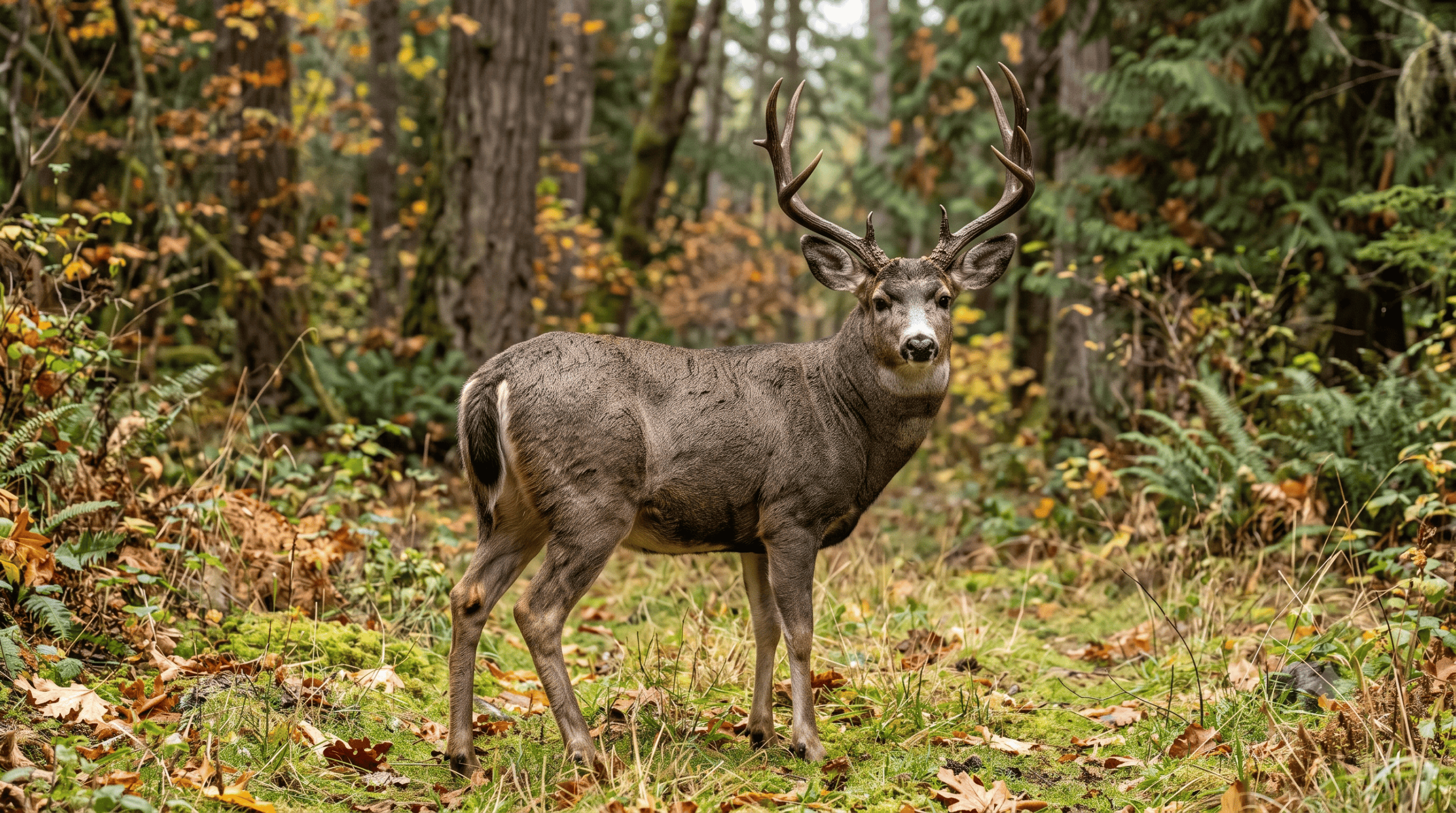
A Black-tailed Deer can be surprisingly difficult to see. Its dark, subdued coat blends into shadowy forests, and it often remains motionless when danger approaches. Fortunately, its large ears, forked antlers, compact build, and dark tail provide useful identification clues.
Two principal forms are generally recognized:
- Columbian Black-tailed Deer (Odocoileus hemionus columbianus)
- Sitka Black-tailed Deer (Odocoileus hemionus sitkensis)
Both are usually classified as subspecies of the Mule Deer. The Columbian form occupies coastal portions of the Pacific Northwest and California, while the smaller Sitka form inhabits the wet coastal forests of British Columbia and Southeast Alaska.
This guide explains how to identify the Black-tailed Deer by its appearance, behavior, habitat, tracks, feeding signs, and differences from similar species.
2. Quick Facts
| Feature | Description |
|---|---|
| Common name | Black-tailed Deer |
| Scientific name | Odocoileus hemionus |
| Family | Cervidae |
| Order | Artiodactyla |
| Animal type | Hoofed mammal and ruminant |
| Principal forms | Columbian and Sitka Black-tailed Deer |
| Body length | Approximately 4–6 feet |
| Shoulder height | Approximately 2½–3½ feet |
| Typical weight | About 80–200 pounds, depending on sex, region, and subspecies |
| Male | Buck |
| Female | Doe |
| Young | Fawn |
| Diet | Leaves, twigs, shrubs, forbs, grasses, fungi, berries, and agricultural plants |
| Breeding season | Primarily autumn |
| Fawns born | Usually late spring or early summer |
| Typical litter | One or two fawns |
| Average lifespan | Commonly under 10 years in the wild; some may live 15 years |
| Activity | Most active around dawn and dusk |
| Main predators | Cougars, wolves, coyotes, bears, and humans |
| Most useful field mark | Dark upper surface of the tail |
The size of a Black-tailed Deer varies considerably. Sitka animals are generally smaller than Columbian animals, and bucks are larger and heavier than does. Alaska wildlife officials report average autumn weights of approximately 120 pounds for Sitka bucks and 80 pounds for does, although unusually large bucks can exceed 200 pounds. Alaska Department of Fish and Game
3. Identification
The Black-tailed Deer has a compact but graceful body, slender legs, large ears, and a relatively narrow face. Its coat generally appears reddish or yellowish-brown in summer and darker gray-brown in winter.
Key identification features
Look for the following combination:
- A dark brown or black upper tail
- Large ears, although usually not as enormous-looking as those of an inland Mule Deer
- A gray-brown or reddish-brown body
- A pale throat patch
- A lighter underside
- A dark forehead or facial mask
- Forked antlers on adult males
- A compact, woodland-adapted build
The tail is the most useful feature. When lowered, it appears dark from above. The underside may be lighter, but the tail does not display the broad, brilliant white flag associated with a White-tailed Deer.
Bucks
An adult male Black-tailed Deer is normally heavier through the shoulders and neck than a doe. During the autumn breeding season, or rut, a mature buck develops a swollen neck and a more muscular appearance.
A buck’s antlers usually fork as they grow. The main beams divide, and those branches may divide again. This branching pattern differs from the arrangement on a White-tailed Deer, whose individual tines generally rise from a single main beam.
Antler size varies according to age, nutrition, genetics, health, and habitat. The relatively small Sitka form typically produces smaller antlers than larger Columbian animals.
Does
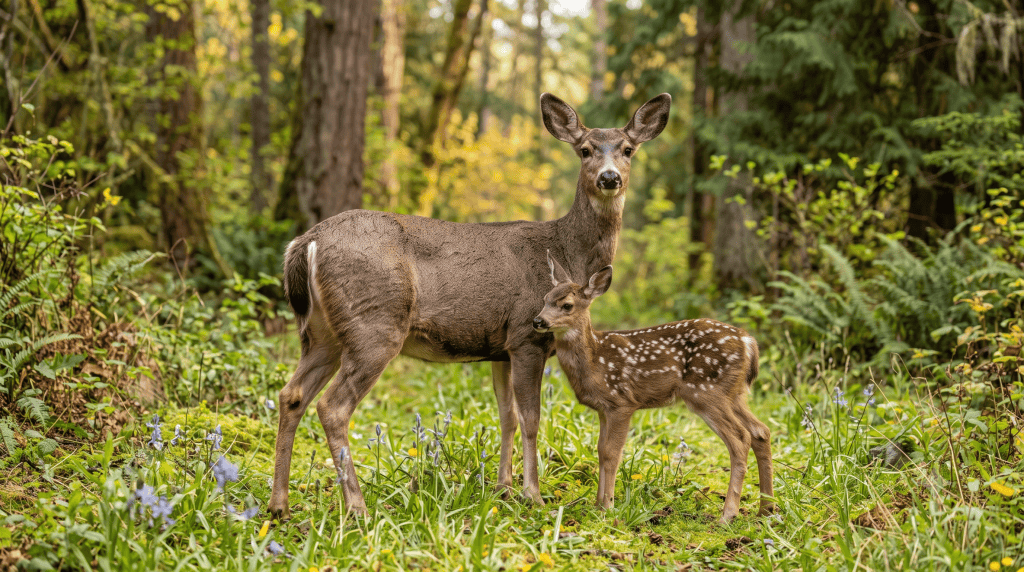
The female Black-tailed Deer lacks antlers under normal circumstances. She has a slimmer neck, narrower chest, and lighter build than an adult buck. Her face may also appear more delicate.
Sex can be difficult to determine after bucks shed their antlers. In late winter or early spring, observers should consider overall body shape rather than assuming every antlerless animal is a doe.
Fawns
Newborn fawns have reddish-brown coats marked with white spots. The spotted pattern breaks up the outline of a resting fawn among patches of sunlight and vegetation.
A fawn may remain hidden and motionless for long periods while its mother feeds elsewhere. A lone fawn is therefore not necessarily abandoned. Watch from a distance and never attempt to handle it.

Seasonal coat
The summer coat is relatively thin and commonly reddish or tawny brown. In autumn, it is replaced by a thicker gray-brown winter coat. Sitka animals may become especially dark during winter, helping them blend into wet coastal forests.

4. Range
The natural range of the Black-tailed Deer extends along the Pacific coast of North America. It extends from Southeast Alaska and coastal British Columbia south through western Washington and Oregon into California.
The two forms have different distributions:
- The Sitka Black-tailed Deer is native to Southeast Alaska and the north-coastal region of British Columbia. Introduced populations also occur in parts of Prince William Sound and on Kodiak and Afognak islands.
- The Columbian Black-tailed Deer occurs from coastal British Columbia south through western Washington and Oregon into coastal and northern California, with populations extending farther south in suitable habitat.
Distribution is influenced by topography, snow depth, forest cover, food availability, development, and local land-management practices. In mountainous areas, some animals move between seasonal ranges, while others remain in relatively small home ranges throughout the year.

5. Habitat
The Black-tailed Deer is primarily associated with forested and brushy landscapes. It often uses a mixture of dense hiding cover and open feeding areas.
Typical habitats include:
- Temperate rainforests
- Redwood and Douglas-fir forests
- Forest edges
- Brushy hillsides
- Oak woodlands
- Coastal scrub
- Riparian corridors
- Clearings and meadows
- Recently burned areas
- Regenerating timberlands
- Subalpine meadows
- Farms, orchards, parks, and suburban neighborhoods
Habitat quality depends on more than the presence of trees. Dense mature forest can provide shelter, but a closed canopy may prevent sufficient ground-level vegetation from growing. Forest edges, natural openings, younger vegetation, and areas with a varied canopy often provide better feeding opportunities.
In snowy regions, mature conifers intercept snow, making it easier for deer to reach ground-level plants. Deep or crusted snow can restrict movement, cover food, and increase the energy required to travel.
6. Behavior
A Black-tailed Deer is usually most active around dawn and dusk, although weather, season, hunting pressure, and human activity can alter this pattern. Deer in undisturbed locations may feed during daylight, while animals in heavily used areas may become more nocturnal.
Does and their young often form small family groups. Bucks may travel alone or associate with other males outside the breeding season. Large herds are less typical than the smaller groups commonly seen in forested country.
When alarmed, a deer may:
- Freeze and stare toward the disturbance.
- Rotate its ears to locate faint sounds.
- Sniff the air.
- Stamp a front foot.
- Snort or blow forcefully.
- Bound into dense cover.
Like other Mule Deer relatives, the Black-tailed Deer may use a stiff-legged bounding gait in which all four feet leave the ground together. This movement, called stotting or pronking, is useful when crossing rough terrain or escaping through brush.
During the autumn rut, bucks become more active and may travel beyond their usual home ranges in search of receptive does. Rival males sometimes spar or fight with their antlers.
7. Diet
The Black-tailed Deer is a selective herbivore and primarily a browser. Rather than consuming large quantities of coarse grass, it chooses nutritious leaves, shoots, buds, flowers, and tender stems.
Its diet may include:
- Blackberry and salmonberry leaves
- Huckleberry and blueberry plants
- Salal
- Willow
- Red huckleberry
- Vine maple
- Ceanothus
- Serviceberry
- Elderberry
- Oak leaves and acorns
- Grasses and sedges
- Clover and other forbs
- Lichens
- Mushrooms and other fungi
- Fruits and berries
- Garden and agricultural plants
Diet changes throughout the year. Fresh grasses, herbs, and new leaves are important during spring. Summer offers a wider selection of leafy plants, flowers, berries, and shoots. Acorns, fruits, and fungi may become important during autumn. In winter, deer depend more heavily on evergreen plants, woody browse, lichens, and whatever vegetation remains accessible.
As a ruminant, the deer has a specialized, multi-chambered stomach. It may feed quickly in an open location, retreat to cover, regurgitate the food, and chew it again as cud.
8. Reproduction & Life Cycle
Breeding generally occurs in autumn, most often from October through December. Timing varies with latitude, weather, elevation, and population.
During the rut, bucks rub their antlers and foreheads on small trees, scrape the ground, scent-mark their surroundings, and search for does. Mature males may eat less while devoting more time to breeding activity.
After a gestation of approximately six to seven months, does give birth in late spring or early summer. First-time mothers frequently have one fawn, while mature, well-nourished does may produce twins.
For the first several weeks, a fawn relies on camouflage and stillness. The mother visits periodically to nurse it but avoids remaining beside it continuously, which could attract predators.
Young deer gradually begin sampling vegetation and are weaned during their first year. Females may remain near their mothers longer than young males, which are more likely to disperse.
Bucks grow a new set of antlers annually. Growth begins in spring beneath a soft, blood-rich covering called velvet. By late summer or early autumn, the antlers harden, and the velvet is rubbed away. The antlers are shed after the breeding season, usually during winter or early spring.
9. Tracks & Signs
Even when the animal remains hidden, tracks and other field signs may reveal that a Black-tailed Deer is nearby.
Tracks
The track consists of two pointed, crescent-shaped hoof impressions. Together, they often form a heart-shaped outline.
Typical characteristics include:
- Two narrow, pointed hoof marks
- Tracks commonly around 2–3 inches long
- Hind tracks sometimes landing in or near the front tracks
- Dewclaw marks occasionally visible in deep mud, snow, or during a fast run
- A walking trail that forms a relatively straight line
Track size is affected by the animal’s age, sex, footing, and speed. A large track does not by itself prove that the animal was an adult buck.

Scat
Droppings usually appear as clusters of oval or tapered pellets. Their texture varies with diet. Winter pellets may be firm and dry, while droppings produced after feeding on lush, moisture-rich plants can be soft or clumped together.
Deer pellets overlap considerably with those of Mule Deer, White-tailed Deer, elk, and other ruminants. Location and size can help, but scat should rarely be used as the only identification clue.
Beds
A deer bed is a shallow, oval depression where vegetation has been flattened. Beds may contain hair, nearby tracks, and pellets. Several beds in one location may indicate repeated use by a family group.
Browsing signs
Look for leaves and twigs that appear pinched or torn. Deer lack upper front incisors, so browsed stems often have ragged ends. Rabbits and rodents, by comparison, may leave cleaner, angled cuts.
Rubs and scrapes
Bucks rub their antlers against saplings, stripping or polishing the bark. A scrape is an area where a buck has pawed away leaves and debris, sometimes beneath an overhanging branch.
10. Similar Species
Mule Deer
The Mule Deer is the closest look-alike, as the Black-tailed Deer is generally considered part of the Mule Deer species.
An inland Mule Deer usually has:
- A pale or white tail with a distinct black tip
- Very large ears
- A paler gray body
- A larger overall build
- More open, dry-country habitat
The dark upper tail and coastal forest habitat favor identification as a black-tail. In contact zones, however, appearances can be intermediate, and field identification may be uncertain.
White-tailed Deer
A White-tailed Deer usually has:
- A long tail with a large white underside
- A tail raised like a flag when fleeing
- Antler tines rising from a single main beam
- A more reddish-brown summer coat
- A galloping escape style rather than frequent stiff-legged bounding
The contrast becomes most obvious when the animal runs. A fleeing White-tailed Deer displays a conspicuous white flag, while a Black-tailed Deer retains a much darker-looking tail.
Sitka versus Columbian forms
The Sitka form is generally smaller, stockier, and darker. It also tends to have smaller antlers. The Columbian form is usually larger and occurs farther south along the coast. Geographic location is often the most reliable clue for separating them.
11. Predators & Threats
Cougars are among the most important natural predators of adult deer. Wolves can also take adults where their ranges overlap. Coyotes, black bears, brown bears, bobcats, and golden eagles may prey on fawns, although the importance of each predator varies by region.
Other threats include:
- Severe winters
- Deep snow
- Malnutrition
- Drought
- Wildfire-related habitat changes
- Habitat fragmentation
- Loss of migration corridors
- Vehicle collisions
- Fences
- Free-ranging dogs
- Disease and parasites
- Poorly planned timber harvest
- Illegal killing
- Climate-related changes in vegetation and snow conditions
Young forest growth can initially produce abundant forage. As those stands become densely shaded, however, ground-level vegetation may decline dramatically. Alaska research has found that some closed second-growth forests provide poor winter forage and limited snow interception, reducing their value to Sitka deer. Alaska Department of Fish and Game
12. Ecological Importance
The Black-tailed Deer influences the plant communities in which it lives. Consuming leaves, shoots, seedlings, fruits, and fungi can affect plant growth, forest regeneration, and competition among plant species.
It also performs several ecological roles:
- Providing prey for large carnivores
- Moving seeds in its digestive tract or on its coat
- Dispersing fungal spores
- Recycling nutrients through urine, droppings, and decomposition
- Creating trails used by other animals
- Influencing the density and composition of understory vegetation
Where deer populations become unusually concentrated, excessive browsing can reduce native wildflowers, shrubs, and young trees. Balanced populations are therefore important to healthy forest ecosystems.
13. Interesting Facts
- The name refers to the dark upper surface of the tail rather than an entirely black tail.
- A Black-tailed Deer can rotate its large ears independently to pinpoint sounds coming from different directions.
- The Sitka form is named for Sitka, Alaska.
- Columbian animals are named after the Columbia River region.
- Fawn spots gradually fade as the young deer grows its first winter coat.
- Antlers are living bone while growing and are among the fastest-growing tissues found in mammals.
- Deer commonly swim across rivers, channels, and narrow stretches of salt water.
- Coastal animals may visit beaches, estuaries, and shorelines to feed on available vegetation.
- Some mountain populations migrate between low-elevation winter habitat and high summer ranges.
- A motionless Black-tailed Deer can be extremely difficult to detect, even when standing only a short distance inside a forest.
14. Conservation
The Black-tailed Deer remains widespread, but abundance differs considerably among regions. Some populations are stable or locally numerous, while others are affected by habitat loss, severe weather, development, road mortality, predation, or declining habitat quality.
Important conservation measures include:
- Protecting winter ranges
- Maintaining forest openings and diverse understory vegetation
- Preserving mature forest cover in snowy regions
- Conserving migration corridors
- Creating safe wildlife crossings
- Managing hunting according to local population data
- Controlling invasive plants
- Restoring native browse
- Reducing disturbance around fawning areas
- Keeping dogs controlled
- Preventing intentional feeding
Feeding wild deer is usually discouraged. Concentrating animals around artificial food sources can spread disease, cause digestive problems, attract predators, increase the risk of vehicle collisions, and create conflicts with neighbors.
Visitors should observe all local regulations and give wildlife enough space to continue behaving normally.
15. Photography Tips
The best time to photograph a Black-tailed Deer is often shortly after sunrise or during the last hours before sunset. Soft light reveals the coat’s texture and produces more attractive forest backgrounds.
For better photographs:
- Search along meadow edges and quiet forest roads.
- Scan the shadows rather than looking only in open areas.
- Use a telephoto lens.
- Focus on the nearest eye.
- Use a fast shutter speed if the animal is walking.
- Position yourself so the deer is separated from a cluttered background.
- Photograph from inside a parked vehicle where permitted.
- Avoid surrounding or following the animal.
- Never approach a fawn for a close-up.
- Do not use food, calls, or scent to lure deer.
- Give rutting bucks additional room.
- Back away if the animal stares repeatedly, stamps, snorts, or stops feeding.
A useful rule is simple: if your presence causes the deer to move or change its behavior, you are too close.
16. Related Species
Other members of the deer family that may interest readers include:
- Mule Deer
- White-tailed Deer
- Coues White-tailed Deer
- Roosevelt Elk
- Rocky Mountain Elk
- Moose
- Caribou
- California Tule Elk
- Key Deer
The Mule Deer and White-tailed Deer are the most useful related species for identification comparisons. Elk and moose leave similar two-part hoofprints, but their tracks, droppings, beds, and feeding signs are normally much larger.
17. Final Thoughts
The Black-tailed Deer is a secretive and adaptable resident of the Pacific Coast’s forests, mountains, woodlands, and brushy openings. Its large ears and forked antlers resemble those of other Mule Deer, but the dark tail, compact build, and coastal distribution provide valuable identification clues.
For the best field identification, avoid relying on a single characteristic. Consider the tail, ears, antlers, body size, coat color, habitat, behavior, tracks, and geographic location together.
Learning to recognize the signs left by a Black-tailed Deer can be just as rewarding as seeing the animal itself. A heart-shaped track, raggedly browsed twig, polished antler rub, or cluster of pellets may reveal that one recently passed through an otherwise quiet forest.
18. Frequently Asked Questions
Is a Black-tailed Deer the same as a Mule Deer?
A Black-tailed Deer is generally classified as a coastal subspecies or regional form of Mule Deer. The Columbian and Sitka forms are both part of Odocoileus hemionus, although their appearance, size, habitat, and geographic ranges differ from those of inland Mule Deer.
How can you identify a Black-tailed Deer?
Look for a dark upper tail, large ears, gray-brown or reddish-brown coat, compact body, and forked antlers on adult males. Coastal forest habitat and geographic location provide additional evidence.
Where do Black-tailed Deer live?
They inhabit the Pacific coastal region from Southeast Alaska and British Columbia south through Washington and Oregon into California. They favor forests, brushlands, woodland edges, clearings, and mountain meadows.
What does a Black-tailed Deer eat?
It eats leaves, twigs, buds, grasses, forbs, berries, acorns, lichens, fungi, and other vegetation. Its exact diet changes with the season and local plant community.
What is the difference between a buck and a doe?
A buck is an adult male and normally grows antlers. A doe is an adult female and is typically smaller, with a slimmer neck and lighter build.
When are fawns born?
Most fawns are born during late spring or early summer. Birth timing varies with latitude, elevation, weather, and the mother’s condition.
Why do fawns have spots?
The spots mimic patches of light and shadow, helping a resting fawn blend into the grass, shrubs, and forest vegetation.
Do Black-tailed Deer migrate?
Some populations move seasonally between high-summer ranges and lower winter habitats. Others remain in relatively small areas throughout the year.
How can you distinguish one from a White-tailed Deer?
A White-tailed Deer raises a broad white tail when alarmed and usually has antlers with tines growing from a single main beam. A black-tailed deer has a dark-looking tail and antlers that typically fork.
Are Black-tailed Deer dangerous?
They usually avoid people, but any wild deer can defend itself. Rutting bucks and does protecting fawns deserve particular caution. Never corner, feed, touch, or approach one closely.
Should an apparently abandoned fawn be rescued?
Usually not. Does routinely leave fawns hidden while feeding nearby. Observe from a distance and contact a licensed wildlife rehabilitator or wildlife agency only if the fawn is visibly injured, beside a dead mother, or in immediate danger.
How long do Black-tailed Deer live?
Many die before reaching old age, but individuals can survive for approximately 10–15 years. Alaska wildlife officials report an average lifespan of about 10 years for Sitka animals, with some reaching 15.