Black Swallowtail Caterpillar Guide
Keep Track of What You See
Create a free Wild Things Guide membership to record this Black Swallowtail Caterpillar in My Sightings and build your personal wildlife list.
Join to Add This SightingLearn how to identify Papilio polyxenes caterpillars, recognize every growth stage, find their host plants, understand their defenses, and support them responsibly in your garden.
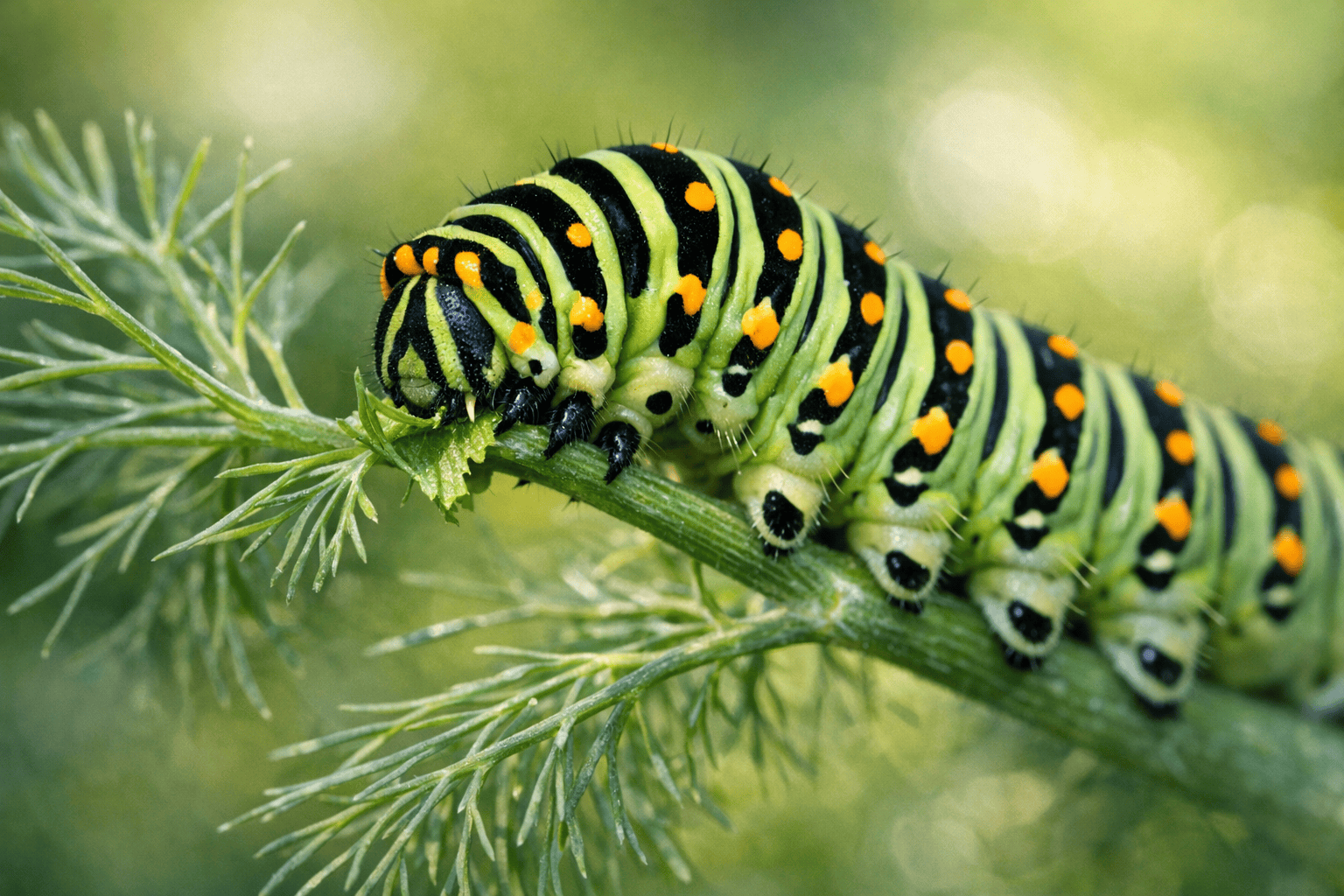
A mature Black Swallowtail caterpillar displays the green, black, and yellow pattern most gardeners recognize.
A striped caterpillar on parsley or dill can cause a moment of uncertainty: is it a garden pest, a Monarch, or something dangerous? In much of North America, it is likely the larva of the Black Swallowtail, a handsome native butterfly that frequently uses herb and vegetable gardens as nurseries.
Although several hungry larvae can visibly thin a small herb plant, they rarely threaten an established garden. Correct identification makes it easier to protect both the caterpillar and your crops. This guide covers its changing appearance, preferred food plants, defenses, life cycle, chrysalis, range, and practical care.
Black Swallowtail Caterpillar Quick Facts and Identification

The mature larva has smooth skin, black crossbands, paired yellow-orange spots, and a concealed forked defensive gland.
How to identify a mature larva
Look for a smooth, plump green body crossed by narrow black bands. Each band contains yellow or orange dots, producing a regular pattern along the body. Short true legs occur near the head, while fleshy prolegs grip stems farther back. Unlike many moth larvae, it is neither furry nor covered in prominent spines.
Identification is strongest when appearance and food plant agree. A banded larva eating dill, parsley, fennel, carrot foliage, or Queen Anne’s lace is an excellent candidate. If disturbed, it may reveal an orange forked organ immediately behind its head—an especially useful clue.
Key identification takeaway
Use four clues together: a carrot-family host plant, smooth green skin, black crossbands with yellow-orange spots, and an orange Y-shaped osmeterium that appears when the larva feels threatened.
Appearance Through the Instars and Similar Caterpillars
Caterpillars cannot stretch their skin indefinitely. They grow through five instars, shedding the old skin between stages. Because the pattern changes substantially, young Black Swallowtails can look like an entirely different species.

Early larvae are dark and bristly; later instars become larger, smoother, greener, and boldly banded.
Early, middle, and late stages
- Early instars: Tiny, dark brown or blackish larvae with pale patches and short bristles. Their uneven coloration resembles bird droppings and helps conceal them.
- Middle instars: Pale bands become stronger, orange markings become visible, and the body gains size after every molt.
- Late instars: Most are bright green with black transverse bands and yellow-orange dots. Some remain unusually dark, so color alone is not conclusive.
Black Swallowtail versus Monarch
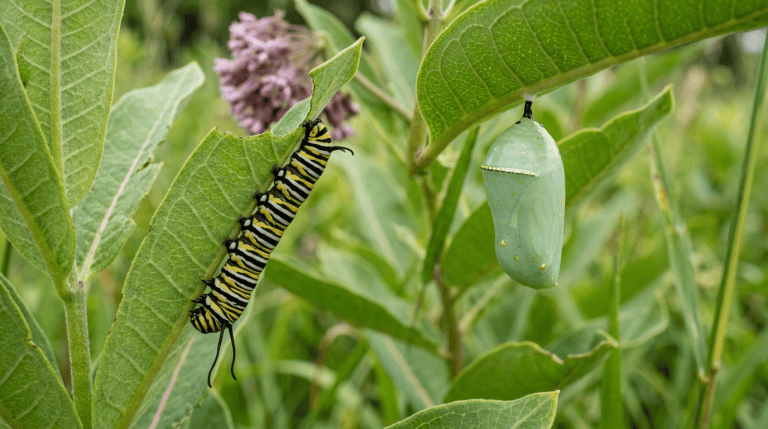
The most common mix-up is the Monarch. Both are striped, but Monarch larvae have black, white, and yellow bands, plus long, black, tentacle-like filaments at both ends. They eat milkweed, not parsley or dill. See the complete Monarch caterpillar identification guide for a closer comparison.
| Feature | Black Swallowtail | Monarch |
|---|---|---|
| Main pattern | Green with black bands and orange-yellow dots | Black, white, and yellow stripes |
| Projections | No long filaments; hidden osmeterium | Two pairs of long black filaments |
| Food plant | Parsley, dill, fennel, carrot relatives | Milkweed |
Anise Swallowtail and Old World Swallowtail larvae may be much closer matches. Geographic location and host identity help: Anise Swallowtails are primarily western, while Black Swallowtails dominate large portions of eastern and central North America. Adult tiger swallowtails look quite different; compare them in the Eastern Tiger Swallowtail guide.
Can It Sting? Defensive Adaptations Explained
Black Swallowtail caterpillars cannot sting. They lack venomous spines and are not medically dangerous to people or pets. Their bright spots may look intimidating, but they are visual defenses rather than weapons.
When alarmed, the larva pushes out an orange or reddish, Y-shaped gland called an osmeterium. This structure emits a pungent odor that can deter ants, spiders, birds, and other potential predators. The display may be accompanied by sudden head movements, making the caterpillar appear more formidable.
The orange “horns” are not stingers. They are a temporary scent gland, normally hidden inside the body and extended only when the caterpillar feels threatened.
Younger larvae rely heavily on bird-dropping mimicry. Older individuals combine disruptive banding, camouflage among fine leaves, odor, and startling movement. While touching one is not hazardous, repeated handling can stress it, damage its soft body, or introduce disease. Observation is better than contact.
Host Plants, Feeding Signs, Habitat, and Range
What do Black Swallowtail caterpillars eat?
Their primary hosts belong to the carrot family, Apiaceae. Females assess plants with chemical receptors before laying their eggs, and newly hatched larvae generally remain on the chosen host.
- Dill, parsley, fennel, and cultivated carrot
- Queen Anne’s lace and other wild carrots
- Golden Alexander and additional native Apiaceae
- Rue, which belongs to the citrus family but is also accepted
Signs include irregularly clipped leaflets, bare stems, missing flower clusters, and dark pellet-like droppings called frass. Check upper foliage and flower heads carefully; small larvae can blend into dried blossoms or shadows.
Habitat, range, and timing
The species occupies much of eastern and central North America, with populations extending into portions of the West, southern Canada, Mexico, and Central America. Sunny gardens, farms, meadows, roadsides, old fields, and other open places work well when larval hosts and adult nectar flowers occur nearby.
Search from spring through fall, adjusting for latitude. Southern populations may produce several generations, whereas northern regions have shorter seasons. Eggs are often found singly on tender tips, and larger caterpillars commonly feed openly during warm weather.
Growth, Molting, Chrysalis, and Complete Life Cycle

Black Swallowtails undergo complete metamorphosis: egg, five larval instars, chrysalis, and winged adult.
- Egg: The female places a small, pale, nearly spherical egg individually on a suitable leaf, stem, or flower.
- Larva: After hatching, the caterpillar eats and passes through five instars. A quiet caterpillar near a patch of old skin may simply be preparing to molt.
- Pre-pupa: A full-grown larva stops feeding, empties its gut, and wanders in search of a sheltered attachment site.
- Chrysalis: It anchors its rear to a silk pad and secures its body upright with a thin silk girdle before shedding its final larval skin.
- Adult: The butterfly emerges, expands and dries its wings, then begins seeking nectar, mates, and host plants.
Chrysalis, cocoon, or pupa?
The correct visible structure is a chrysalis, which is the pupa of a butterfly. It is not a cocoon: cocoons are silk coverings made by many moth caterpillars around their pupae. The angular Black Swallowtail chrysalis remains exposed and may be green or brown, matching vegetation, bark, fences, pots, or garden structures.
In summer, development from egg to adult often takes roughly a month or somewhat longer, depending on temperature and food quality. A summer chrysalis may open after about one to three weeks. Late-season pupae can enter diapause, remain motionless through winter, and emerge the following spring. This exposed chrysalis differs from the silk-wrapped stages described in guides to moths such as the Polyphemus moth.
The Adult Black Swallowtail Butterfly

An adult female shows extensive blue scaling, yellow spots, hindwing tails, and orange-red eyespots.
The adult is a dark butterfly with two tails on each hindwing, rows of yellow spots, blue scaling, and orange-red eyespots near the hindwing margins. Males typically show a brighter yellow band, while females usually have more extensive iridescent blue across the hindwings.
Adults no longer chew foliage. Their coiled proboscis draws nectar from milkweed, thistle, coneflower, phlox, zinnia, blazing star, and many other blooms. Dark coloration may give some resemblance to the distasteful Pipevine Swallowtail, although the Black Swallowtail itself is not considered strongly toxic.
For detailed sex differences, courtship, flight behavior, and adult identification, visit the full Black Swallowtail butterfly guide.
Garden Impact and What to Do If You Find One
A large larva can consume a surprising amount of foliage, and several may strip a young dill or parsley plant. Established ornamentals generally recover, but small culinary plants can suffer noticeable loss. Commercial growers should monitor crops carefully while avoiding indiscriminate treatment.
Responsible steps for gardeners
- Confirm the identification before taking action, including checking the host plant.
- Plant extra herbs so caterpillars and people do not compete for a single parsley or dill plant.
- Avoid systemic and broad-spectrum insecticides, which can harm larvae, adult butterflies, pollinators, and beneficial predators.
- Relocate only when necessary. Move the caterpillar gently onto another pesticide-free plant of the same species or a known host it already accepts.
- Leave sheltered vertical surfaces where wandering mature larvae can pupate and overwinter undisturbed.
If you must move a caterpillar:
Move the stem or leaf it is standing on rather than pulling its feet free. Place it directly against fresh foliage on an untreated host plant, away from heavy foot traffic and intense afternoon heat.
Captive rearing can expose crowded larvae to disease and requires fresh untreated food, excellent ventilation, daily waste removal, and enough space for pupation. Unless the animal faces immediate danger, preserving good outdoor habitat is usually safer than bringing it indoors.
Interesting Facts and Frequently Asked Questions
- The Black Swallowtail is the state butterfly of Oklahoma.
- Environmental cues around the pupation site help influence whether the chrysalis becomes green or brown.
- A caterpillar can increase dramatically in size across five molts while repeatedly replacing its restrictive outer skin.
- The species survives cold seasons as a chrysalis in many northern parts of its range.
Is a Black Swallowtail caterpillar poisonous?
No. It has no venomous spines and cannot sting. It should not be eaten, however, and handling is best minimized for the caterpillar’s welfare.
Will it kill my parsley, dill, or carrots?
A few large larvae can defoliate a small plant, but mature plants often recover. Transfer larvae to spare pesticide-free host plants if protecting a crop is necessary.
Why did the caterpillar suddenly disappear?
A full-grown larva commonly leaves its food plant and wanders to a protected place before pupating. Predation is also possible, but disappearance near maturity is normal behavior.
How long does development take?
Warm-season development commonly takes about four to six weeks from egg to adult, but weather, latitude, and food quality create substantial variation. An overwintering chrysalis may remain for many months.
Is a motionless chrysalis still alive?
Usually. Chrysalides do not feed or move regularly, and those in diapause remain still all winter. Avoid squeezing or detaching one; look instead for damage, collapse, persistent leakage, or mold.
How can I attract Black Swallowtails?
Combine pesticide-free host plants with nectar flowers that bloom from spring through fall. Add dill, parsley, fennel, golden Alexander, coneflower, phlox, blazing star, zinnia, and milkweed in sunny, sheltered beds.
Conclusion: Identification Leads to Better Stewardship
Black Swallowtail caterpillar identification becomes straightforward when you combine pattern, plant, and behavior. Mature larvae are smooth and usually green, with black crossbands and yellow-orange spots; young larvae are darker and resemble bird droppings. They cannot sting, and their dramatic orange osmeterium is an odor-producing defense rather than a weapon.
These caterpillars feed mainly on carrot-family plants, pass through five instars, then leave their host to form a girdled green or brown chrysalis. A little tolerance—and a few extra herbs—can turn ordinary garden space into habitat for one of North America’s most recognizable butterflies.
Make Your Garden a Safe Stop for Black Swallowtails
Plant pesticide-free dill, parsley, fennel, native host plants, and nectar-rich flowers. Leave a few sheltered stems and structures in place so every stage, from egg to overwintering chrysalis, has room to thrive.